
Opinion Not English, neglect of rich bhashas is the problem
If Prime Minister Narendra Modi castigates Macaulay, a cacophony of voices immediately arises to defend the latter
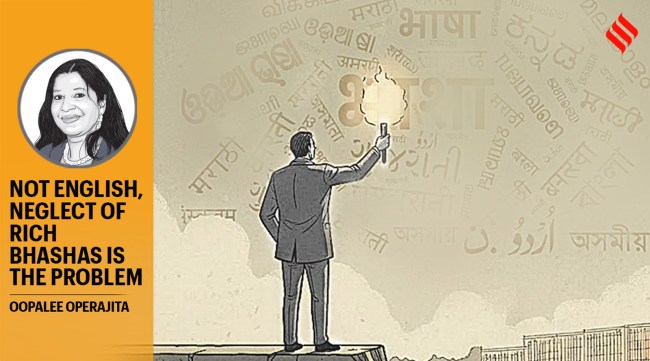 `The Indian use of the English language has afforded India global prominence. It is, after all, also an Indian language.


“Uttering a word is like striking a note on the keyboard of the imagination.” — Ludwig Wittgenstein
One hundred and ninety years after English was introduced in India as its official language — and 78 years after the British were made to leave India — we, in India, are debating our use of English, and whether it engenders “a colonial mindset”. About 140 million Indians know the English language with varying levels of expertise; some sources peg that figure at 235 million. We could easily defenestrate the colonial mindset without discarding the English language, as many Indians have done and will continue to do. The Indian use of the English language has afforded India global prominence. It is, after all, also an Indian language.

However, this must not happen at the expense of Indian languages and bhasha literature. As an Indian from Odisha who grew up across cities in India and Nepal, I acquired both Odia and English as my first languages. I have a degree of proficiency in Sanskrit and Hindi, and in spoken Tamil and Bengali. I grew up studying in English-medium schools, colleges, and universities; Hindi was a compulsory second language and subject in my school.
My parents and I translated the genius Gopinath Mohanty’s magnum opus, Amrutara Santana, into English (at Mohanty’s request). It was an enlightening experience. This sense of exultation holds for any readers when they come upon magnificent literature in new languages.
If you speak to scholars and university professors in the UK and the USA, they will often praise the Indian ability to both write and speak in English. I have to respectfully remind them that English is also an Indian language.
If Prime Minister Narendra Modi castigates Macaulay, as he recently did at an Indian Express event, a cacophony of voices immediately arises to defend Macaulay. PM Modi is not telling us to jettison English: He is asking India to valorise its infinite ocean of extraordinary bhasha literature and languages, and accord them the respect and primacy they deserve. Macaulay’s not-so-ulterior motive was to shatter Indian confidence by dismissing its civilisational heritage, and imposing an English identity upon Indians. Macaulay had the temerity to state that a single shelf of English literature was worth more than all of India’s literature — of which he had scant knowledge — put together.
The Vedas, the Upanishads, the Tolkappiyam, the Ramayana, the Mahabharata, the Bhagavad Gita, the Charyapada — there is a cornucopia of writings in Indian languages that has tragically been relegated to the backburner owing to the obsession with English. The neglect of India’s rich bhashas and literature is serious, and so is the valorising of English literature and language above them. Czeslaw Milosz said that language is your only homeland. I recall being moved by that numinous insight decades ago when I was a graduate student and Rotary Foundation ambassadorial scholar at Canada’s Dalhousie University — and away from home for a rather lengthy period for the first time in my life.
If India is to be a genuine global force, it needs to empower its youth through use of languages they feel comfortable with, as well as develop au courant scientific and technical vocabularies in Indian languages. Educated Indians have the advantage of being at least bilingual, if not multilingual. I cannot overemphasise the advantage of learning multiple languages — each new language activates a separate region of your brain, and opens your mind and heart to a new culture. And it is language that grants you “the rare virtue of interior spaciousness”.
If we consider colonisation qua spoken English, Giorgia Meloni and Emmanuel Macron, for example, speak it with heavy accents — and this is readily accepted — but Indian leaders speaking English with local accents elicit an unjust rap (alas, from Indians too). Here is another example of the pernicious colonial mindset we need to address.
We adore our Indian languages; and we treasure English. I will say we need both, wherever possible; for, in the final analysis: Une nouvelle langue est une nouvelle vie: A new language is a new life.
The writer was appointed distinguished fellow at Carnegie Mellon University in 1990. She is also a global adviser on public policy, communications, and international relations, and an award-winning Odissi and Bharatanatyam artiste and choreographer.
Views are personal

 Share
Share


