
Opinion The Middle East needs the UN. Will Israel listen?
Israel’s solution is mass ‘emigration’ of the Palestinian people from the strip. It is not feasible
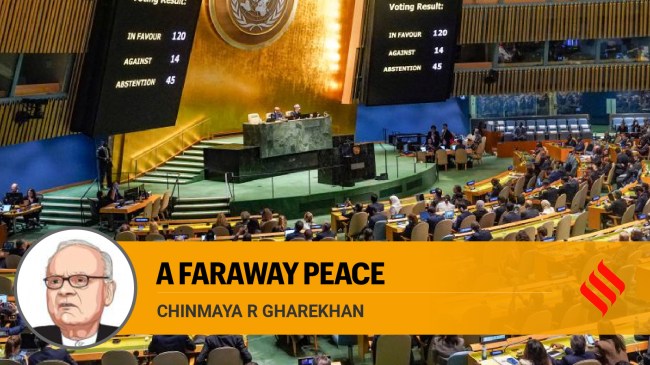 In this writer’s view, the United Nations will have to be an indispensable part of any solution, Israel’s allergy to the international organisation notwithstanding. (Reuters)



What is common between the war in Ukraine and the war in the Middle East? Both are a case study in miscalculation. Vladimir Putin thought he would subdue Ukraine within a matter of weeks. Benjamin Netanyahu thought he would crush Hamas within a matter of days. Both wars have run into a kind of stalemate. The more powerful countries in both are unable to impose their demands. The weaker party is dictating the political process. Ukraine will simply not agree to any solution short of the complete withdrawal of Russian forces from what Ukraine regards as “occupied territories”. Hamas is refusing to accept any proposal short of a permanent ceasefire and withdrawal of all Israeli troops from the Gaza Strip. Ukraine has won by not being defeated and Hamas has won by not getting destroyed and continuing to lob rockets into Israel after more than three months of war.
Of course, there is a huge difference between the two wars. Putin’s Ukraine war was unprovoked whereas Netanyahu had ample provocation to try and destroy Hamas when the latter carried out a brutal attack on Israel on October 7, 2023. That trauma, however, does not and cannot justify Israel’s no-holds-barred war on Gaza. The death and destruction it has wreaked on the civilian population of Gaza is equally unacceptable. South Africa’s case against Israel accusing it of committing genocide on the Palestinians in Gaza cannot be dismissed.

Israel, by its disproportionate, indiscriminate and nonstop bombardments on civilian targets in Gaza has managed to do two things: Alienate world public opinion against it and generate unprecedented support for a Palestinian state, something which Hamas could not have anticipated in its wildest dreams. It has also managed to annoy its most powerful and indispensable ally by openly defying Joe Biden’s call for restraint.
Netanyahu has also caused fissures in Israeli society which is focused on getting back the 130 Israeli hostages in Hamas’s custody. Worse, differences seem to have emerged within his own cabinet. Israel’s decision to withdraw some of its troops from Gaza is aimed at “giving” something to President Biden. As one of its ministers has said, Israel is not a star in the American flag, but it is equally true that without American support, it could not continue the war for such a long period.
What about President Biden? He too has failed in preventing the escalation of the conflict into a wider war. Israel’s northern border with Lebanon has become active with Hezbollah lobbing missiles and rockets into Israel. Iran’s proxies Houthis defiantly continue attacks on the Red Sea shipping lanes despite joint retaliatory strikes on Houthi’s missile and weapons depots by American and British navies in Yemen’s territory. Iraq has asked the US to pull out its troops from its territory, and now perhaps, even Pakistan is getting sucked into this mess through its attack on Iran.
Netanyahu is defiant. He tells his people that war will continue until both objectives have been achieved: The destruction of Hamas and the return of hostages. Can he achieve the first objective? Yes, he can, by following the strategy propounded by two of his senior ministers. His ministers of national security and finance have suggested what it inhumanly calls a humane solution — mass “emigration” of the Palestinian people from the strip. They advocate this “emigration”, they claim, on humanitarian considerations. They candidly admit that the war is a good opportunity to encourage mass emigration of Gazans; they will, thereby, create space for settling Israeli citizens, naturally only Jewish citizens, in the strip. In other words, depopulate Gaza and repopulate it with Israeli settlements. This is the only way in which the objective of destroying Hamas can be achieved. These statements of Israel’s ministers must be taken seriously. They are in line with the early Zionists slogan: “A land without people for a people without land”.
Which country will agree to absorb these “emigrants”? Egypt? No, thank you, will be Egypt’s response. As it is, Palestinians are not popular in any Arab country; the governments are anxious to normalise ties with Israel, as some have done under the so-called Abraham Accords. The current war will delay the realisation of their desire but will not derail it. Already, reports are suggesting that the secret talks between Saudi Arabia and Israel for normalisation of relations are continuing notwithstanding the war.
Israel could endeavour to follow Britain’s example of persuading one or two African countries to settle illegal migrants in return for a handsome financial reward. Governments and experts in many countries have been pondering and offering suggestions for establishing peace in the region, in a way that would assure Israel of protection against future attacks from Gaza.
Any proposal that calls for Arab states to deploy troops to monitor the Israeli-Gaza border is a non-starter. No Arab country will offer to act as Israel’s security guard. America has rejected Israel’s idea to create a buffer zone on Gaza’s side. Perhaps, the most practical proposal is the one Egypt is reported to have prepared and discussed with the main protagonists as well as with Qatar and the United States. It involves a phased exchange of Israeli hostages and Palestinian prisoners in Israeli jails, ending with a permanent ceasefire. A government of experts would be appointed — by whom is not clear — to run both the West Bank and Gaza. It would work with all parties and the Palestinian factions to agree on parliamentary and presidential elections. Israel is reported to have offered a two-month suspension of hostilities in return for getting back all the hostages. It is also willing to let the Hamas leadership emigrate to another country. But Hamas, in perhaps a miscalculation of its own, is insisting on a permanent ceasefire and withdrawal of all Israeli troops before returning the hostages. In this writer’s view, the United Nations will have to be an indispensable part of any solution, Israel’s allergy to the international organisation notwithstanding.
In the Middle East, one must always expect the unexpected. There surely are secret talks and negotiations going on between several parties on all aspects of the highly volatile and complex situation in the region. Let us hope that we will all be pleasantly surprised one day when we read or hear about some breakthrough.
The writer is India’s former permanent representative to the UN and author of Centres of Power: My Years in the Prime Minister’s Office and Security Council

 Share
Share


