
Opinion Lessons from Kathal: Tracking India’s missing girls
Stepping up mobile surveillance services, empowering Anti-human Trafficking Units, linking the data of all missing children with orphanages, shelter homes, and incentivising police officers will go a long way in addressing the gaps in the system
 Set in Uttar Pradesh’s Bundelkhand, it rightly raises the compelling and oft-neglected issue of hundreds of children, especially girls, routinely disappearing from various parts of the country.

Kathal, a light-hearted film recently released on Netflix, is a perceptive parody of the sometimes misplaced political and professional preoccupations of the police. Set in Uttar Pradesh’s Bundelkhand, it rightly raises the compelling and oft-neglected issue of hundreds of children, especially girls, routinely disappearing from various parts of the country, and whose records keep languishing under piles of the police’s “more” preeminent work.
The sheer number of missing children amplifies the enormity of the challenge. In 2021, 69,014 cases were registered across the country, of which 55,120 pertained to girls within the age group of 12-18. It would be naive not to admit that the common initial assumption of the police, in response to the missing report of an adolescent girl, is that she has voluntarily eloped with a boy. This presumption, consequently, delays an immediate response by the police, leading to a critical loss of the “golden hours” to trace the victim. Instead, police station-level officials may reprimand parents for not being able to “control” their daughter. This presumption, however, is fraught with great danger. Marriage, sexual abuse, domestic servitude, and forced labour/slavery remain the main motives behind the kidnapping and abduction of children.

Films like Gangubai Kathiawadi, based on a true story, remind us of the serious vulnerability of the “missing girl” that can lead her to dark alleys by her own so-called paramour. The depiction in Kathal of the gardener’s young daughter being kidnapped for sale as a child bride is also hardly any exaggeration. The abysmal sex ratio in several states of the Hindi heartland has resulted in a “bride crisis”, and the sale of girls, as young as 12 years old, for marriage to elderly men in their forties or fifties. Such gangs can be easily traced by the police with just a little scratching of the surface. Seemingly trustworthy extended family members or neighbours could well be the culprits who would lure a girl away with the promise of a city life, a plush job or a husband of choice. The price of a girl is no more than Rs 50,000 to Rs 60,000 to be shared by the tens of persons acting as links in the despicable chain.
There are, nevertheless, some redeeming developments against this bleak scenario. Thanks to the activism of the courts, women, child commissions and political leadership, there is developing a trend to promptly register FIRs at least in cases of missing minor children, both boys and girls. These FIRs, as per the directions of the Supreme Court, are to be registered as kidnapping from lawful custody and, hence, to be accorded the necessary seriousness. In the case of an adolescent girl, where the parents admit to the girl having a possible romantic liaison with a boy, Section 366 of the IPC (kidnapping, abducting or inducing a woman to compel her marriage) is invoked. The strict supervision of the courts and of senior police leadership has now made it rather difficult for the police force to “close” unsolved cases of missing children, thereby swelling the pendency of such cases to hang like an albatross around its neck.
This has, at least partially, curbed the smugness on the part of the investigating officer to simply sit in his office typing out his “efforts” to trace the child, without ever stepping out, and then file a perfunctory closure report for “want of evidence”. However, merely registering FIRs or keeping them alive is also not enough to bring back the missing. As of December 31, 2021, the latest year for which complete relevant data is available, 50,345 children gone missing in previous years were still untraced.
Child victims of kidnapping and abduction (2021)
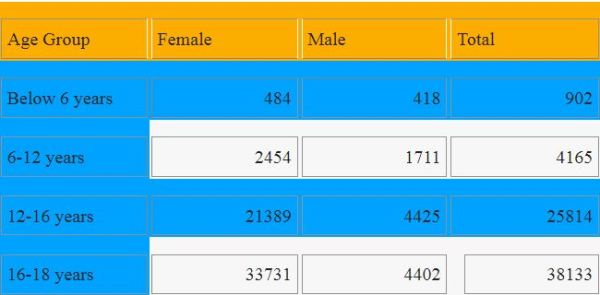 Data is from the National Crime Records Bureau(NCRB)
Unrecovered Victims of Kidnapping and Abduction from previous years (as on 31.12.21)
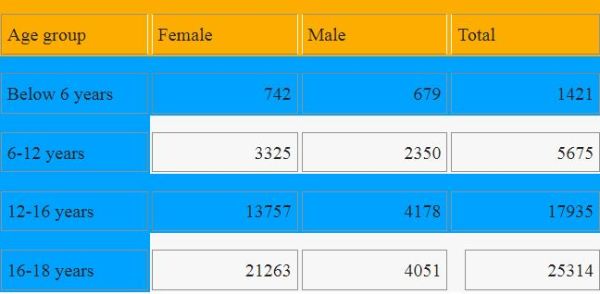 Data is from the National Crime Records Bureau(NCRB)
Some basic interventions can drastically improve this unsettling state of affairs. Mobile surveillance services, now amply used in every district for crime detection, must repeatedly keep scanning the locations of relevant mobile numbers and social media accounts of the victim or her abductor for their possible location. A gazetted police officer may be designated as a nodal supervisor to oversee and ensure that this exercise is carried out for all missing children not just after the commission of the crime (when mobile phones are most likely to be switched off) but repeatedly and regularly, until the case is solved. It is the need of the hour that important bus stations, railway stations, taxi stands, toll booths are equipped with high-resolution CCTV cameras providing exhaustive coverage. A timely scan of their footage, when available, can often help trace the escape method and the route of the accused.
There is a dire need to link the records of all the orphanages, child shelter homes, and Nari Niketans in the country. Many young children found wandering with no ascertainable credentials or contacts or those recovered from the clutches of an abductor in a new place by the local police are often admitted to the nearest shelter home, while the desperate family back home keeps hunting in vain. This mostly happens when the children are too young to explain where their home is or who can be contacted. It would be a worthy investment by the Ministry of Women and Child Development to link the records of all the registered shelter homes in the country. The District Probation Officers or the District Social Welfare Officers, the overall supervisors and custodians of such centres on behalf of the government, could be made responsible for the regular updation and sharing of this data.
Anti-human Trafficking Units (AHTU), established under the aegis of the Ministry of Home Affairs and now functional in every district of the country, can also play a remarkable role in helping trace missing children from faraway places. In a personally conceived and supervised initiative, a designated team from the AHTU, comprising dedicated, empathetic, soft-spoken police personnel made a weekly visit to all shelter homes in the district and regularly engaged with the children there. It was noticed that after three to four rounds of discussion over a few weeks, the team would be successful in gleaning some relevant information from young children like the name of a Gram Pradhan or a local fair, through their informal personalised interactions which would not have been possible through a formal one-time interrogation.
This technique helped trace the families of over 200 missing children from all corners of the country within a short span of 12 months. Many private shelter homes are notorious for consciously not letting the children in their care to leave, even when they can recall relevant details to help trace their homes, as the donations received by these institutions are directly tied to the number of children they house. Proactive regular visits by the AHTU, and a mandatory one-on-one counselling session with every missing child, can help subvert such sabotage of a child’s best interests. This regular exercise would also help enhance the utility of the AHTUs. They still remain an under-utilised entity, investigating just a handful of cases, and are often treated as a parking ground for the physically infirm, soon-to-retire, or demotivated police personnel.
Providing promotion incentives for tracing missing children has yielded wondrous results in this project, as demonstrated by the Delhi police. In 2021, the Delhi police announced an out-of-turn promotion incentive for constables and head constables, who would trace more than 50 children below the age of 14 in a year. As a result of this incentive, for the first time in decades, the number of children recovered by the Delhi police that year was more than the number reported missing in the year.
These experiments are a testament to how much can be done to restore a child to her family, where there is professional will. Any measures to make this possible deserve the highest political and administrative support. It takes being a parent to even imagine what it means to lose a child and be condemned to live with the fear that she could possibly be experiencing the most terrible hell in a depraved world.
Every single missing “kathal” is priceless to whom it belongs and deserves the deployment of all possible resources to be traced.
The writer is an IPS officer. Views expressed are personal

 Share
Share


