
Opinion With ‘Kathal’, the rise of the new Dalit protagonist
Lead characters in Hindi films, de facto, don upper-caste identity markers and adopt Brahmanical cultural values. With Dahaad and Kathal, we see the portrayal of Dalits as dynamic and intelligent middle-class professionals.
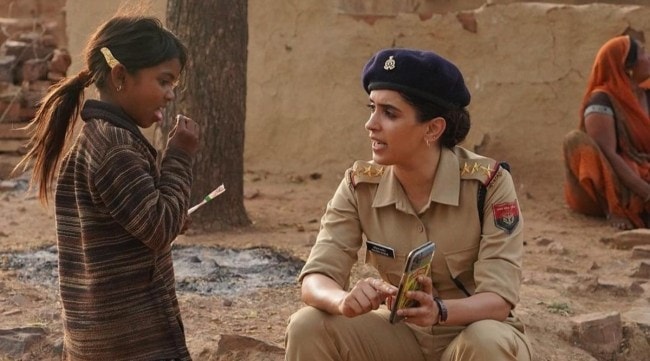 A scene from 'Kathal'. (Photo: Sanya Malhotra/ Instagram)

Much has been written about the brilliance of Reema Kagti’s recently released web series Dahaad on Amazon Prime. Another significant film, Kathal, (directed by Yashowardhan Mishra) is available on Netflix. Both have similar social values. Dahaad portrays the story of a powerful Dalit woman police officer (Sonakshi Sinha) investigating a case involving missing girls and chasing a serial killer in a small town in Rajasthan. A complex investigation and some thrilling adventures later, she nabs the culprit, and through the story, the audience is introduced to the dark realities of our growing urban centres.
Kathal’s protagonist is also a young Dalit woman inspector, Mahima Basor (portrayed very well by Sanya Malhotra), who investigates the case of several missing girls in a small fictional town in Uttar Pradesh. Unlike Dahaad, Kathal is a social satire. It provides comical and critical commentary on contemporary issues like corruption, feudal control and caste-based hierarchies in smaller towns. Inspector Mahima is investigating the case of two jackfruits (kathals) that went missing from local MLA Munnalal Pateria’s (Vijay Raaz) house. However, during the investigation, she encounters the case of a missing young girl from a poor working-class family about whom nobody cares. To find her, Basor adopts creative and intelligent strategies, while her partner, constable Saurabh Dwivedi (Anant Joshi is fabulous in this role) provides her with care and affection at every step. Together, they expose the criminals and earn promotions for their good work.

The narrative is simple and engaging. What makes it truly interesting is the rupture it causes in the stereotypical image and portrayal of Dalits on screen. The Dalit protagonist is an ordinary, peppy and likeable person, engaged in everyday chores as a duty-bound citizen. Though she acknowledges her “lower” caste identity, she treats herself with respect, and is confident and courageous. She underplays the casteist slurs hurled at her by showcasing her newly gained mobility as a respected police officer. Mahima Basor is not obsessed with the quest to emerge as a classic aggressive hero, committed to a certain ideological orientation (like Dahaad). Her character is nuanced. She utilises the new state-backed power she has earned to do righteous acts with humility and love.,
Such Dalit characters, realistic and believable, are rare. A similar angle was explored in Amit Masurkar’s Newton, India’s Oscar nomination in 2017. Therefore, Kathal is a creative, socially-engaged production. The film also challenges earlier approaches that presented Dalit women characters either as vulnerable and poor victims (films like Sujata, Ankur, Sautan, Damul, etc.) or as rebellious feminist challengers (Bandit Queen, Bawandar, Madam Chief Minister, etc.). In Dahaad too, the Dalit lead is a strong feminist officer.
Dalit or other “lower” caste identities generally find portrayals in line with common stereotypes — characters with the surname Yadav are often shown as corrupt politicians (Shool and Gangajal) or uncouth rural peasants (Aarakshan); Dalits are wretched (Paar), voiceless (Sadgati) or even physically challenged (Lagaan). It is abnormal to have chirpy, happy, loveable Dalit characters. These attributes are often associated with “upper” caste characters because they do not have to bother about their pitiful social location and can operate as free, unencumbered beings.
The protagonist in Kathal belongs to a numerically insignificant Dalit caste called Basor — they are traditionally engaged in the making of bamboo products. A majority of them are poor, a node in the rural economy. For a long time, their political and social voices were insignificant. The community has recently gained a voice, with their claims and concerns now finding some space in mainstream public discourse. Popular Hindi cinema, in particular, is notorious for distancing itself from Dalits and the caste question. Dalit characters have appeared very sparingly on screen for decades now. In this context, presenting a Basor protagonist is a courageous and welcome change.
Protagonists in Hindi films, de facto, don upper-caste identity markers and adopt Brahmanical cultural values — all seen as “natural”. No questions are raised on the omnipresence of the social-elite hero and the relegation or neglect of other social identities like the OBCs, Dalits and the Adivasis. With web series and movies like Dahaad and Kathal, a dynamic aberration is witnessed. These stories are not only about the vulnerable castes and their precarious social locations, they are about the arrival of Dalits as dynamic and intelligent middle-class professionals. They are not passive and vulnerable but are ready to respond to humiliating taunts with the power and dignity offered by the Constitution of India.
This genre in Hindi cinema is young. Only a handful of films can be associated with this idea. However, it is making significant inroads and can emerge parallel to the seasoned “Muslim representation” genre in the coming future. Mainstream filmmakers’ new-found interest in caste and Dalit identities will democratise the conventional “populist” narrative style of cinema. Through it, creative and artistic approaches to social dramas can be explored. Such cinema, while providing the audience with a good dose of entertainment and laughter, will also educate and enlighten them about social realities and effective reform.
The writer is assistant professor of political science at Delhi University

 Share
Share


