
Opinion IIT Kharagpur director writes: What we are doing for future workers in a world of AI
Our vision at IIT Kharagpur is to continue to produce cutting-edge research in STEM, strengthen the educational foundations of those who pass through our doors, and provide a nurturing environment to facilitate entrepreneurship
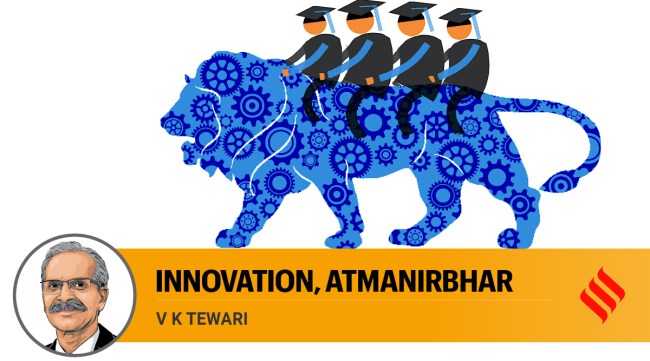 India is at the forefront of the latest technological development, focusing on capacity development and enhancement. However, recently we have seen that many have been leaving the country, perhaps due to the presence of greater opportunities elsewhere. (C R Sasikumar)

The history of the IIT system dates back to 1946 when a committee was set up by Jogendra Singh, member of the Viceroy’s Executive Council, to consider the setting up of higher technical institutions. The committee headed by N R Sarkar recommended the establishment of four institutions on the lines of the Massachusetts Institute of Technology in the US. With this recommendation, the first Indian Institute of Technology was born in May 1950 in Hijli, Kharagpur. The institute started its journey in the old Hijli detention camp where some of our freedom fighters had sacrificed their lives.
In 1951, when the first session started, there were 224 freshers and 42 teachers. Seven decades later, it is now home to 16,630 students, more than 746 faculty members and 887 employees. It has 20 academic departments, 12 schools, 18 centres (including 10 centres of excellence), and is engaged in several international and national mission projects.

Coming from an agricultural engineering background, I strongly feel that the upgradation of farm machinery has changed the face of an agro-based country like India. As a country, we do not lack in research. What we lack is collaboration between academia and industry. The New Education Policy (NEP) 2020 has provided a framework for research practices that can be broadened by collaboration between industry and academia. The institute has successfully implemented NEP, which democratises education by providing flexible academic programmes through multiple entry-exits and also allows students to move between disciplines so that they can assimilate knowledge from different disciplines like precision agriculture, affordable healthcare, advanced manufacturing systems, safety engineering & analytics, smart infrastructure and advanced transportation that will drive the institute’s growth trajectory to be among the top 10 universities in the world.
For me, multidisciplinary methodology plays a critical role in the growth of a country and takes a holistic approach to technical studies. The institute has instituted research activities under G20 declarations in 12 major areas of advanced materials, rare-earth and critical minerals; energy sustainability and climate change; agri & food technologies; semiconductors; advanced computing, including supercomputing, AI, quantum computing; healthcare & medtech; space and defence; next-gen communications; disaster management and resilient infrastructure; blue economy; Smart Cities & mobility, and manufacturing & industry 4.0.
IIT Kharagpur is grateful to the Ministry of Education for entrusting the institution with establishing the Department of Education that offers B.Sc-B.Ed (Secondary Stage) under Integrated Teacher Education Program (ITEP) from the academic session 2023-24. It is a four-year integrated dual major programme, with one major in education and the other in various disciplines.
We are also planning to start an undergraduate course in AI and Machine Learning for first-year students irrespective of their engineering domains. The institute has also started research activities in 6G and beyond and collaborated with tech giants to build Technology Research Parks in Kolkata and Bhubaneshwar for labs-to-market products. Alumni Centre, Bengaluru, comprising of 20 incubation seats to promote fellowship among its members, was also recently acquired.
Technology will never replace great teachers but technology in the hands of great teachers is transformational. There is always a way to do it better, find it. What is now proved was once only imagined.
Major strategic initiatives have already been undertaken towards a multidisciplinary research approach offering science, technology, management and law programmes. We are now initiating a new dimension by starting an MBBS programme at the Dr B C Roy Multispecialty Medical Research Centre. Further, a new class of programmes called Interdisciplinary Dual Degree Programmes have been introduced, which allows students to undertake a B.Tech and M.Tech programme.
Previously, the UG programmes had an eight-week summer internship. This has now been extended to eight months of research or an industry internship. To study Indian languages, art and culture and ensure quality research in these fields and their integration with engineering, science and social sciences research, the institute has also set up a Centre of Excellence for Indian Knowledge Systems. There have been record-breaking placements in the last three years. The institute received the fastest 1000+ offers and highest packages among all IITs. It has established several Centres of Excellence, the most recent one in Urban Planning and Design by the Ministry of Housing and Urban Affairs, GOI.
The fast pace of technological innovation has transformed our lives and our world. Food production that once required only the simplest of tools now also utilises drones, agribots and more intricate machines. This is the new India we want the world to know about. With our modern technologies and innovative minds, just think about the opportunities we can create for the next generation!
IIT Kharagpur through its R&D has developed remarkable technologies including the COVIRAP diagnostic test kit for Covid-19, painless needle, 2G Ethanol, arsenic and fluoride removal from groundwater, recovery of battery cathode metal oxides and copper from battery wastes. The institute has also worked diligently to achieve sustainable development through solid and liquid waste management along with wastewater management.
India is at the forefront of the latest technological development, focusing on capacity development and enhancement. However, recently, we have seen that many have been leaving the country, perhaps due to the presence of greater opportunities elsewhere. We need to create an ecosystem that encourages and facilitates innovation and taking risks, providing exciting opportunities for the millions who enter the labour force each year.
Our society always had the spirit of self-reliance. The Swadeshi movement, which contributed to the development of Indian nationalism, is a perfect example of a self-sufficient movement. Right from the understanding of zero by Aryabhata, we have a rich history of scientific inquiry. This has existed from the Vedas to Vivekanandaji, from the Gita to Gandhiji, and from Upanishads to Upadhyayji. Everyone, from great men to governments, in their own way, accepted the importance of self-reliance. The state of the world today suggests that an Atmanirbhar Bharat is the only way forward.
Our scriptures speak of Eshah Panthah — a self-sufficient India. That Sanskrit phrase is taken from Mundaka Upanishad and it means “the only path”. The culture and tradition of India speak of self-reliance and its soul is Vasudhaiva Kutumbakam — “the world is one family”. Atmanirbharta does not mean looking inward. Instead, as Prime Minister Narendra Modi has said, it means intent, inclusion, investment, infrastructure and innovation.
Our vision at IIT Kharagpur is to continue to produce cutting-edge research in STEM, to strengthen the educational foundations of those who pass through our doors, and to provide a nurturing and encouraging environment to facilitate entrepreneurship. By doing so, we will play our part in building this great nation.
The writer is director, IIT Kharagpur

 Share
Share


