
Opinion Global power shifts, economic pragmatism are bringing India and China back to the negotiating table. But for how long?
Recent bonhomie is better seen as a tactical accommodation, rather than a strategic reset. Both are aware of the risks of outright hostility in an increasingly unstable international order, and neither is prepared to betray their core interests
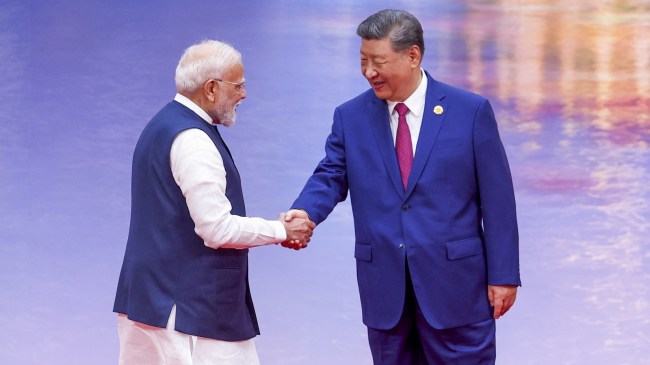 Ultimately, this thaw also reflects the paradox of the current international system: A great-power rivalry coupled with pragmatic interdependence


Written by Shibashis Chatterjee
Relations between India and China have been marked by friction, mutual suspicion, and occasional confrontation for much of the past decade. The bloody clashes in Galwan in 2020 appeared to drive ties to their worst point in decades, confirming the view that the two Asian giants were locked in an inexorable duel. However, recent signs — including renewed high-level dialogues, a cautious resumption of trade talks, attempts at border de-escalation, and joint statements at multilateral forums — indicate a tentative thaw. This new bonhomie means hope but also anxiety: Is this the start of a strategic rapprochement or a temporary pragmatic pause in the long-running battle for power and influence?

The global context in which this transformation is unfolding is one of instability and unpredictability. The liberal international order that facilitated globalisation in the 1990s and early 2000s is now coming apart at the seams. American primacy is being challenged as never before. Multipolarity appears to be a foregone conclusion, but its institutions and rules remain uncertain. In a fluid order, India and China, two civilisational states with rival aspirations, cannot ignore each other, nor can they afford unmitigated hostility. There are obvious reasons that cooperation is attractive to both sides. For one thing, economic rationality demands exchanges. Despite persistent trade deficits, China remains one of India’s top trading partners, supplying raw materials for manufacturing and inputs for technology. The prospect of stabilising trade relations while diversifying supply chains is an appealing one for India. To China, entry to India’s growing market and partnership in fields such as digital payments, pharmaceuticals, and clean energy can ease the strains of distancing from the West. Each has something to gain if economic pragmatism mitigates political animosity.
Regional stability is another reason the two are heading to the table. Both are worried about Afghanistan’s slide into extremism, and about the tenuousness of Myanmar’s political order and the burgeoning militarisation of the Indian Ocean. Unmanaged, these challenges can quickly escalate into crises of broader significance. This limited cooperation can help avoid the spillover of conflicts and enable both nations to concentrate on their domestic development agendas. Global power shifts have also made it difficult to predict how the US will respond to such eventualities. Fears of uncertainty can bring rivals together.
Equally important is the symbolism in terms of the Sino-Indian interaction’s impact in magnifying the voice of the Global South. With Western-centred institutions losing their credibility, primarily due to implosions led by an exclusively transactional US, Beijing, and New Delhi can influence discussions about climate justice, reform of Bretton Woods institutions, and more equitable access to development finance. Their common platforms, such as BRICS or the Shanghai Cooperation Organisation (SCO), may be used as an opportunity for all to articulate the collective voice of the developing world. In India’s case, it is not easy to present itself as a bridge between the West and the Global South without ensuring there is a working relationship with China. The ideational rivalry between the two Asian giants over leading the postcolonial world is unmistakable. Yet, when the hegemonic power becomes intransigent, ideas may be rebranded and new imaginations forged in response. Power, after all, is one of the most potent drives behind ideological shifts.
Preserving strategic autonomy is another key consideration. Unfortunately, India and China are being cautious not to be confined to a binary decision made in Washington. An exclusively pro-Western tilt would be suicidal for India, for non-alignment, and for its capacity to reach out to the broader developing world. For China, the warming of ties with India disrupts the formation of an anti-China cartel in Asia. For both, dialogue serves as a means of creating space for manoeuvre in a divided world system. However, under this cold pragmatism, some risks and contradictions suggest the bonhomie might not be long-lived. The border is brittle. When the Line of Actual Control becomes confrontational, a day can eliminate years of trust. No amount of cooperative verbiage will take the place of a political resolution to this longstanding conflict.
Moreover, the unequal power relation adds yet another layer to the equation. Put simply, China’s military and economic power vastly exceeds that of India, making any potential alliance lopsided. Beijing may view cooperation as a mechanism to control India, but New Delhi is loathe to be pushed into being a pawn. Such disequilibrium restricts the potential for strategic convergence. When capabilities between powerful states are unequal, the trust deficit becomes starker. China’s Belt and Road Initiative has shown little regard for Indian sensitivities in Pakistan-occupied Kashmir, and Beijing has consistently obstructed India’s membership in global regimes such as the Nuclear Suppliers Group. For India, the actions are a reminder that China is at least as likely to trample on its core interests as it is to respect them. At the same time, Beijing is wary of India’s increasing involvement in the Quad, as well as Washington and Japan’s efforts to bolster defence ties. The signals are mixed. At the recent SCO summit, Prime Minister Narendra Modi called on the member states to unambiguously condemn the “double standards” on the issue of terrorism, which met with success as the regional grouping condemned the Pahalgam terror attack in its summit declaration. It is encouraging that China did not veto this. Nonetheless, considering the strong China-Pakistan ties and the temporary nature of the India-China-Russia alignment (prompted by shared discontent with Trump), it is uncertain how long this perspective will hold.
Finally, there are constraints born out of geopolitical predispositions. India’s deepening ties with US-led technology and defence networks do not sit well with China’s own confrontational relationship with those powers. Both can handle tactical cooperation, but the structural imperatives of the US-China rivalry may compel harder choices on India sooner rather than later. The recent bonhomie, then, is better seen as a tactical accommodation, rather than a strategic reset. Both are aware of the risks of outright hostility in an increasingly unstable international order, and neither is prepared to betray their core interests. India’s task is to maximise cooperation without compromising deterrence. For China, the challenge is to attract India without permanently pushing it into the Western camp.
Ultimately, this thaw also reflects the paradox of the current international system: A great-power rivalry coupled with pragmatic interdependence. In the years ahead, Sino-Indian relations will continue to be characterised by an oscillation between reluctant cooperation and constrained rivalry. They may not become friends, but they also cannot afford unconstrained rivalry. In an unsteady world, dialogue and diplomacy might provide a stabilising force if both sides refrain from overplaying their hands.
The writer teaches at Jadavpur University, Kolkata, and was the Eugenio Lopez Visiting Chair at the Department of International Studies and Political Science at Virginia Military Institute, US

 Share
Share


