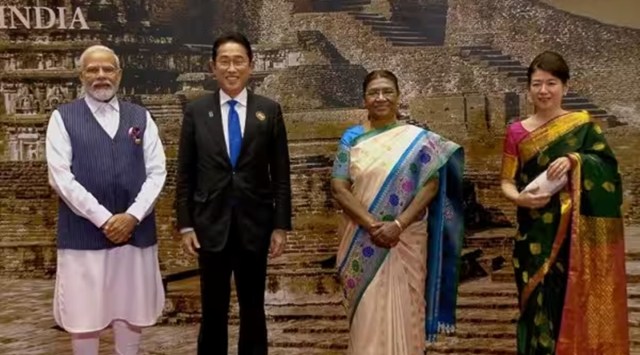

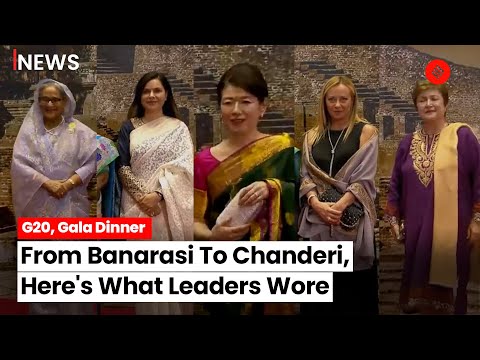
When Japanese First Lady, Yuko Kishida, posed for pictures in front of the sepia-tinged backdrop of the Nalanda University at the G20 gala dinner, the jewel tones of her green and fuchsia silk punctuated with zari brocade stood out in stark contrast. The sari or the six yards was having its moment alongside the immaculate Banarasi on the President of India. The First Lady of Mauritius, Kobita Jugnauth, was the other guest in sari the same night. The Managing Director of IMF, Kristalina Georgieva, turned up in an embroidered phiren, while Giorgia Meloni, the Prime Minister of Italy, came swathed in a Tilla embroidered stole, which had a robust paisley peeking out from its borders. Bangladesh Prime Minister Sheikh Hasina wore a lilac jamdani sari. The night looked as though Indian textiles and the Subcontinent’s fashion were having their hot moment at the G20.
The personal is now the political and in choosing to turn up in saris and phiren cuts for the gala dinner, the contextualisation was unmissable. From the recently concluded exhibition, ‘The Offbeat Sari’ at the Design Museum in London, to the sari walkathon by nearly 700 sari-clad women of Indian origin in London, the sari has surely arrived as an object worthy of academic study and political symbolism. With more than 24.3 million posts on Instagram filed under #sari and many million posts under #sarilove, women are taking to sari as objects of art, precious heirlooms and an intense fashion statement.


Many foreign delegates at the Mumbai Development Committee meeting tried their handloom at the makeshift loom displayed at the venue. In Bengaluru, the naturally-coloured brown khadi of Karnataka was displayed. With fashion contributing to much of the pollution, India’s showcasing of its textile heritage is an important point on sustainable production that the government has been trying to emphasise. It makes business sense as well, with the exports of handlooms and handicrafts at an all-time high. It was not very long back that the homegrown brand from Kerala, Neytt, made the handwoven rug of 6,950 sq mtrs for the Met Gala.
In pitching to be a global leader, the diversity and range that our textiles present is an important conversation point. As the repository of many handweaving skills that are largely unknown to the rest of the world, India is a voice of ethical production and timeless aesthetic. This is about the dignity of human labour and the careful preservation of skills, which the government has supported for long. Not many countries boast of a Ministry dedicated to textiles, which runs a wide network of many weavers service centres, a unique initiative to support handloom and handicraft.
With more and more Indian designers being worn by international celebrities and Indian handlooms and handcrafted textiles (handprints and hand embroideries) being recognised for their quality and timelessness, it was but natural that G20 should have showcased this in a big way. While first ladies donning sari-inspired gowns (Jacqueline Kennedy and the many India-inspired outfits) is nothing new, the range presented on the stage at the Gala dinner on Saturday night was wide. From Kishida with her silk aanchal pinned neatly on the back, walking with aplomb holding her pleats up to the golden Tilla Dozi on Meloni, the winner was the soft power of India and her wide repertoire of hand skills in textiles.
The writer is a career bureaucrat who has worked with the Ministry of Textiles for five years


