
Opinion How political drama let Constitution debate down
The small difference is that while Congress argued that the Constitution was being violated today, for the ruling party, the violations of yesterday matter the most. Isn’t this both funny and tragic?
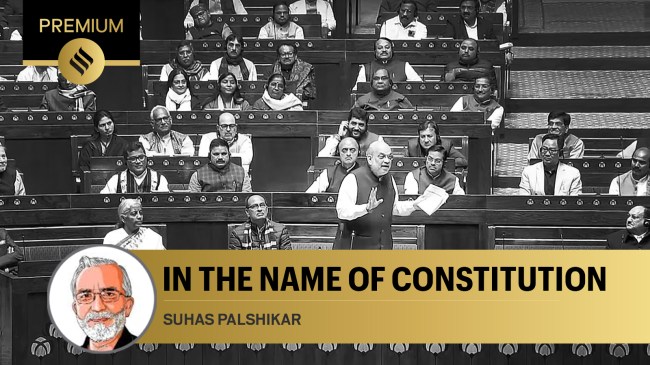 Union Home Minister Amit Shah speaks during the Constitution debate in the Rajya Sabha at the Winter session of Parliament, in New Delhi, Tuesday. (PTI Photo)

It is difficult to say whether the ongoing posturing over the Constitution is funny or tragic. In this year, when the Constitution entered the amrit moment — 75th year — there has been a lot of unfruitful manthan — churning — in the political arena over what our Constitution means and why we should protect it. Unfortunately, the noise generated does not seem to have led to any meaningful lessons for political players and citizens.
Following the Bharat Jodo Yatra, the top leadership of the Congress went into overdrive over the “red book”. They attacked the ruling party for its violation and subversion of the Constitution and, to some extent, made it an election issue. While there is no evidence that voters were swayed away from the BJP because of this, at least the Constitution became a talking point. However, this initiative of the Congress was rather vacuous because the party did not convert it into a mass movement. In all probability, Congress workers continue to be clueless about the substantive import of this invocation of the Constitution. Cynically, this move was seen as an attempt to win over the Dalits — as if the Constitution mattered only to them.

As the year comes to an end, the Prime Minister has paid back in the same coin of empty symbolism and harsh polemic, arguing that the Congress always subverted the Constitution. The small difference is that while Congress argued that the Constitution was being violated today, for the ruling party, the violations of yesterday matter the most. Isn’t this both funny and tragic?
There seem to be three different ways in which the Constitution has come under attack. Right from the time of its commencement, criticism was offered that the Constitution was an alien document, that it was not Indian enough; more specifically, it was not based on the values of the Hindu society. Through the Seventies, when those offering this criticism realised the value of political/civil liberties, this criticism became somewhat muted. Today, even as the PM is extolling the values of the Constitution, criticism in the English language is gaining intellectual respectability. It argues that the Constitution exemplifies colonial legacy. So, it becomes a complicated question whether to be proud of what our forefathers drafted or to bring a rupture and build a new Constitution. The PM would have done better if he had clarified this. The urge for indigenous laws, ideas, interpretations and indeed for an indigenous founding document is expanding under his leadership in the judicial, legislative and academic universes. Is this funny or tragic?
The second attack has been through practice. Unless those for whom the Constitution is drafted adopt a healthy respect for it and translate it into actual practice, it is bound to remain a mute idol. In India, even as the Preamble was recited in schools and colleges, we the people always gave short shrift to its objectives — liberty, equality, justice and, above all, fraternity. No wonder the government and its institutions often found ways of using the Constitution as an instrument of repressive control rather than reasoned regulation. If today the government is undermining the Constitution, it is due to the deep-rooted rejection of the idea of limited government. The last 75 years stand testimony to our penchant for sacrificing constitutional morality at the altar of the wisdom of rulers. This line of attack often invokes national interest, collective good, welfare, etc. to underplay the importance of constitutional morality.
Against this backdrop, the third attack has often been through attempts to amend, change, reform, review — and now, Indianise the Constitution. In his speech in Parliament, the PM spoke of controversial amendments. If he meant the Emergency-era amendments, then most changes have been wisely undone subsequently. If the PM had the amendments from the late Sixties in mind — the 24th and 25th amendments for instance — then those have been corrected by the 1973 Kesavananda Bharati ruling.
But as is customary these days, no analysis is complete without blaming Jawaharlal Nehru. PM’s attack too implied the mistake Nehru made in the matter of the First Amendment. While it is a political tragedy that a PM presiding over the most vicious application of existing laws targeting dissent should remind us of this, let us face Nehru’s mistake. Nehru’s mistake was that he was a child of the democratic movement which believed in the capacity of the power-holders to be constrained — it trusted their discretion and ability for self-regulation. Therefore, he sought to empower the state with a belief that democratic politicians will not trespass and also that institutional mechanisms will function against misuse. Both were misplaced.
What needs to be learned from this mistake? One lesson could be the need to evolve political consensus on adequate protection for citizens from the state and ensure that unseemly effects of the First Amendment are undone. Since both the BJP and the Congress stand by the Constitution, that should not be difficult. Pending this, all parties can pledge that they will not harass dissenters, arrest citizens at the drop of a hat, oppose bail except when evidence or witnesses are likely to be tampered with, or unleash government agencies against opponents. Moreover, self-doubt rather than self-assurance should mark law-making and its implementation when there is a clash between state power and citizen rights.
As for the government, lofty praise for the Constitution sits ill with a Chief Minister coming out in support of a judge who openly defied the Constitution. The criticism about amendments could not have come at a more inopportune moment when the government is set to fundamentally rewrite parts of the Constitution in its ambition to streamline the electoral cycle.
While the contradictions in our political life between intent and rhetoric, claims and practices are indeed funny, it is only tragic that a solemn moment is transformed into theatrical exchanges rather than introspection.
Above all, what we can learn from the experience of constitutional democracy over the last seven decades is that there can be tension between public sentiments (about what is right and wrong) and constitutional norms (of fairness). There is also tension between the ambition of rulers and the scope of what governments can legitimately do. In such moments, public sentiments and goals adopted by the rulers appear democratic and attractive but in the long run, unless the Constitution is adhered to, we run the risk of Bonapartism. That certainly is not funny.
The writer, based in Pune, taught Political Science

 Share
Share


