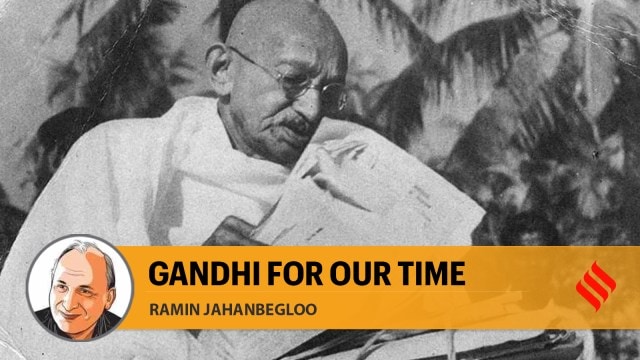

At a time when violence seems to have taken over our world in a variety of forms, celebrating Mahatma Gandhi’s 155th birthday might seem as unpopular a choice as it is necessary. Conflicts, murders, shootings, harassment and violations of civil liberties and human rights by states and individuals attest to the fact that humanity has not yet accepted the nonviolent message of Gandhi. There is an urgent need, in India and around the world, to invest time and effort in learning and understanding nonviolence through the life and action of Mohandas Karamchand Gandhi. Followers of nonviolent civil resistance in the Western world and other continents have never read one page of Gandhi. And yet, there is a genuine search in our world for moral leaders, like Gandhi, who could play an important role in showing us the path of peace-making. At a time when children are being killed everyday in Gaza, a disastrous war continues in Ukraine, along with many other examples of human madness and injustice, any form of awareness about nonviolence should be celebrated as an act of maturity. Martin Luther King Jr articulated this point brilliantly: “The choice today is no longer between violence and nonviolence; it is either nonviolence or nonexistence.”
The Gandhian philosophy of nonviolence is the noblest mode of resistance to injustice in our recent history. We can define Gandhian nonviolence as the inescapable compromise of human beings with life. As such, a nonviolent resister is an individual of wisdom and humility, who devotes all their strength to the betterment of humanity. Therefore, what Gandhian nonviolence teaches us is that the uplifting of the human condition in today’s world is not dependent on money and power politics, but on the cultivation of moral excellence and living in truth. In the world of Gandhian nonviolence, plurality of aspirations goes hand in hand with diversity of life. But there is also a sense of solidarity and empowerment of the powerless. This is what Gandhi called “swaraj” or self-rule and self-realisation. Gandhi underlined, “…real swaraj will come not by the acquisition of authority by a few but by the acquisition of the capacity by all to resist authority when it is abused. In other words, swaraj is to be attained by educating the masses to a sense of their capacity to regulate and control authority.” For Gandhi, as for Martin Luther King Jr, swaraj was considered shared sovereignty.


The public trend of nonviolent struggle towards global awareness and radical responsibility is an answer to the question that the French philosopher, Paul Ricoeur, asked in February 1949: “Under what conditions can the nonviolent individual be something other than a pure person on the margins of history?” This is where the reference to Gandhi can become more explicit and straightforward. Gandhi, in our times, stands for something more than a hope and wishful thinking. He is a moral exemplar who defines and extends the force of nonviolence in our time. The Gandhian challenge here is in the possibility of acting for change and taking responsibility for one’s actions. This takes us to another dimension of nonviolent struggle, which is the dissenting and revolutionary characteristics of the concept of nonviolence. To say that nonviolence is a revolutionary concept is another way of saying that it can change our view of humankind and the world. This is where Vaclav Havel followed Gandhi and left us a Czech testament of Gandhian nonviolence. He wrote: “We must trust the voice of our conscience more than that of all abstract speculations and not invent responsibilities other than the one to which the voice calls us. We must not be ashamed that we are capable of love, friendship, solidarity, sympathy, and tolerance, but just the opposite: We must set these fundamental dimensions of our humanity free from their ‘private’ exile and accept them as the only genuine starting point of meaningful human community.”
What is left of Gandhi today? If we ask the younger generation of Indians, they will certainly dismiss him. But the truth is that there can be no history of modern India without a chapter on Mahatma Gandhi. Also, we cannot write a history of modern politics without including Gandhi and his philosophy of nonviolence. Gandhi revolutionised the concept of politics, not only by giving it a new meaning, but also by transforming it into a process of self-examination. Accordingly, the Gandhian philosophy of nonviolence can help us change our social imagination of politics, which has continuously taken shape on the battleground of brute force.
The writer is Director, Mahatma Gandhi Centre for Nonviolence and Peace Studies, O P Jindal Global University


