
Opinion In Our Opinion: The method to Trump’s trade war
US President’s tariff salvo may or may not bring desired results for America. But other countries must deal with fallout
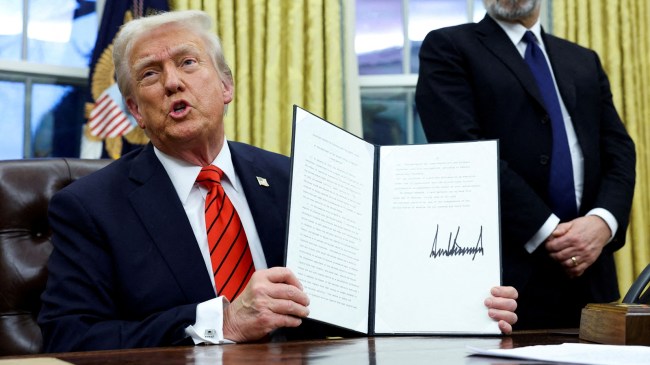 US President Donald Trump holds a signed executive order on tariffs on aluminum imports in the Oval Office of the White House. (Image: Reuters)

Dear Express reader,
In 2020, economists Anne Case and Angus Deaton published a book evocatively titled Deaths of Despair and the Future of Capitalism. The book, which draws on their earlier work, carefully documented rising death rates in the US due to three factors — suicide, drug overdose and alcoholic liver disease — observed prominently among middle-aged White non-Hispanic Americans with low levels of education. Several explanations have been put forth to explain this rather unusual trend, ranging from loss of jobs, declining wages and inequality to globalisation and the nature of the US healthcare system.
Now, fast forward a few years. After weeks of uncertainty, on February 1, 2025, US President Donald Trump signed executive orders imposing steep tariffs on three of its largest trading partners — Canada, Mexico and China. The stated reason for doing so was to hold them “accountable to their promises of halting illegal immigration and stopping poisonous fentanyl and other drugs”.

The issue of drug overdose is undoubtedly a serious matter, one with wider political salience. According to the US Centers for Disease Control and Prevention, over 1,10,000 died in America from drug overdose in 2022, of which around 70 per cent was caused by fentanyl and other drugs. While there may be criticism of the study carried out by the economists, by arguing that “illegal aliens” and “drugs” constitute a “national emergency” under the “International Emergency Economic Powers Act”, Trump has used this route to levy tariffs in order to extract concessions from the targeted countries. The decision to impose tariffs on Canada and Mexico has been held off by 30 days following assurances by leaders of both countries of steps to stem the flow of drugs and illegal migration.
Is there a method to Trump’s tariff wars?
Drugs aren’t the only reason for Trump’s tariff salvos. The US President also seems to believe that tariffs will help American manufacturing and jobs, bring down the trade deficit and boost government revenues. The US does indeed run a massive trade deficit. In 2024, it was almost $1 trillion. The loss of manufacturing jobs in the country has also been well documented — as per some estimates, manufacturing employment fell by about 5.5 million between 2000 and 2017. According to another study, the China Shock — a period that saw a staggering increase in Chinese exports — accounted for “59.3 per cent of all US manufacturing job losses between 2001 and 2019”. The Tax Foundation, a Washington-based think tank, also estimates that the threatened tariffs on three countries “would increase federal tax revenue by $106.1 billion in 2025, or by nearly 0.35 per cent of GDP.”
However, despite that, many argue that there is little evidence to suggest that Trump’s tariff proposals will fulfil all his objectives. Instead, as per some estimates, US households and the broader economy are likely to feel pain from these measures.
According to the Peterson Institute of International Economics, a Washington-based think tank, the direct costs of Trump’s tariffs on Canada, Mexico and China, to a “typical US household” would be over $1,200 a year. The Tax Foundation has estimated that the tariffs on Canada and Mexico “would reduce long-run GDP by 0.3 per cent”, and those on China would reduce GDP by 0.1 per cent. Crucially, these calculations are all “before foreign retaliation”. The targeted countries have, however, not yielded.
China has retaliated in kind, escalating the trade war between the two countries. And in response to the latest tariffs on steel and aluminium — 25 per cent on both with no exemptions and exceptions, effective from March — several others have already announced their intention to hit back. Canadian Prime Minister Justin Trudeau has said that Canada will give a “firm and clear” response to the latest trade barriers, while Ursula von der Leyen, President of the European Commission, has said that the “unjustified tariffs on the EU will not go unanswered — they will trigger firm and proportionate countermeasures.”
Trump has now gone one step ahead. His latest salvo calls for imposing reciprocal tariffs — the US levying the same taxes on imports from other countries that they impose on US exports. But with Trump also using tariffs as a tool for negotiation, to get what he believes is a better deal for the US, there does seem to be room for negotiation, especially considering that the reciprocal tariffs are expected to be in effect from March.
The imposition of tariffs could, however, push up prices in the US at a time when inflation is already inching upwards. In January, headline inflation was 3 per cent, up from 2.9 per cent in December. Core inflation was even higher at 3.3 per cent. This will have implications for US monetary policy. In its last meeting, the US Federal Reserve kept interest rates unchanged, maintaining the target range for the federal funds rate at 4.25 to 4.5 per cent. Recent developments suggest that the Fed is likely to maintain the status quo until greater clarity emerges.
Donald Trump has already made known his preference on the trajectory of interest rates. At the World Economic Forum in Davos, he told business leaders via video that “with oil prices going down, I’ll demand that interest rates drop immediately, and likewise they should be dropping all over the world”. After the Fed’s recent meeting, he criticised it on a social media platform, saying that it had “failed to stop the problem they created with inflation”.
So where does this leave India? In the recent budget, the Union government reduced duties on items that are exported by the US such as high engine capacity motorcycles and high-end cars. This suggests a forward-looking pragmatic approach. During Prime Minister Narendra Modi’s US visit several steps have been taken to strengthen the relationship between the two countries. Plans have been announced to “negotiate the first tranche of a mutually beneficial, multi-sector Bilateral Trade Agreement (BTA) by fall of 2025”. Stated alongside is the intention to double trade between the countries to $500 billion by 2030.
In an increasingly uncertain world, Delhi must take advantage of any opportunity that comes its way. Alongside, it should reevaluate its broader trade strategy, shunning protectionism.
Till next week,
Ishan Bakshi

 Share
Share


