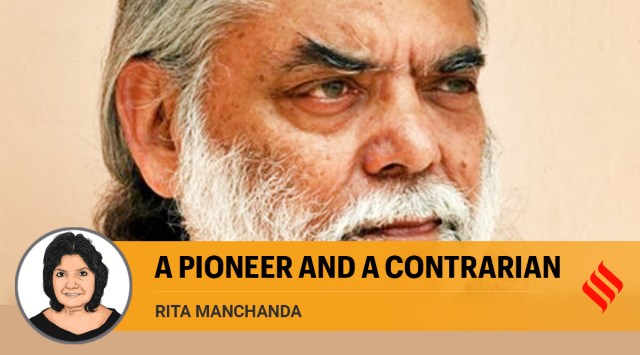
My indomitable friend, Dinesh Mohan, I cannot imagine that you went “gentle into that good night” but that you raged against the dying light and fought as you have done all your life against ignorance, mediocrity and above all, injustice. To know Dinesh — whether as a student or colleague — or to be counted among his vast array of friends, meant engaging with him intellectually, and so exasperatedly. For, Dinesh would argue counter-intuitively, veering on blasphemy at times, but in that unsettling process, pathways to clarity were opened. Take the Covid-19 debate. Dinesh questioned the value of prioritising testing, pushing many public health professionals to re-examine their position, and in that jousting both recognised that testing must not be falsely positioned as treatment or healing.
Dinesh was not your comfortable go-along-with colleague, friend and mentor, even though his energy, zest for life, passionate political convictions and deep compassion drew young and old to him. Vague and loosely-held positions had to be challenged. On Covid-19, a mobilising group’s retreat from the social obligation of cutting through medical obfuscation around the pandemic — falling back instead on the “leave it to the medical experts” option — prompted a retort. It led to a transformation in the Delhi Solidarity Group’s civic intervention — one based on the appreciation of shared responsibility for civic health and a recognition that an informed interrogation of “experts” is necessary for humanitarian response. This was an offshoot of Mohan’s passionate conviction about the nature, purpose and relevance of science in society.


Such defiance was not without significant professional cost and a calling to account by intelligence sleuths — notwithstanding that his professional brilliance and expertise in his chosen field of road transport and safety made him a natural member of multiple national and international public policy committees. There too, he never hesitated to be true to his convictions, willing to be a contrarian on the Delhi Metro, criticising it as expensive. He was critical of Delhi’s switch to CNG and braved public controversy over the introduction of the BRT (Bus Rapid Transport) and its eventual surrender to the dominant car lobby. For Mohan, his academic and policy research on road transport and safety was integral to his commitment to social justice. It privileged the most vulnerable of road users, the pedestrian and the cyclist, and valued affordable mass public transport, buses.
Dinesh pioneered research in the field of road safety and co-authored the international Public Charter on Right to Safety. He was an institution builder, founding IIT’s Transport Research and Injury Prevention Programme (TRIPP). Recently he co-founded and became the director of the Independent Council for Road Safety.
Above all, Dinesh was a caring and generous friend to many and very diverse people he forged an intimate connection with. He was never too busy if a friend called, nor did he hesitate to help someone. His laughter comes to mind and so, too, his generosity as a host at myriad gatherings at their home with his wife Peggy, a distinguished author, linguist, painter and cook.
You have left a terrible void, Dinesh. You would have never given up the struggle against injustice. Now, it is on us to carry it forward.
This column first appeared in the print edition on May 27, 2021 under the title ‘A pioneer and a contrarian’. The writer is a peace studies scholar and human rights activist


