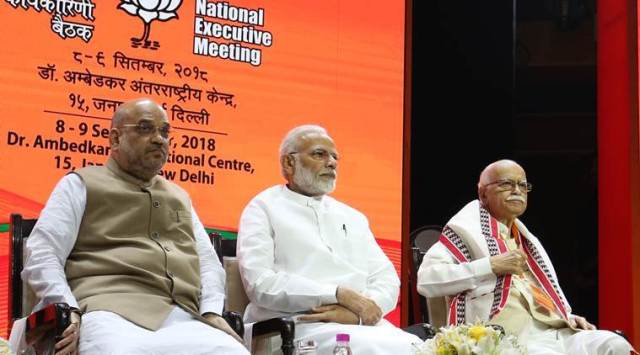
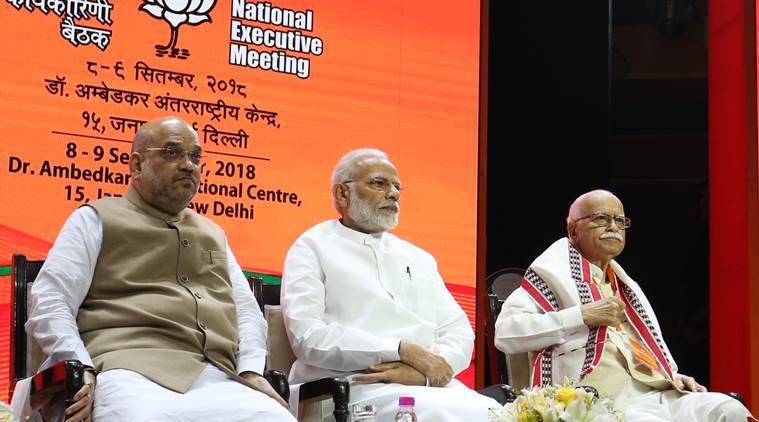
At the BJP national executive in Delhi last week, the media was segregated from the delegates. When Defence Minister Nirmala Sitharaman briefed journalists on the first day’s proceedings, co-convener of the media cell, Sanjay Mayukh, cut her short when she attempted to explain Amit Shah’s remarks on the petrol price rise. Sitharaman, who just a month ago threw a fit when Karnataka state minister Sa Ra Mahesh tried to end her press conference claiming she had a busy schedule, surprisingly did not protest. However, a day later, Law Minister Ravi Shankar Prasad stood his ground and completed his remarks to intrepid scribes who raised the petrol price hike issue, even though Mayukh once again wanted to abruptly conclude the meeting with a “namaste”.
At the Mumbai release of his latest book Newsman: Tracking India in the Modi Era, veteran journalist Rajdeep Sardesai pointed out that today’s politicians are far less tolerant of criticism than earlier. Both national political parties have started boycotting TV news channels if they object to their coverage. To illustrate his point, Sardesai recalled how, during the Mumbai riots in 1992, he telephoned the late Mumbai MP Murli Deora to question him about the lack of police protection for minorities. Deora replied that he was in the middle of a game of bridge. The next day’s newspaper carried the headline “Deora too busy playing bridge” much to his annoyance. Deora swore that he would never speak to newsmen again, but within a week he relented. His son, Congressman Milind Deora, who was in the audience, laughed. Today the boycott of channels seems to have become a standard pressure tactic for arm-twisting. Last month, a BJP spokesman appearing on a programme on a news channel blacklisted by his party got a furious call from the BJP’s media cell. His whispered response was audible to those present in the studio, “I thought the ban had been lifted.”


The Gujarat police admitted Hardik Patel, who was on hunger strike for over a fortnight, to the Sola Civil Hospital in Ahmedabad. The doctor on duty was about to do some tests when Patel insisted that he be transferred immediately to a private hospital. On the WhatsApp group of Patel’s hardcore supporters, there was a politically incorrect explanation for moving to a different hospital. It was claimed that government hospitals were filled with medicos without proper qualifications as they were from reservation quotas. There were even videos on the WhatsApp group making the point that while the reservation category got admission with 72 per cent, a Patel child could not get entry into educational institutions with 92 per cent. Hardik and Jignesh Mevani may be good friends, but it is doubtful if their followers are on the same page. Hardik, meanwhile, ended his fast after 19 days.
After Narendra Modi’s Chai pe Charcha and Amarinder Singh’s Coffee with the Captain, Digvijaya Singh has launched Sangat mein Pangat (Community feast and chat). Singh’s idea is to provide a forum for disgruntled elements in the Madhya Pradesh Congress and special interest groups to air their problems. Since Kamal Nath is PCC chief and Jyotiraditya Scindia campaign in-charge, Singh has perforce to carve out a noticeable role for himself.


