
Opinion With BJP in Delhi, what happens to Indian federalism?
While it is a lot tougher to create Delhi-like situations in full states, election outcome could embolden the Centre, make it more confrontational
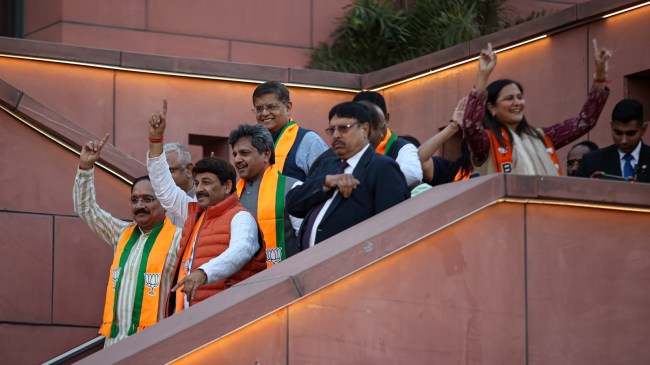 BJP leaders celebrate after winning Delhi Assembly polls. (Express photo by Praveen Khanna)

The reasons for the loss of the Aam Aadmi Party (AAP) in 2025 and the emergence of the Bharatiya Janata Party (BJP) with a clear majority, after two resounding wins for AAP in 2015 and 2020, in the recently concluded elections to the Delhi Assembly, will be examined by pollsters and pundits. But it’s important to analyse what the results mean for federal politics in Delhi under the constitutional provision of Article 239AA.
It is easy to put a post-facto lens on a win or loss, but electoral outcomes are often controlled by more day-to-day issues than ideological pundits on either side of the political spectrum admit. But one thing is clear: The Centre must face up to the allegation of using the constitutional architecture to tie the Delhi government’s hands in carrying out day-to-day administration. The difference between the BJP and AAP, though large in terms of number of seats, is only about 2 per cent in terms of vote share, both polling around 45 per cent of the vote. It seems that a section of voters felt that for a government to work in Delhi, it must be of the same political colour as the party holding office at the Centre.

In May 2015, barely three months after the AAP won a thumping majority, the Centre issued a slew of notifications that appeared to restrict the functioning of the elected government. These notifications were challenged, leading to the decision of the Five Judge Constitution Bench in July 2018 (“First CB”). While interpreting the constitutional provision that introduced an elected Assembly and Government in Delhi — Article 239AA — the Supreme Court unequivocally held that except for the three expressly excluded subjects of police, public order and land, the elected Delhi Assembly and the government headed by the elected CM exercised the real powers of governance of the National Capital Territory. In all aspects of governance, except these three subjects, the Lieutenant Governor (LG) was, in effect, a figurehead, like the governors in states.
After this decision, the Delhi government functioned relatively easily between 2018 and early 2022. That the LG during this period was a balanced former bureaucrat helped. However, things began to change after AAP’s victory in the Punjab Assembly elections in March 2022. A new LG assumed office in Delhi in May 2022. From thereon, several hurdles were created in even the most elementary functioning of the Delhi government.
The bureaucracy, too, was not on the same page with the elected government, creating impediments in carrying out policy decisions and even paralysing the day-to-day functioning of the government. This was combined with the use of central government agencies such as the CBI and the ED to prosecute criminal cases against prominent AAP leaders and arrest their top brass.
In May 2023, another Constitution Bench of the Supreme Court unanimously held that the services and civil servants in the Government of NCT were in the administrative control of the elected government (“Second CB Decision”). This decision had the potential of preventing, for good, unwarranted interference by the Centre/LG. However, within a week of the Second CB Judgment, an ordinance and, thereafter, legislation was brought in, effectively placing the civil service under the control of the LG. A challenge to this legislation is now pending before a third Constitution Bench.
It is impossible to run even a small professional office or business if your employees do not just listen to you but, in fact, take a conflicting position. Extrapolate this to the running of the entire government of a national capital with nearly two crore inhabitants, and one gets a real sense of the conditions under which the AAP tried to govern Delhi. Between 2022 and 2024, nearly a dozen petitions were filed by the elected Delhi government to keep the government functioning. In most of these cases, the SC passed orders that helped the elected government to function. These ranged from the appointment of the Chairperson of the Delhi Electricity Regulatory Commission to ensuring that the Delhi Government’s Good Samaritan-Farishtey scheme funds allocated by the Delhi Assembly are actually released by the bureaucracy.
However, because of the constant hurdles in its functioning, the elected government could not fully address civic issues such as the maintenance and repairing of roads and ensuring water supply. The government was in office but not in power. The people of Delhi suffered as a result.
A common refrain of Delhi voters in various pre-election interviews was that in the second term from 2020-2025 the quality of governance in Delhi has gone down compared to AAP’s earlier tenure of 2015-2020.
Delhi’s residents seem to have accepted, even if hesitatingly, that the NCT needs the same party in office as that in the Centre. B R Ambedkar had famously described federalism as distribution of powers between the Centre and state governments — the federated unit, envisaged in the Constitution, not at the mercy and whim of the Centre. Despite two Constitution Bench judgments reinforcing that principle, the federal demarcation was breached, reinforcing inefficacy in governance.
The new BJP Government will also not have “services” in its control. However, the informal mechanisms of the same party at the Centre and in the State could ensure that this is not a hindrance.
The consequence of all this for Delhi is obvious but there are larger implications for federalism in India. In full-fledged states, unlike Article 239AA, the demarcation of power is quite clear and settled through years of jurisprudence. It is therefore a lot tougher to create Delhi-like situations there. However, that has not stopped the Centre from using the Raj Bhawan against opposition-ruled state governments. The Tamil Nadu governor blocking state legislations — recently examined by the SC — is a case in point. Criminal cases have also been foisted on state leaders in Opposition-ruled states. Karnataka is a case in point. The Delhi outcome could make the Centre more confrontational against full-fledged states.
The writer is senior advocate and represented the Government of Delhi in two Constitution Benches before the Supreme Court in 2018 and 2023

 Share
Share


