
To sustain the compulsory flag salute, we are required to say that a bill of rights, which guards the individual’s right to speak his own mind, left it open to public authorities to compel him to utter what is not in his mind.” This significant observation was made by US judge R.H. Jackson in Barnette, 1943. Affirming its universal truth in Bijoe Emmanuel, 1987, our Supreme Court ruled that if any religious belief is “genuinely and conscientiously held, it attracts the protection of Article 25”. While in Barnette, the right of school students belonging to a particular religious sect not to salute the country’s flag was upheld, in Bijoe Emmanuel, the SC ruled that mandatory singing of the national anthem could not be imposed on pupils who genuinely believed that it was against their religious belief.
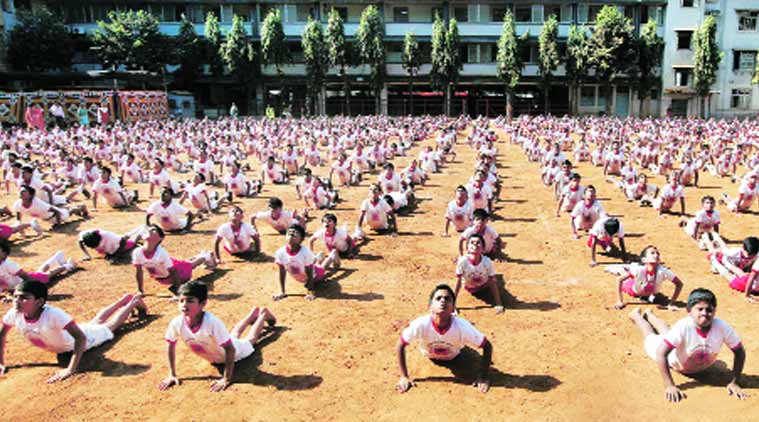
The controversy over yoga and suryanamaskar should be judged in light of these judicial pronouncements.


The first fundamental duty of a citizen under Article 51A is “to abide by the Constitution and respect its ideals and institutions, the national flag and the national anthem”. The Prevention of Insults to National Honour Act, 1971, till date recognises only three things — the Constitution, the national flag and the national anthem — as symbols of national honour and prescribes penalties for insulting these. Section 2 of the act prescribes penalties for “whoever… shows disrespect to or brings into contempt (whether by words, either spoken or written, or by acts) the Indian national flag or the Constitution of India or any part thereof”, and the next section for intentionally preventing singing of the national anthem or causing disturbance to any assembly engaged in its singing. The SC had given its Bijoe Emmanuel ruling with reference to these provisions of the Constitution and the 1971 act.
Any health-building tradition of India, however historic or beneficial, or any religious practice, however widely prevalent in society, cannot be put on a higher pedestal than the national flag and the national anthem. They cannot be imposed on unwilling individuals or communities in violation of the clear provisions of Articles 25 and 28. If public authorities do so, it would, to use the words of Justice Jackson, “transcend constitutional limitations on their power”. And those who are demanding that they be made mandatory are clearly violating the letter and spirit of the 1971 act, which declares it an offence to “show disrespect and bring into contempt the Constitution”. The right of conscientious objectors who want to be exempted from following any such tradition or practice is unequivocally protected by the Constitution and judicial precedents. The choice between people’s genuine religious beliefs and what others may see as a test of patriotism has to be unconditionally left to individual citizens.
As per Bijoe Emmanuel, “Article 25 is an article of faith in the Constitution, incorporated in recognition of the principle that the real test of a true democracy is the ability of even an insignificant minority to find its identity under the country’s Constitution.” Neither the rulers of the day nor right-thinking citizens of the country can afford to overlook this “real test of democracy”.
The writer is former chair of the National Commission for Minorities and ex-member, Law Commission


