
Opinion A New Dalit Agenda
The politics of outrage and patronage has run its course
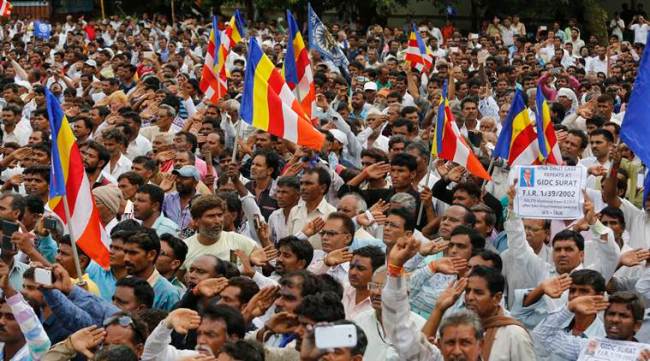 Unlike in the pre-1947 era, when eradicating casteism was an important strand of both the freedom struggle and many Hindu reform movements, most savarnas today believe that there is little more that they need to do to redress three millennia of injustice against Dalits. (File photo)

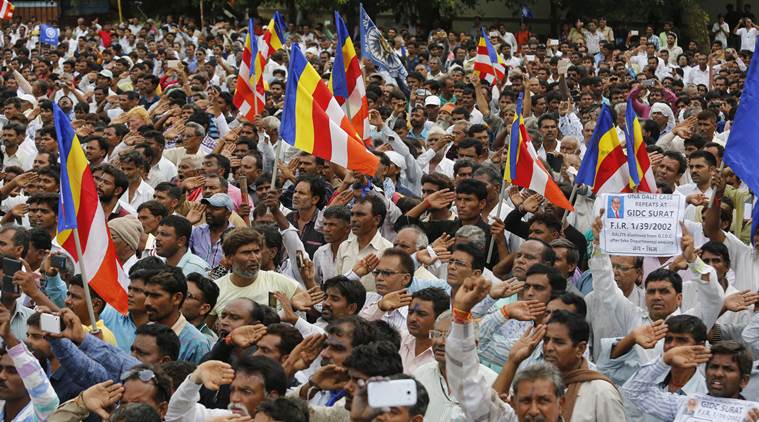 The Dalit worldview is a “work in progress”. The classical mode of confrontation is not the answer, but a constructive path that leads to collaboration is the need of the hour. (Representational Image)
I was in Sitamarhi, North Bihar, earlier this month, to participate in an event celebrating the centenary of the Champaran Satyagraha. After the function, a group of young Dalits came up to me to enquire about employment opportunities in Mumbai and Delhi. Considered to be the birthplace of goddess Sita, Sitamarhi is distant from these two metropolitan cities in time and space. The region epitomises the Dalit politics of outrage and patronage, which has weakened the self-confidence of the marginalised. Yet, in a sign of the changing times we live in, the only questions youth in Sitamarhi had were about jobs and a better life in metropolitan cities.
The results of the recently-concluded assembly elections in five states have tremendous implications for subaltern politics in the country. The verdict delivered a body blow to those who claim to represent the cause of the marginalised. It shocked the intelligentsia, which refuses to acknowledge the presence of multiple perspectives. One striking feature in India’s politically most significant state, Uttar Pradesh, is the changing voting dynamics of the Dalit community. Candidates of the Bharatiya Janata Party won in 75 out of 85 assembly constituencies reserved for Scheduled Caste candidates.

This trend indicates that apart from the non-Jatav Dalits, the Jatavs also supported the BJP-led coalition that comprised two relatively smaller parties: The Suheldev Bharatiya Samaj Party (SBSP) and Apna Dal. In fact, the difference between the seats won by the Indian National Congress and the SBSP is not much, considering the number of seats contested by the two parties. India’s grand old party is losing steam. A politics of populism and benefaction does not resonate with the aspirations of youngsters from socially-backward communities.
The Bahujan movement initiated by Kanshiram was a reaction to the regressive assumptions of treating Dalits as a political commodity. He led one of the most successful non-political movements to consolidate Dalits through the Backward and Minority Community Employees Federation (BAMCEF). The outfit was conceived to address social inequalities of caste, gender and community. Kanshiram galvanised this social coalition and gave it a political shape in the form of the Bahujan Samaj Party which became the pre-eminent Dalit voice in national politics. He nurtured Mayawati politically to ensure the movement continued after him.
But Mayawati failed to take a cue from her predecessor on developing a second generation leadership in the BSP. There is no significant leader in the party apart from Mayawati now. Her party has also failed to construct and communicate a narrative of growth and development. Demagoguery around selective readings and interpretations of the Manusmriti will not have traction among the younger generation. To paraphrase Henry Ford, the only history Dalit youth is interested in is the history they are making today. “I want all people to be Indians first, Indians last and nothing else but Indians,” B.R. Ambedkar said, outlining his vision for a India where caste, community and creed no longer define an individual.
It becomes pertinent here to acknowledge the services of the Dalit Indian Chambers of Commerce and Industry (DICCI), a unique conglomerate of Dalit entrepreneurs across the nation, which has more than 5,000 big and small entrepreneurs as its members. The government has also launched schemes such as Stand-Up India, which focuses on creating a supportive ecosystem for aspiring Dalit entrepreneurs. More than 1.25 lakh branches of public sector banks have been mandated to extend financial support to SC/ST entrepreneurs.
The Dalit worldview is a “work in progress”. The classical mode of confrontation is not the answer, but a constructive path that leads to collaboration is the need of the hour. The community must be equipped with skills to negotiate with any administration. It is time to shift the focus from emotive rhetoric to an agenda for empowerment.
The writer is former Union minister and associate professor, Patna University
 Share
Share


