6 min read
© The Indian Express Pvt Ltd



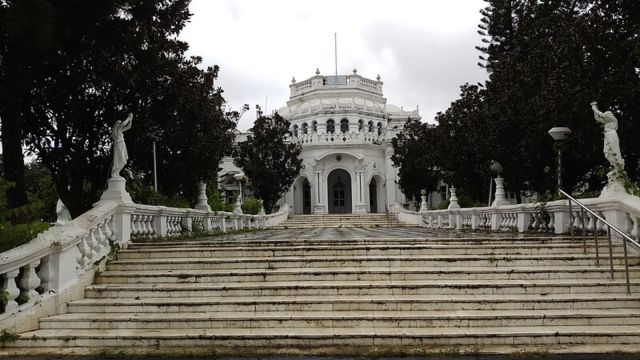 Built in 1917, the Pushpavant Palace had served as the governor's residence until 2018, when the Raj Bhawan was shifted to a new building at the New Capital Complex. (Wikimedia Commons)
Tripura government on Friday signed a Memorandum of Understanding (MoU) with the Tata Group subsidiary Indian Hotels Company Limited (IHCL) to set up a luxury hotel on Pushpavant Palace premises, which was formerly the Raj Bhawan, in Agartala.
Built in 1917, the palace had served as the governor’s residence until 2018, when the Raj Bhawan was shifted to a new building at the New Capital Complex.
The government’s decision comes amidst strong of protests from the Opposition parties, and even from government allies like TIPRA (Tipraha Indigenous Progressive Regional Alliance) Motha party. The regional party had earlier pressed for fulfilling the ruling Bharatiya Janata Party’s (BJP) poll promise of turning the Pushpavant Palace into a museum.
However, TIPRA Motha on Friday put its protests to rest, saying both parties signing the MoU have given assurances to ensure that the dignity and history of Pushpavant Palace would be maintained and investments would be made to train tribal youths in hospitality management, among other things.
The MoU was signed by Tripura Industries and Commerce Secretary Kiran Gitte and IHCL General Manager Jayanta Das.
Chief Minister Dr Manik Saha, Industries and Commerce Minister Santana Chakma, Tourism and Transport Minister Sushanta Chowdhury were present at the event.
The palace built during the period of king Birendra Kishore Manikya Debbarman would be transformed into a massive five-star hotel, boasting a hundred rooms with an investment of Rs 250 crore, the developers said.
A majority of the structures would be set up outside the heritage building, while some suites would be maintained inside the royal palace to offer the royal charm to visitors and clients.
Chief Minister Dr Manik Saha described the move as a “historic milestone” as it was the first time IHCL has partnered with the state government to develop a heritage hotel in Tripura.
Saha told reporters that the project is in sync with Tripura’s goal for modernization, boosting employment opportunities for youths, increasing tourist footfalls and honouring the erstwhile royal legacy.
Regarding concerns over the Pushpavant Palace being turned into a hotel, CM Saha clarified that the issue was discussed in different platforms before finalising the MoU.
Pushpavant Palace was handed over to the government by the then Regent Queen Rajmata Kanchanprabha Devi in 1949 with terms and conditions to accommodate the Governor there.
TIPRA Motha founder and royal scion Pradyot Kishore Manikya Debbarma had earlier vehemently protested against the luxury hotel project when it was first announced last year.
He alleged it was contrary to the understanding between the royal family and government to accomodate the gubernatorial head in Pushpavant Palace, and that the decision was made without considering the culture and sentiments of the people of the state.
Prior to coming to power in 2018, the BJP-IPFT government promised to convert the palace into Maharaj Birendra Kishore Manikya Museum and Cultural Centre.
“Everything can’t be done for money, for profit. I completely oppose it and I am telling the government to rethink over the decision, or, else, we have to hit the streets and oppose it,” Debbarma had said.
His was referring to the foundation stone for a national level digital cultural museum laid by President Droupadi Murmu in October, 2022, at the palace.
However, on Friday evening Debbarma said the Tata Group and state government have assured Motha three things related to the project – to retain Pushpavant Palace’s original name and restoration of the heritage building, setting up of a Hospitality Skill Development Centre of Excellence for tribal youths at Khumulwng – the Tripura ADC headquarters, and to upgrade seven Industrial Training Institutes (ITIs) under the tribal council through MoU with Tata Technologies.
“A few months ago, news emerged regarding the establishment of a private hotel at the historic Pushpabanta Palace in Agartala. This sparked serious concerns and doubts among the indigenous Tiprasa people of the state, particularly regarding the process and rationale behind the palace’s handover. | expressed my deep concerns about the matter, and following protests from various socio-political organisations and individuals, the issue was taken up seriously by all concerned parties, including the State Government and IHCL-Taj of TATA Group,” Debbarma said in a statement.
It also said the MoU signed incorporated the terms and conditions set forth by the tribals and respected the sentiments of the Tiprasa people alongwith introducing initiatives aimed at empowering them.
“The hotel would retain its original name, and the heritage building will be restored. The history, culture, and traditions of the indigenous Tiprasa people will be prominently displayed, with the objective of raising awareness among both local residents and visitors about the state’s rich legacy. Consultation will take place with the Royal Family to ensure that the history and traditions are accurately represented,” Debbarma said.
He added that the IHCL-Taj has acknowledged to honour Article III of the Tripura Merger Agreement dated September 9, 1949, which is referred in the Inventory of Immovable Property of the erstwhile Manikya monarchs, including those which were handed over to the government after merger.
Debbarma also said that the state government has agreed to allocate Rs 13 crore to set up a Hospitality Skill Development Centre of Excellence for tribal youths at Khumulwng.
He claimed that these assurances from the government came due to the protests put forth by tribal people over the Pushpavant Palace issue, Debbarma also trained guns at the Left Front for allegedly trying to change names of royal monuments and structures during their rule in Tripura.
“The new generation of Tiprasas must not repeat the mistakes of the past. The Communists made numerous efforts to erase our rich history, culture, and traditions—from erecting random statues to renaming historical monuments to distorting our textbooks,” his statement said.