Journalism of Courage
 5 min read



We have the new millennium staring us at our faces. In fact we are treating it as a milestone in achieving goals and reaching new heights. But consider the plight of women today and all our endeavours to achieve them seem rather shallow. Let us take a glance at the virulence that a woman faces all through her life 8211; from the pre-natal stage if sex-determination labels the foetus female, female foeticide is common or else infanticide is resorted to.
Then follows neglect, discrimination and abuse. Her childhood consists of an early marriage. Child labour and prostitution are common. With adolescence comes restrictions on mobility, taboos related to menstruation and puberty along with neglect and discrimination. As the young girl turns into an adult she faces frequent pregnancies, marital and family violence. She might become an unwed mothers, suffer illegal abortions, rape, abuse due to alcoholism, desertion due to infertility, dispossession of property and witch hunting. Towards the end of her life as an old woman she faces the denial of basic rights and securities along with abuse and neglect. After all this one wonders how she is surviving today.
But all is not so bleak as several organisations come to the fore to help women in their basic need for support. The WAH women and health Programme is a multi-regional collaboration promoting comprehensive, gender sensitive, sustainable healthcare for all, with special concern for women and girl children, and for disadvantaged persons. It emphasises a holistic view of health care for women, an approach which takes into account tradition, health and healing practices, effective and sustainable local health management and a stand against social inequality and discrimination as it affects health.
It all began in 1990 when DSE German Foundation for International Development looked into the potential for supporting NGOs to promote women8217;s income generation capacities. A number of NGOs were called upon in India and Nepal. With the reunification of Germany, the country began to look out for the reconstruction of public health services and so a Public Health Promotion Centre ZG was set up by the DSE which would also promote health training and dialogue in countries of Africa, Latin America and Asia.
Today, WAH teams are working in four regions: Southern Karnataka and Tamil Nadu, Western Gujarat and Rajasthan, Maharashtra and Nepal.
The Maharashtra WAH programme is in the stage of partnership building and resource development in preparation for the first training course in 1999.
This goal is approached through training and advocacy, where there is training for capacity building of programme co-ordinators and advocacy for policy changes at the regional and national levels. This has been brought about by programme partnership with non-governmental and autonomous semi-governmental organisation. Though there have been several efforts towards upliftment of women8217;s health, they are still a neglected lot.
The Reproductive and Child Health Policy looks at women primarily as reproducers rather than individuals requiring complete health coverage. Also with 33 per cent reservation through the Panchayat Act, limitations arise in the implementation due to gender discrimination. Women8217;s panchayats require information and guidance to plan and direct proper health management. With liberalisation and privatisation has come increased exploitation and social disparity. With low income and rising costs,people are fighting for survival.
Development has brought about environmental changes bringing in its wake a host of diseases; rural-urban migration and media exposure with shifts in social values have gone on to spread sexually transmitted diseases including AIDS. As always, women have been at the receiving end of it all. Though the scope of health improvement is an uphill task, women in the grassroots community have gone ahead with political, economic and health initiatives. Such processes need to be encouraged and WAH has identified some key roles for programme co-ordinators in non-governmental and government linked health projects.
The co-ordinators are trained over a period of one tear and has a ninety day curriculum in three residential training phases of one month each with a post course follow up activity in the project areas. Topics related to primary health care, people8217;s health culture, gender relations and health management are covered in three phases. The training faculty includes experienced persons from the field of social sciences, medicine, community health, women8217;s development and management. The Maharashtra WAH programme is co-ordinated jointly at Pune through the Pragati Foundation and MASUMMahila Sarvangeen Utkarsh Mandal. The former manages the programme and the latter coordinates the training process. The entire programme is documented by the documentation and resource unit.
On the 23rd of July, an advocacy meeting was held at the YMCA where the participants of the programme interacted with each other discussing problems and ways to overcome them. The workshop continued over a period of three days followed by the 30 day course. It was heartening to see the number of participants which included men as well along with a large number of NGO8217;s. With society realising the need for better health standard for women, the task cannot be an impossible one.

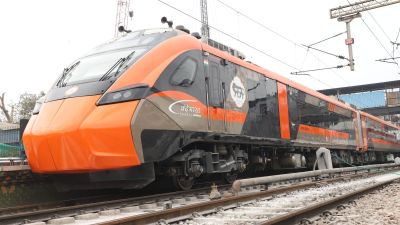
Railway Minister Ashwini Vaishnaw on Saturday said Vande Bharat Sleeper trains will be introduced across all states, including Kerala. He made the comments during a press briefing at New Delhi railway station after inspecting the Howrah–Guwahati–Howrah Vande Bharat Sleeper rake, which is set to be launched this month.