8 min read

Journalism of Courage



How do you crack the consumer code of a country with seven religions,70 festivals and millions of kirana stores? Kishore Biyani did it by being unconventionally conventional. Modern doesnt always mean western. And sometimes hiring an anthropologist makes more sense than hiring an MBA. He looks at you and tells you whether you are an easy or difficult consumer for a marketer. Indias biggest private retailer spoke to Archna Shukla.
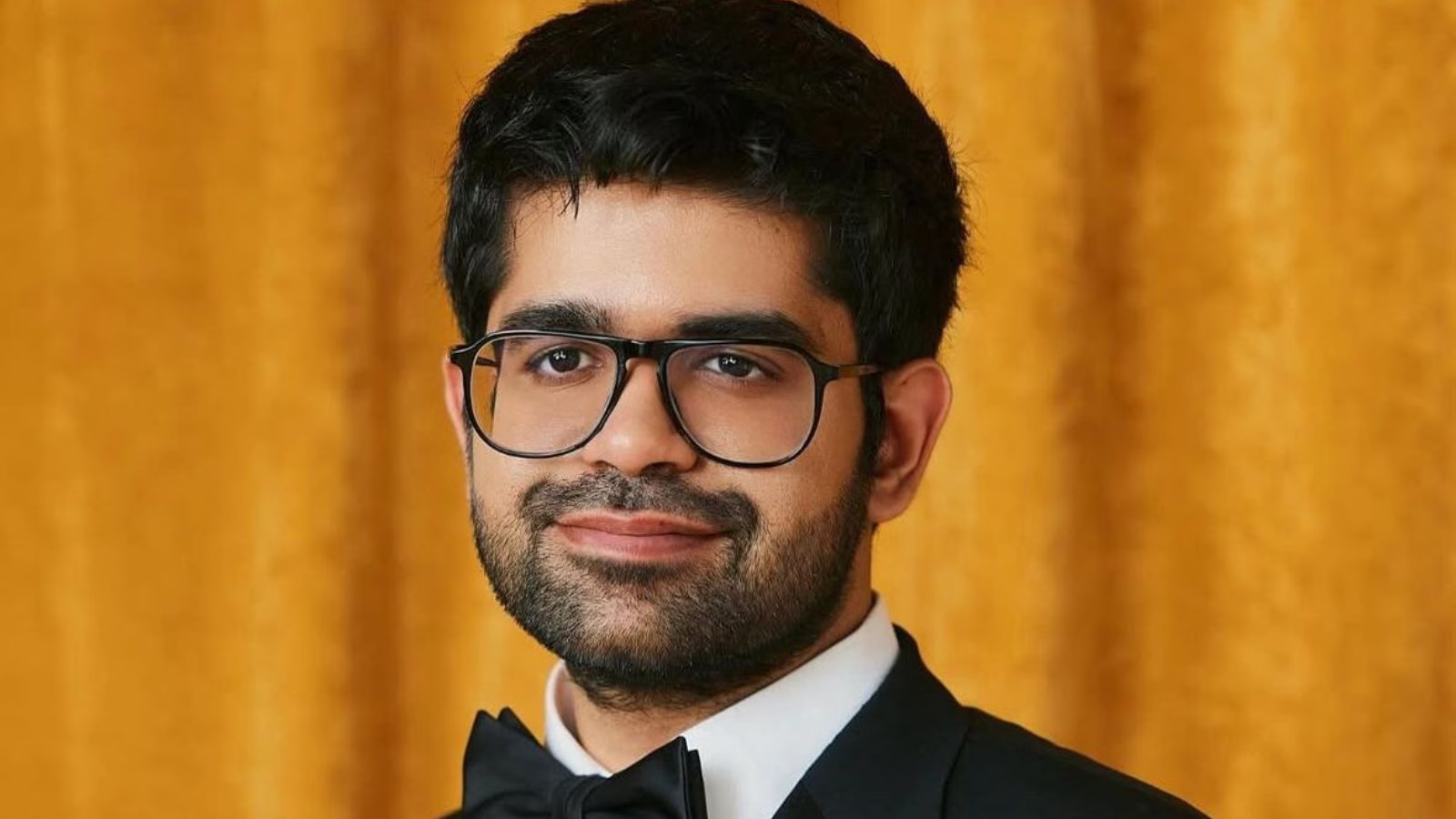
Kishore Biyani has you figured out. This much could be said of the man who owns the countrys largest and most successful retail chain over 1,000 outlets,16 million sq ft of retail space. The man who,in the initial years of Big Bazaars growth,would hang out in his stores,watching people,which racks they stopped by with overladen trolleys,which Buy One,Get Three offer they fell for. The man who takes one look at me in my workaday clothes and says,You are a minimalist consumer. No make-up,little jewellery,discreet. The kind that make any marketers job difficult.
The 49-year-old is seated on a big white sofa,dressed simply in a white shirt with burgundy stripes and black trousers. He hardly looks the retail czar. But he says,I love to shop. Its a gratifying experience. In fact,I have always spent more than what I earned on shopping.
In the last financial year,220 million visitors walked into his stores Pantaloons,Big Bazaar,Food Bazaar,Home Town,Brand Factory and Fair Price with their earnings and 45 per cent left after making a purchase. In the same period,consumers in 80 cities and towns bought goods and services worth Rs 11,000 crore from the Future Group,Biyanis business house that includes his flagship enterprise,Pantaloon Retail,and subsidiaries in consumer finance,insurance,leisure and entertainment and brand development,among others. Around 2 million pieces of merchandise are sold every week at the fashion stores of the Future Group.
And its not sales or discounts that lure the consumers. Almost 80 per cent of the business,Biyani says,comes from merchandise sold in non-sale periods. Thirty-six electronics stores house more than 125 products of leading brands; and around 20 per cent of the total sales of around Rs1,000 crore come from his in-house brands such as Koryo and Sensei. The groups Gourmet Food Bazaar in Delhi offers consumers a choice of imported food items; and in small towns such as Malleswaram and Siliguri,Big Bazaar Family Centres cater to the ethnic and local food choices of the aam aadmi.
Biyanis retail journey is just over a decade old. The first Pantaloons store came up in Kolkata in 1997 across a retail space of 8,000 sq ft. Born into a family of fabric traders in Mumbai,Biyani says he was clear since his college days that he wanted to do something big. I was looking for a big canvas,a space that had infinite opportunity, he says. A trip to the UK in 1991 and a visit to Marks and Spencer made him realise that retail was his calling. Back home,the first set of economic reforms had rolled out. And with it began the discovery of the Indian middle-class consumer.
Biyani,too,sensed an opportunity. Till then,he had stumbled from one enterprise to another,largely the offshoots of his fathers local cloth business. He began making mens trousers under the Pantaloons label in the late Eighties,and wanted to expand the enterprise. Resources,though,were a big challenge. He went on to raise a little less than Rs 500 crore by listing Pantaloon Retail in 1991 on the bourses. In the following years,he tried to persuade a leading retailer to store his merchandise but was rebuffed. This partly led to his move from Mumbai to Kolkata,where he began work towards setting up his own retail outlet at a time when the action was in Delhi,Mumbai and Chennai. I wanted to first firm up my idea,and to make it a success before announcing it to the world, he says. Today,in less than 15 years,Pantaloon Retail is the largest retail company in the country.
Modern retail has been a tough nut to crack even for the most astute of entrepreneurs in India. It is estimated to be worth around 375 billion,but it is the preserve of millions of unorganised,neighbourhood kirana stores that account for 90 per cent of the sector. The biggest challenges for retail companies have been the lack of capital availability for expansion,retail rentals and the high cost of real estate, says Ramesh Srinivas,executive director of KPMG Advisory Services,a management consultancy. Besides,for a majority of consumers,retail outlets are still a leisure and amusement destination than places for serious buying.
Its a tough market to survive. During the 2008-09 slowdown,for example,even big players such as Reliance Retail,Aditya Birla Retail and Spencers had to scale down their expansion plans,and have since moved extremely cautiously. In the same period,the success story of Subhiksha Trading Services went bust.
Biyani,on the contrary,has moved at a break-neck pace 2009 was the exception. Observers credit his success to his habit of taking risks and defying conventional wisdom,but a closer look reveals that his accomplishments are rooted in convention.
While other retailers and marketers spent billions of rupees on market research,product engineering,sourcing and in giving their outlets an international appeal,Biyani decided to study Indias history and Indian consumers evolution. He hired experts from backgrounds in sociology,anthropology,psychology,arts and design and asked them to come up with ideas that will find least resistance with the culturally-rooted Indian consumer. His older daughter Ashni,who leads Future Ideas,a team of 12 people working on future innovations in retail,is trained in art and design. I decided against going to a business school because I agree with my fathers view that business education is best gained on the job. Those leading successful enterprises need to hone their ability to generate ideas. They have to have a sharper right brain, says Ashni.
Biyanis right-brained team includes managers educated at Ivy League colleges and trained with top global corporations. Most say it was Biyanis originality that made them join him. He truly believes in the power of thinking. He respects intellect and is genuinely stimulated by ideas, says Santosh Desai,MD of Future Brands,a company that manages the 21 brands owned by the group.
Damodar Mall,who joined the Future Group in 2004 after having spent close to a decade with Hindustan Unilever and later setting up DMart Stores,says that Biyanis strength is that his strategy is not led by statistics but his insights into the consumers mind. He has never been intimidated by the fact that the insights picked up from the ground arent validated by marketing theories or research data. He inspires people in his team to unlearn things picked up from textbooks, says Mall.
Biyani would also love you to junk the thought that consumerism/consumption is a western fad. Indians love to celebrate,rejoice and spend too,he says,but in less obvious ways. Bhog,sambhog are ideas that emanated from India. Our literature talks about economic growth through consumption. It is described as an activity that evokes positive emotions. The process to gratifying these emotions,however,needs to be charted carefully, he says.
Biyani reminds us that wooing consumers in a country of seven religions and more than 70 festivals is both a challenge and a opportunity. And he ensures that Future Group outlets cash in on the opportunities with sales on Independence Day,Raksha Bandhan,Pongal,Durga Puja,Diwali,New Year,Holi and other festivals.
He makes it seem easy,cracking the consumer code. Modern retails evolution in India has been slow because most retailers have confused it with international offerings. In this,they have tried to change the inherent consumption values and traits,and failed, says Biyani. At the end of the day,consumers tell us what they want. And he is listening.