


Tags:


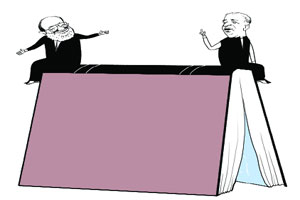
This is not the end of the book: A conversation between Jean-Claude Carriere amp; Umberto Eco
Curated by Jean-Philippe de Tonnac

Harvill Secker
Pages: 336
Rs 599
When two bibliophiles converse the must sometimes tends to lodge in your nostrils.
You are also beset with this eerie suspicion that right in front of your eyes,the subtext is trampling all over the text. When two European scholars,touching 80,set out self-consciously to display their scholarship,as in this book,all that is evident is the paternalistic posture of Western enlightenment which,even some 65 years after the rupture with colonial imperialism,has not been able to tune into other world knowledge systems. As the two divas pop their corn,it becomes stunningly evident that the cobs have turned sodden and seem squishy and sticky on the teeth.
And,there is yet another danger.
In his peripatetic wanderings as the quintessential voyager presaging European colonialism,Jonathan Swifts Gulliver has an encounter with the frighteningly intellectual Noddies of Laputa. These worthies,perennially preoccupied,drift and nod off between sentences and have to be flapped awake with bladders tied to the end of a stick,by a retinue of servants expressly employed for the purpose.
The present jumpy,staccato often showy conversation between two ageing studs of the European intellectual enterprise,has that same rambling structure with annoyingly recondite references from arcane Western bookshelves and the gratuitously glorified incunabula. They need to be flapped periodically to return to the assigned business at hand to discuss the place of books in the digital future,a role curator Jean-Philippe de Tonnac performs,but listlessly.
One of my personal favourites,Umberto Eco is a semiotician par excellence,a linguist,a master of inter-textual fiction,an expert on Joyce and Borges and owns a library,distributed over two palatial residences,of some 50,000 volumes of which perhaps 1,200 are precious antiques. Jean-Claude Carriere,equipped with some 40,000 tomes on his shelves,with some 2,000 special early editions,is a celebrated collaborator with filmmakers like Bunuel,Godard,Michael Haneke and Nagisa Oshima and is more familiar in India as the playwright of Peter Brooks nine-hour-long Mahabharata.
Interesting as it might be,the whole conversation project is a fuzzy enterprise and redeemed merely by the individual idiosyncrasies of the protagonists. Of course,the recordings conducted over several evenings at many locations,are propped with quotable quotes. Eco: I dont show my collection to many people. A book collection is a solitary,masturbatory kind of phenomenon8230; Carriere: How do we decide which books to put next to each other? Why do we arrange our books in this or that order? Levi-Strauss said that cultures are only alive to the extent that they are in contact with other cultures. A solitary culture is no culture at all. Carriere: A large part of what we know of the past comes from half-wits,fools and people with a grudge. Eco: We are the first era in any civilisation to have so many good bookshops.
Both scholars are canny trawlers in the antique books market in particular the incunabula. The incunabula meaning the cradle is a term ascribed to all the books published from the time the 42-page Gutenberg Bible was printed in 1452-55 and the midnight of December 31,1500. These have become highly sought-after trophies some of which have to be cleverly unearthed with global tracers and some which simply fall in the lap of the intrepid or lucky rummager on urban pavements. In the spirit of the true collector,both writers find their excitement in the hunt and acquisition,rather than in the eventual need to actually read what they now possess.
On the way,they pause to reflect on the considerable amount of material that might have been lost to fires,accidents,theft,vandalism or sheer idiocy. This,inevitably,leads to a conversation on the theme of filtering or selection in culture and the role of collective memory. Memory,as enshrined in books,thus becomes a dialogue with the past. Yet,it also contributes to a distortion of the past through prejudice or stupidity of transmission.
While this might be true of the past,the two polymaths also find the structural shadow of that past weighing over our own digital times. Being equally techno-savvy,they are acutely aware of the frailty of contemporary media formats and the tyranny of speed which contributes to rapid loss of cultural heritage. Having headed the famous La Femis film institute in France and having dealt with both analogue and digital media,Carriere is emphatic that there is nothing more ephemeral than long-term media formats. For each of them,the Internet represents a sieve of unverifiable collective memory. Eco,for example,is particularly concerned by the manner in which online editing of his own manuscripts leaves no trail of changes he makes in various drafts of his work. So,while the old method enabled several drafts and a final version which could be chronologically verified,the online process in fact creates phantom versions. This is a contemporary predicament that the editorial desk of any media house will immediately identify with.
The upshot of all this is that both writers are sanguine about the future of the book and are convinced that neither the book nor the reading habit is in anyway immediately threatened.
My specific problem with these two giant minds is that they both unwittingly retain and exhibit their Euro-centric prejudices. Try explaining concept to an Indian, scoffs Carriere. Rushdie survived protected by Western intellectuals, gushes Eco. One feels like flapping them with the bladder and making them recite Kabir: Pothi padh padh jag mua,pandit bhayo na koy8230;.


