


Tags:


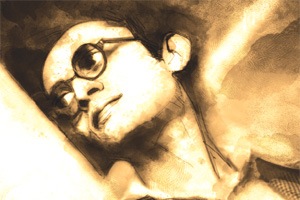
On Saadat Hasan Mantos birth centenary,falling on May 11,a look at the maverick widely regarded as one of the greatest short story writers of the subcontinent. As a writer,he revealed societal ills and hypocrisy without losing faith in the residual goodness in human beings.
Hailed as the greatest Urdu short story writer,Saadat Hasan Manto 1912-1955 defies facile categorisations,spatial,temporal or ideological. Fiercely independent minded,he sneered at those who called him a progressive and was disdainful of the mandarins of the colonial and post-colonial states who routinely charged him with obscenity. Saadat Hasan Manto is a human being and human beings ought to be progressive,he told a group of students at Bombays Jogeshwari College in 1944. By calling him progressive his detractors did not describe him so much as prove that they were not progressive and did not wish to progress. Progress for Manto meant self-improvement in all spheres of life and he exhorted the students to strive to reach their ideals. Amidst the celebrations,readings,theatrical performances and literary appraisals underway on the occasion of Mantos birth centenary in 2012,it is pertinent to ask whether Saadat Hasan achieved some of the ideals he set out for himself during a short but productive lifetime spanning just 42 years,eight months and four days.


Despite his exposure to international literature,Manto was shaped as a writer by political and literary developments in the subcontinent. He started his literary career at a time when literary circles in India were abuzz with controversy over the perceived transgressions of a new generation of writers. Influenced by transnational,anticolonial themes and communist thinking,they defied social norms by taking up issues deemed indecent for public discussion. In 1936,the pro-Communist,anticolonial Progressive Writers Association PWA proclaimed its establishment with aplomb. Committed to uncovering social injustices and moral hypocrisies that posed a barrier to their goal of equality,the progressives were anathema to the conservative old guard of writers and their influential supporters. Though never a formal member of the PWA,Manto became associated in public perception with the progressive writers,some of whom were his personal friends,notably Krishan Chander,Rajinder Singh Bedi,and Ahmed Nadeem Qasimi. His break with the progressive writers in the aftermath of Partition overlapped with obscenity charges brought against him by the post-colonial Pakistani state. This confirmed his reputation as a firebrand who could brook no labels and limitations,but also made it more difficult to impartially assess his literary legacy across the 1947 divide.
A maverick with a unique streak,Manto belongs to an illustrious genre of writers from the colonised world whose universalist aspirations and cosmopolitan attitudes were informed by regional languages,literatures and cultures. He wrote about ordinary people with telling empathy. His brand of cosmopolitan humanism was both regional and global. If he learnt the essentials of the literary craft by translating French and Russian literature from English to Urdu in his youth,Mantos modernity was shaped by a world of colonial difference and the welter of internal differentiations accentuated by the presence of alien rule. Few writers were as deft as Manto in uncovering the everyday cosmopolitanism that transcended those differences. The sheer audacity with which he took to writing about marginal and discarded elements in society prostitutes,pimps and criminals to expose the low-lying morality of the high and mighty shocked his readers,earning him a volley of brickbats but also some kudos. Denying that he wrote pornography,Manto argued that the flaws in his writing were the flaws of the times. He was not a provocateur. How could he strip the blouse off society when it was stark naked to begin with? What he did not do was adorn society with clothes,which was the task of a tailor,not a writer. People called him a black pen when instead of writing on a black slate with a black pen,all he did was use white chalk to bring out the blackness of the board. It followed that those who found his writings distasteful found living in the real world distasteful.
For a writer widely remembered for daring to ask whether he was a better storyteller than god,Manto in a moment of humility admitted to being a lesser storyteller than god,noting that it was his lowliness that made him write. The creator of literary gems like Toba Tek Singh,Hatak Insult,Bu Odour Nia Qanoon The New Constitution and Thanda Gosht Cold Flesh was no lowly storyteller. He weathered the frustrations of a disrupted career as a scriptwriter in the Bombay film industry,and overcame disappointments at the lack of opportunities in Pakistan to write some of his best stories. Manto never found his place in his adopted homeland. Except for sporadic moments,there has been a virtual state censorship in Pakistan where his literary corpus remains anathema to the doctors of state controlled moral health. In India where the Urdu language became a victim of Partition,there is a studied official indifference towards a writer who opted for the other side. Despite the lack of state sponsorship,Mantos works continue to be widely published,discussed and read across the subcontinent. The ranks of his admirers have been growing in recent years. His bold choice of themes and sensitive depiction of the violence unleashed in 1947 makes him indispensable to any discussion of Partition that takes account of the human dimension. Indications are that Manto will only grow in stature as his life and work become more readily available,not just in Urdu and English but also in the subcontinents other regional languages. The interest generated by the theatrical productions of Mantos work in India by Naseeruddin Shah is encouraging theatre groups in Pakistan to follow suit.
Manto is rapidly acquiring an enthusiastic transnational following. With the internet making his writings available to a larger readership,the trend will only grow. His writings on social duplicity,womens sexual exploitation and prostitution,criminality as a product of external ills or violence mistakenly attributed to religious passions have a perennial relevance. If Saadat Hasan were living today,Manto would have been among the practitioners of a literature reflecting the multifaceted social and political ills of our own distressing and disorientating times. If there were one theme on which he would have surely wielded his pen,it is the pressing need to defuse tensions between Pakistan and India. Manto would have decried the lack of empathy between the two neighbours,and the corresponding failure to realise that what they hate so intensely about each other also resides within them,a point poignantly conveyed in his post-Partition story Yazid.
A writer whose relevance transcends spatial and temporal boundaries,Manto would have written with renewed vigour on the tragic follies of nuclearisation as he did in his humorous piece Imaan-o-Iqaan Peace and Certainty. Structured in the form of radio broadcasts,the story unravels with the chilling announcement by the United Nations Security Council in an emergency session at Lake Success that the US and the Soviet Union had ended the Cold War after agreeing to a contest to prove which of the two had the greater capacity to wreak destruction. After targeting their respective nuclear devices at each other,the instinct for survival leads the two superpowers to see sense. Sparing each other,they decide to redirect their airborne weapons to another part of the world. The ill-fated region where the bombs are headed is none other than the bitterly divided subcontinent! Manto ends the piece mocking the prayer services organised by both states along with the more pragmatic digging of trenches,and questions their faith in god.
With the Cold War long over,the two nuclearised neighbours are finding it hard to shrug off its deadening legacies to rustle up the political will to arrive at a historic compromise. Manto,the humanist and pacifist,would have been in the vanguard of those trying to persuade the leaders of India and Pakistan to rectify past mistakes by arriving at a mutual accommodation of their differences. With his uncanny ability to step out of his comfort zone and see things from different perspectives,Mantos literary oeuvre is an overture to that elusive peace. This may partially explain why his admirers in both Pakistan and India will commemorate Mantos birth centenary year without much statist fanfare.
Ayesha Jalal is Mary Richardson Professor,Tufts University,Boston and author of The Pity of Partition: Manto as Witness to History,Princeton University Press,forthcoming


