


Tags:


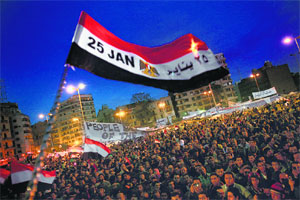
The military on Thursday declared on state television that it would take measures to maintain the homeland and the achievements and aspirations of the great people of Egypt and meet the demands of the protesters who have insisted on ending Hosni Mubaraks 30-year rule.
Amid the declaration,some in the crowd held up their hands in V-for-victory signs,shouting the people want the end of the regime and Allahu Akbar, or God is great, a victory cry used by secular and religious people alike.

The moves marked a decisive turn in an uprising that has brought hundreds of thousands into the streets in the most sweeping revolt in the countrys history.
Many amongst the protesters were born roughly around the time that Mubarak first came to power,most earned degrees from their countrys top universities and all have spent their adult lives bridling at the restrictions of the Egyptian police state some undergoing repeated arrests and torture for the cause.
They are the young professionals,mostly doctors and lawyers,who touched off and then guided the revolt shaking Egypt,members of the Facebook generation who have remained mostly faceless very deliberately so,given the threat of arrest or abduction by the secret police.
Now,however,as the Egyptian government has sought to splinter their movement by claiming that officials were negotiating with some of its leaders,they have stepped forward publicly for the first time to describe their hidden role.
There were only about 15 of them,including Wael Ghonim,a Google executive who was detained for 12 days but emerged this week as the movements most potent spokesman.
Yet they brought a sophistication and professionalism to their cause exploiting the anonymity of the Internet to elude the secret police,planting false rumours to fool police spies,staging field tests in Cairo slums before laying out their battle plans,then planning a weekly protest schedule to save their firepower that helps explain the surprising resilience of the uprising they began.
In the process many have formed some unusual bonds that reflect the singularly nonideological character of the Egyptian youth revolt,which encompasses liberals,socialists and members of the Muslim Brotherhood. I like the Brotherhood most,and they like me, said Sally Moore,a 32-year-old psychiatrist,a Coptic Christian and an avowed leftist and feminist of mixed Irish-Egyptian roots. They always have a hidden agenda,we know,and you never know when power comes how they will behave. But they are very good with organising,they are calling for a civil state just like everyone else,so let them have a political party just like everyone else they will not win more than 10 percent,I think.
Many in the circle,in fact,met during their university days. Islam Lotfi,a lawyer who is a leader of the Muslim Brotherhood Youth,said his group used to enlist others from the tiny leftist parties to stand with them in calling for civil liberties,to make their cause seem more universal. Many are now allies in the revolt,including Zyad el-Elaimy,a 30-year-old lawyer who was then the leader of a communist group.
Elaimy,who was imprisoned four times and suffered multiple broken limbs from torture for his political work,now works as an assistant to Mohamed ElBaradei,who won a Nobel Peace Prize for his work with the International Atomic Energy Agency. In turn,his group built ties to other young organisers like Moore.
The seeds of the revolt were planted around the time of the uprising in Tunisia,when Walid Rachid,27,a liaison from an online group called the April 6 Movement,sent a note to the anonymous administrator of an anti-torture Facebook page asking for marketing help with a day of protest on January 25,Rachid recalled. He wondered why the administrator would communicate only by Google instant message. In fact,it was someone he already knew: Ghonim,the Google executive.
The day of the protest,the group tried a feint to throw off the police. The organisers let it be known that they intended to gather at a mosque in an upscale neighborhood in Cairo,and the police gathered there in force. But the organisers set out instead for a poor neighborhood nearby, Elaimy recalled.
In signs of a generation gap echoed across Egypt,the young people acknowledged some frustration with their elders in the opposition parties. Simply,they are part of the system,part of the regime, Lotfi said. Mubarak was able to tame them.
Even so,he said,having members of the Muslim Brotherhood in the square proved to be a strategic asset because as participants in an illegal,secret society,they are by nature organised.
That organisation proved crucial a few days later when the protesters quickly formed a kind of assembly line to defend against an onslaught of rocks and firebombs from an army of Mubarak loyalists. One group used steel bars to break up pavement into stones,another relayed the rocks to the front and the third manned the barricades.
When people have been killed,from time to time you feel guilty, Lotfi said. But after the war that night,we felt more and more that our country deserves our sacrifice.
A few days later,seven members of the group were abducted by the police after leaving a meeting at ElBaradeis house and detained for three days.DAVID D KIRKPATRICK


