


Tags:


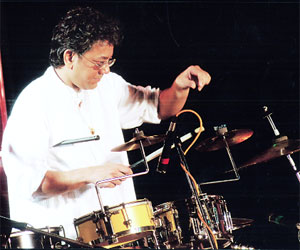
He is proud of his lineage and is always exploring new vistas of percussion. Taufiq Qureshi,who has hit the right notes in his new projects,strikes up a conversational rhythm with Screen.
Your new album,Ta-Dhaa,has a curious name.
The name represents the sound or the syllables of the tabla. It was the way my father Ustad Allahrakha would play the tabla at the end of every performance 8211; the notes would soar and there would be a sudden thumping climax with ta-dhaa,a resonant note that kept ringing in the ears. It was an expression of high energy that I can never forget,neither the sound nor Abbajis facial expression at that time.


I would first like to say that this is not the conventional way one looks at high energy in music 8211; this is not about fast or loud music that has to be very pulsating. Let me give you the example of a modern elevator 8211; its silent,smooth but the energy is so high that you reach your floor in half the time. Like silence too can be an expression of high energy sometimes. Or a gentle alaap can have it too.
In my album,I sense this expression of high energy at various points. In addition,the sound makes for a very catchy and intriguing title for an album.
What is the concept of this album?
There is no concept in the conventional sense. But there is variety and ta-dhaa is about my expression of things. There are nine pieces this time. The first track,Tana dere na tana,is an original composition by Abbaji. There is a very interesting story behind it. It was in 1994 that he was singing it on his harmonium at home and I recorded him on a simple home music system. Thanks to technology today,I could play around with it,so I cleaned up the recording and boosted it,added tabla solos to match,got the famous Ganesh Rajagopalan of Ganesh Kumaresh to play the violins and even got Bela Shende to match Abbajis voice. The net result is a fascinating track that is also pulsating.
What about the other tracks,or pieces as you term them?
The piece Dhati is sung by Vijay Prakash and me. Here there is no musical instrument,with each instrumental sound produced vocally by us. This is known in Western classical music as Accapella which literally means in the manner of the chapel in Italian. We have made this track very groovy too. Then I have a very ghazal gaayaki-studded mellow but rhythmic number by Roopkumar Rathod and a slow,very 60s and 70s Hindi film song-like melody written,composed and sung by my wife Geetika. This ones purely nostalgic and I have avoided a contemporary flavour because Geetika and I are both die-hard fans of the music of that era. I have also composed Maha-Folk to celebrate Maharashtra and its heady rhythms,which are highly energetic. I have given this piece a very jazzy kind of treatment and even got a brass band from Jaipur to give it a shaadi-like feel. The last track is a duet between my elder brother Zakir Hussainbhai and me.
In your last album Rhy-Dhun,you even used cans and other metallic scrap to create percussive sounds. Have you done something like that here?
Yes,I have done that in one track.
What took you eleven years to come out with a solo album?
I cannot churn out albums for the sake of doing them. With my lineage,there has to be substance. Very importantly,I must feel from within that I must do something. Even in this case,I have been working on the album since 2009. And essentially I am a live performer.
Who are the other artistes that are a part of Ta-Dhaa?
Ranjit Barot,Niladri Kumar and Sridhar Parthasarthy are also a part of the album.
Your father was the first in his family to go into music.
Smiles He was! In our family,every one was either a farmer or in the Army. There was no way he would go into either profession,so he ran away to my chachas house in Lahore from our village,telling him that he wanted to work there. But the real reason was that he wanted to meet the renowned Miya Kader Bux and learn music! After him,my brother Zakir followed in the profession,and so my mother decreed that the younger son 8211; me 8211; would become something else and did not let me learn music.
So how and when did you begin to learn?
The environment in my house was replete with the tabla and music. My father had observed that my hands would move in rhythmic fashion as if I was playing some tabla in the air. Yeh haath pair to maarta hi hai,he told my mother,saying that he was sure that I would go only into music. Finally,I think I was 11 when he began training me. Now with my wife Geetika also being a musician,the lineage will continue with my son Shikhar,who is 14 and plays the tabla with me.
You are also launching your own music label with this album.
Yes,along with my partner,Shivprasad Tendulkar. The concept is that there is too much splitting of music into genres today 8211; even the so-called Sufi Music is split into Sufi Pop,Sufi Rock and so on. But where is the need to split music like this? Someone said that music is only divided into good and bad music,but I subscribe to Trilok Gurtus conviction that music is always good,but sometimes it is the musician who is bad. As Abbaji would always say,Whatever be the kind of music,uss mein rooh-daari honi chahiye 8211; it should touch your soul. My album,for example,has so many so-called genres in it. So Ta-Dhaa Music 8211; yes,I have given my label the same name 8211; has been conceived to encourage every musician who believes in doing assorted things. When I was judging a television show,I was amazed at the talent that was there in Maharashtra itself. There was this man who was playing the sambal like the tabla and another brilliant jal-tarang player. I have even used an artiste or two from these places in my album.
How do you separate your pure classical and fusion work?
By sticking to either of them only according to where I am performing. But I must confess that my classical roots do come into my fusion. A 90-minute DVD of mine will be out next month where I am playing the West African instrument djembe just like the tabla. In fusion,therefore,only the instruments change,but my roots remain!
Otherwise,how would you say Indian music is different from Western music?
Western music is free-flying,and they can play around in scales and jump from a C-Minor to D-Major in one track. We Indian musicians do a lot of spontaneous improvisations but stick to the structure and parameters of a raag. Western musicians are unable to do complex rhythms and therefore bow down to the intricacies of our classical music.
Your father was one of the earliest Indian classical virtuosos who popularised our music abroad.
Yes,Pandit Ravi Shanker,Ustad Vilayat Khan and Abbaji built a great respect for our music there. When one of their biggest musicians,Mickey Hart,watched Abbaji perform with Panditji,he came backstage after the concert,took my fathers hand and examined it,saying Where are the machines,man? He had thought that there were some tiny hidden machines that made my father do all those intricacies! But the essence is that when you study most of the raags,you cover all their scales,which are limited vis-à-vis the hundreds of raags that exist.
The whole aim of my fusion is to expose our music to the West,where the musicians are moving towards our music. We therefore need to package our music better to them. But we ourselves are,sadly,moving West-wards. Indian instruments are also suffering because of this 8211; we hardly hear swarlin or jal-tarang today and less than a handful of our instruments are having budding exponents.
Coming to films 8211; you said that you are a die-hard fan of the music of the 60s and 70s,so how involved have you been in movies professionally?
I have composed largely background scores for Train To Pakistan,Tahaan and Renuka Shahane-Ranas Marathi film Rita. My brother has also been involved sporadically,but Abbaji,under the name of A.R.Qureshi,had composed music for over 50 films,including the Ashok Kumar-Raj Kapoor film Bewafa and Punjabi films like Madari and Jagga.
Why have you not composed songs in films too?
Frankly,no one has asked me to do so yet! But again,I do not know whether I will have the patience to go through the needs of making music for a film! I am happy being a musician for other composers. From Rajesh Roshan to Nadeem-Shravan,Jatin-Lalit and now Pritam,Sajid-Wajid,Shankar-Ehsaan-Loy and others,I have played for most leading composers. Partner,Saawariya,Dhoom:2,Bhool Bhulaiya and Action Replayy are among films that had my contributions to the rhythms of specific songs. Out of respect,the composers all give me a brief and after that I get a free hand to make the music pieces.
rajiv.vijayakarexpressindia.com


