4 min read

Journalism of Courage



With the Railways defending its signal system,claiming it was foolproof and highly unlikely that any glitch in the system led to the collision near Mathura,the spotlight is now on an escape by an undertrial on board the Mewar Express that may have been the trigger for the chain of events.
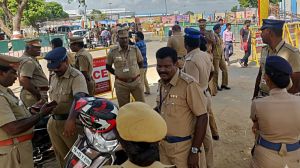
The Delhi-bound Mewar Express,before it was hit by the Goa Express which was also headed for Delhi,had halted on the tracks near Mathura because of chain-pulling,according to Mathura SSP B D Paulson. It is yet to be established who pulled the chain to stop the train. But three constables from Kota came to my office around 3 pm with a request to lodge an FIR on the escape of a criminal they were escorting to Delhi. They were travelling by the Mewar Express. The Highway police station has been asked to lodge an FIR, Paulson said.
The constables were escorting one Sajid alias Munna who had to be produced in a Tis Hazari court in Delhi. They told the SSP that Sajid escaped in the confusion after the accident. On why it took them so long to report the escape,the constables said they had gone to the police station immediately but the entire staff was busy at the accident site.
But the constables were unable to explain how Sajid,who was handcuffed and tied with a rope,managed to free himself and bolt. Kota IG Rajiv Dasot said constables Virendra Singh,Ashok and Bahadur Singh have been placed under suspension for negligence. All three are from the Kota city police lines. We will question them when they get back, Dasot said.
It is suspected that Sajids escape may have led to the chain-pulling that made the Mewar Express halt. The Goa Express was trailing it,six minutes separating them. Railway officials suspect that the Goa Express engine driver overshot the signal which could not have been green given that the Mewar Express had halted mid-section.
The section in which the accident took place has Automatic Block Signalling ABS which is a well-established,foolproof system and used worldwide. This system ensures that if a train stops mid-section,it is protected by the signal behind it, said Sri Prakash,Railway Boards Member Traffic.
With track circuits in place,ABS ensures that once a train stops in the middle of a block,the three signals behind it immediately turn red,double-yellow and yellow red for Stop,yellow for Caution and double-yellow for Slow down.
Since each of these signals are at least a kilometre apart,a train coming on a track where another train is stationary has ample time to slow down. The driver of the rear train gets adequate warning in such an eventuality, Sri Prakash said. He,however,declined to fix the blame on the Goa Express driver,saying an inquiry by the Commissioner of Railway Safety will establish the cause of the accident.
R K Chaturvedi,the Goa Express loco-pilot,has been working with the Railways for 20 years and is said to have an excellent track record.
With the fastest of trains in the Indian Railways not needing more than a kilometre to come to a complete halt,the Railways are looking at a scenario where the Goa Express could have jumped at least two signals given the fact the Mewar Express,that had halted for eight minutes after chain-pulling,had begun to move. This,said Railway Ministry sources,would be one of the key points in the inquiry.
On the possibility of these signals and the ABS system failing,officials maintained that the signals in an ABS system are fail-safe which means that even if the signal fails,it will automatically become red,ensuring that an incoming train gets a warning not enter a particular block section.
Work on installing the Anti Collision Device ACD it is a patented product of the Konkan Railways designed to prevent high-speed collision in mid-section,station areas and at level crossing gates across the rail network has been slow. Until now,the ACD system has been operationalised on only 1,736 km of the North Frontier Railway. The Railways plan to extend the system to another 1,700 km on Southern,South Central and South Western Railways in the next two years.