Journalism of Courage
 4 min read



My niece has e-mailed me some incredible facts about India that had, in turn, come from a friend who had done the good Samaritan act of relaying information that someone else, far down the line, had taken pains to collect. It couldn8217;t have arrived in a better lap. I have this passion for e-mail and its colossal power for the speedy dissemination of information.
Not satisfied with the hundreds I have already shared this information with though cyberspace, In intend to share it with many more through this column.
Some may dispute the facts, like, quot;India never invaded any country in the last 10,000 years of her history.quot; But when many cultures were nomadic forest-dwellers over 5,000 years ago, Indians established the Harappan culture in the Indus Valley. The world8217;s first university, established in Takshila in 700 BC, had 10,500 students from all over the world studying more than 60 subjects.
The university of Nalanda, dating from the 4th century BC, is acknowledged as one of the greatest achievements ofancient India in the field of education. And Sanskrit, through Latin, is accepted as the mother of all European languages. A 1987 report in Forbes magazine said Sanskrit was the most suitable language for computer software.
India contributed to the number system the numeral 0, innovated by Aryabhatta. Algebra, trigonometry and calculus originated here. The quadratic equation was solved by Sridharacharya in the 11th century. The Greeks and Romans contented themselves with rather small numbers, while Hindus the then inhabitants of the land of Sapta-Sindhu used units as big as 10 to the power of 53 with specific names as early as 5,000 BC, during the Vedic period.
Today, the largest unit in use is tera, or 10 to the power of 12. The solar year was calculated as 365.258756484 days by Bhaskaracharya in the 5th century, hundreds of years before the astronomer Smart. The value of pi was first calculated by Bodhayana, who also discovered the Pythagorean Theorem in the 6th century, long before the Europeanmathematicians. The place value system and the decimal system were developed in India in 100 BC.
Ayurveda is the oldest school of medicine, codified by Charaka 2,500 years ago. Sushruta, the father of surgery, conducted complicated procedures dealing with cataracts, artificial limbs, fractures, urinary stones, plastic surgery, caesarean section and brain surgery 2,600 years ago. The use of anesthesia was known in ancient India. Over 125 surgical instruments were in use.
A century-old suspicion that the pioneer of wireless communication was Prof. Jagadish Bose and not Marconi now stands proven. And Nature has reported that a Danish physicist and his team in the US have slowed down light from the speed of 300 km per second to 71 km per hour using the Bose-Einstein Condensate to stall it in its path.
The art of navigation was born in the river Sindh 6,000 years ago. The very word navigation8217; is derived from the Sanskrit naugatih. Although modern images of India show poverty and underdevelopment, it wasthe richest country on earth until the arrival of the British. Christopher Columbus was attracted by India8217;s wealth. According to the Gemological Institute of America, until 1896 India was the world8217;s only source of diamonds. The earliest dam for irrigation was built in Saurashtra. According to the Saka King Rudradaman I, a beautiful lake called Sudarshana was constructed on the hills of Raivataka in Chandragupta Maurya8217;s time.
There is no doubt that chess is an Indian invention, in the form of Shatranj or Ashta Pada. Polo originated in Manipur. The first man on Everest was Tenzing Norgay, not Sir Edmund Hillary. And the forensic use of fingerprints was discovered and developed in Calcutta.With all this potential, what is it that inhibits the Indian from excelling today? Isn8217;t it time we arrested the downward slide? Or are we past caring?

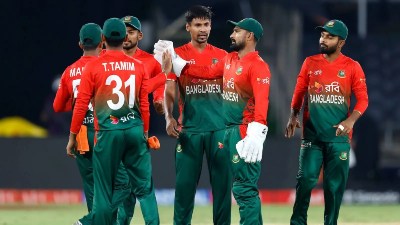
Bangladesh have brought back pacer Taskin Ahmed and dropped Jaker Ali in their squad for the 2026 T20 World Cup. Litton Das will be leading the side and senior pacer Mustafizur Rahman, who has been caught in the middle of a storm after being released by his Indian Premier League (IPL) side Kolkata Knight Riders (KKR), has also been included.