Journalism of Courage
 6 min read



Two years too late, Bangladeshis are finally going to the polls to elect a new government to run the country for the next five years. The elections that were to take place on January 22, 2007 are now all set to be held on December 29, 2008.
The elections will again be a face-off between the two archrivals: the Awami League AL led by Sheikh Hasina and the Bangladesh Nationalist Party BNP led by Khaleda Zia. Ever since the fall of Gen Ershad in 1991, these two parties have bitterly fought three elections with BNP winning in 1991 and 2001 and the AL in 1996. Opinion surveys give AL an edge and if the anti-incumbency tradition persists then it has a good chance of forming the next government.
Khaleda Zia has once again, as in 2001, allied herself with the fundamentalist Jamaat-e-Islami JI party and with two other smaller partners making her four-party alliance. Sheikh Hasina has, for the first time, formed an alliance with the former dictator and highly discredited General Hossain Mohammed Ershad8217;s Jatiya Party JP and some small left-leaning parties making the self-styled Grand Alliance.
The two alliances will vie for votes of 81 million-plus voters divided into 300 constituencies. The AL has conceded 48 seats to Ershad8217;s JP and the BNP has given 38 seats to JI in separate seat-sharing arrangements that have led to rebel party aspirants contesting as independents that may cost a few seats to them both.
Bangladesh has passed through a most unusual two years of caretaker government rule under an emergency law that curbed fundamental rights and brought the military to the very door-step of assuming power. Though a very significant influence, the army, to its credit, did not openly take control of the country, or suspend the constitution. It decided to work behind the scenes in aid of the caretaker government CTG with the declared intention of working towards a genuinely free and fair election, driving out corruption and reforming the confrontation politics that brought the emergency in the first place.
In terms of preparing for a free and fair election the CTG and the military can be credited with significant success, the most important of which has been the preparation of an electronic voters8217; list of more than 81 million. For the first time Bangladeshis will have a voters8217; list with an individual photograph and a digital national ID card. The list is fully computerised and capable of preventing duplication. The accompanying photograph will also prevent false voting, a phenomenon that caused claims of vote rigging in the past. Credit for this voters8217; list singularly belongs to the armed forces.
Led by an independent Election Commission, there have been significant amendments to the electoral laws, including party registration, disclosure of personal and financial information of candidates and provision for disqualifying them for false declarations. Strict campaign laws have prevented strident, provocative and religion-based electioneering, and have significantly reduced the open use of black money and extravagant election spending.
The campaign strategies of the two alliances mark a stark contrast. While the AL has given out a futuristic and programme-based manifesto titled 8220;Charter for Change8221; that many consider highly ambitious, the BNP has harped on the same old tune of Bangladesh8217;s sovereignty, independence and religion being under threat. Though its manifesto does also have economic and social programmes, its campaign thrust has so far been alarmist and negative.
India baiting has, by and large, been absent in the election so far as it was in 2001. Though references to the 8220;threat to sovereignty and independence8221;, the code words meant to point to India8217;s perceived domineering role, are being made by the BNP-led alliance, they have remained limited so far. But, they are counting on the so-called 8220;Islamic vote8221; with claims about Islam not being safe in the hands of the AL whose secularist tendencies are being depicted as a part of a hidden agenda to weaken Bangladesh8217;s Islamic heritage.
Interestingly, there are 32 per cent, or 26.1 million-plus, voters who will for vote for the first time. While the AL has dedicated its manifesto to the young and has mentioned some specific programmes for them, the BNP and its alliances have practically ignored them. If second-time voters are added to the above list, then it becomes clear that the elections this time round will be dominated by comparatively young voters, all of whom will have been born after the birth of Bangladesh, and a very large proportion of them after the assassinations of both Sheikh Mujibur Rahman and General Ziaur Rahman, the two men whose legacies dominate the politics of the two rival parties. It is an open question how much influence their respective memories will have on this group, especially in selecting the party they will vote for.
This time round 50 women candidates, the highest number ever, are directly contesting the elections. In addition there will 45 women MPs from reserved seats who will be indirectly elected by the parliament in its first seating. While women voters constitute nearly 50 per cent of registered voters, their issues continue to be neglected and neither alliance can be seen to make any special effort to woo them.
So far the election preparations and campaigning have been remarkably free of violence. Though rumours and newspaper reports of possible threats to Sheikh Hasina8217;s life persist, leading to significant curtailment of her election campaigning. This has forced her to resort to video conferencing on a limited scale. The recovery of a few grenades at some distance to one of Khaleda Zia8217;s meetings has also led to talks of threats to her life. In addition periodic discoveries of caches of homemade arms and explosives from various parts of the country and the activities of two militant groups, the Jama8217;atul Mujahideen Bangladesh and Harkatul Jihad, feed the fear of some last-minute violence.
The most significant and heartening lesson from the two years of emergency rule is that the people of Bangladesh prefer democracy, however flawed, and an elected government to rule them, however inept. This resounding reassertion for democracy will now have to be matched by a newly elected government that will have to deliver on the economic, social and political fronts. Will this election deliver such a government? The answer will have to wait, but several recent polls show that people believe that there will be significant improvement of our political culture in the future.
The writer is the editor-publisher of 8216;The Daily Star8217;, Dhaka
expressexpressindia.com

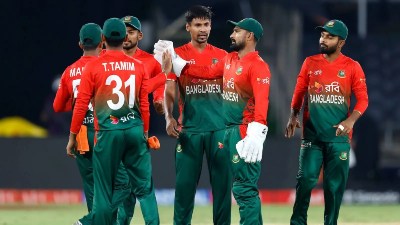
Bangladesh have brought back pacer Taskin Ahmed and dropped Jaker Ali in their squad for the 2026 T20 World Cup. Litton Das will be leading the side and senior pacer Mustafizur Rahman, who has been caught in the middle of a storm after being released by his Indian Premier League (IPL) side Kolkata Knight Riders (KKR), has also been included.