


Tags:


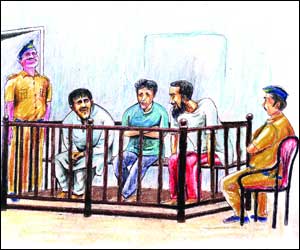
Outside the Mumbai Central prison on the busy Sane Guruji Marg,the show of strength is absolute. On half of the roads width thats blocked to traffic,Indo Tibetan Border Police ITBP personnel periodically march around the perimeter of the jail,some with automatic rifles,one with an incongruous grenade-launcher hoisted on his shoulder. Barely 10 metres from Mumbais crazed traffic and adjacent to a pavement on which are housed vada pav vendors,a corner restaurant doing brisk business,a newspaper vendor and sundry other little shops,the ITBP men are used to getting gawked at,but nobody asks any questions. Everybody already knows that the prison is the current address of the man labelled as somebody who has united the financial capital in hate and anger,Ajmal Amir Kasab,21.
Inside,in a special court conducting what is arguably the countrys most significant trial right now,Kasab is having a new antic.


This is Kasabs daily break from solitary confinement,in what was once Barrack Number 1 of the prison,now a special court adjacent to the already operational TADA court where the 1993 serial bomb blasts trial was held. During that trial,policemen off bandobast duty would catch their cat naps here.
The room,while better appointed than many courtrooms in Mumbais lower courts,with its six 1.5-tonne split airconditioners,four fire extinguishers and seating for up to 100,cant quite shrug off its prison-barrack genesis. The two windows are barred with iron,the wall plaster is peeling and the dank smell is not unlike Mumbais other crowded spaces,prompting a spritz of jasmine-scented room-freshener during proceedings.
At the front of the 15 ft-by-50 ft room is the judges podium,his white-backed chair,his laptop,a microphone and a stenographers desktop computer. Alongside 20 chairs for lawyers,investigating officials and witnesses are,on either side,the dock with its simple bench minus a backrest for the three accused and the wooden witness stand,a microphone perched atop. Ten rows of benches follow,occupied by journalists and bored policemen waiting to escort the accused in and out of court.
Inside the dock,seating arrangements are unchanging: Kasab sits on one end,closer to the door they are led in through,co-accused Fahim Ansari to his left and Sabahuddin Ahmed next. The dock is barely 5 ft by 3 ft,but is guarded by no less than four unblinking policemen,two seated and two standing erect,eyes sometimes wandering,but never for too long. They are unarmed,a tweaking of security arrangements following fears that Kasab could pounce on a policemans weapon and open fire in court.
The gunmans actions notwithstanding,in court he actually appears to share a comfortable rapport with all,springing to his feet respectfully every time Judge Tahaliyani addresses him,smiling and laughing easily and often without apparent reason,expressionless when witness after witness points him out as one of the assailants on Mumbais long night of terror.
A butka fellow and a lambu fellow, may be words that wont make it,translated,to any courts records anywhere in the world. But clearly,witnesses in the 26/11 trial know what to say: They are not to know him as Ajmal Kasab from the newspapers,they are to identify him as they saw him that day,over eight months ago,to avoid their identification of him being discredited in cross-examination. Dozens of the 147 witnesses who have deposed till now have unfailingly followed the Mumbai Polices lead in referring to Kasab as ek butka,a short guy. Lambu,of course,is his accomplice,Abu Ismail,killed in the encounter at Girgaum Chowpatty.
So,Police Naik Suresh Kadam says he saw a butka and a lambu jump the wall of the Cama amp; Albless Hospital around 11.45 p.m. on 26 /11. He saw the duo later drive out of Rang Bhavan lane in a police Qualis,the lambu at the wheel and firing with one hand wielding his automatic weapon. Government vehicle driver Maruti Madhavrao Phad,32,also says he saw a butka and a lambu shoot at him as he tried to drive a Honda City out of Rang Bhavan lane that night. And it is the butka who later tries to open Phads car door,but is foiled by the central locking.
When one witness,restaurateur Sharan Ramesh Arasa,28,breaks convention and calls him a naata aadmi,the judge actually has to explain to defence lawyer Abbas Kazmi that they are synonymous.
It is comic despite all the gravitas of the trial and incongruent with the weightiness of the moment and with the unprecedented security around the courtroom,including Rs 2-crore reinforcements to the walls. In fact,the hearings are anything but gruelling on many days,with the post-lunch session almost always wrapped up in a couple of hours and some moments bordering on the bizarre.
Light moments and casual banter are routine. Youre growing thinner every day, Judge Tahaliyani remarks to Senior Inspector Ramesh Mahale on Friday,remembering during the course of a discussion on staying fit a pot-bellied police witness who deposed in the pre-lunch session on Wednesday. His belly had a freedom of its own, the judge says,as titters go through the court. And then I told myself,one should not look at the bellies of our policemen, he says,adding to Special Public Prosecutor Ujjwal Nikam that rules should be introduced to send unfit policemen on compulsory leave.
On Friday,as a handwriting expert concludes that notings on a set of maps were written by Fahim Ansari,his lawyer is absent. Earlier,a discussion on the comparative merits of upvaas fasting during the holy month of Shravan and roza during Ramzan sees the three Muslim accused looking on nonplussed. Fahims wife is almost a daily fixture in court,in complete naqaab,and their eye contact in court is now the stuff of courtroom legend among reporters.
When document and handwriting expert Jayant Ahir introduces himself and adds that he holds a BSc Honours from Pune University,some time is spent debating whether an honours programme refers to a second degree or a distinction or a score over 60 per cent. As Nikam and the judge recollect their graduation percentages,defence lawyer Abbas Kazmi interjects,to some laughter around: But your lordship is your honour,sir.
On Monday,during the deposition of Police Naik Suresh Shantaram Kadam,40,the gaggle of reporters in the courtroom learn for the first time since 26 /11 that there were policemen who had actually seen Kasab and his accomplice walk into Rang Bhavan lane,firing at a white Honda City with a red beacon as they walked in. Minutes later,three top city policemen would lose their lives inside that lane. When they jumped the wall of Cama Hospital and walked on the footpath,somebody in our group said they might be photographers, says Naik. Kasab stifles his laughter but only until the judge responds: You saw an AK-47 and thought it was a photographer?
The mirth he sets off continues as journalists leave through whats usually referred to as the prisons back door. Two iron gates separated by about 8 feet of space are guarded by ITBP personnel. Both gates are never opened simultaneously. Somewhere inside,beyond another high stone wall,are lodged actor Shiney Ahuja,gangster-turned politician Arun Gawli,gangster Abu Salem and over 2,000 other undertrials.
For now,though,everyone has eyes only for the trial of Kasab and the accompanying drama.
Accused No. 1 Ajmal Amir Kasab is neither antihero nor supervillain. Instead,what strikes you about Kasab as he is marched into the dock by four policemen is his utter ordinariness. Nowhere is the bigotry on display,nor the icy glint in his eye caught by a camera from the office of a national daily on the night of 26/11. Instead,here is a surprisingly short man,barely visible behind the strapping men who stand guard around him,inches away,even as court proceedings continue.
Meet his eyes and he looks away,shifty-eyed on instinct,but continue looking and hes up to the challenge,gazing back,an equal.
He slouches,he smiles,he laughs,all without any evident prompting. He follows the proceedings or appears to switch off on whim,but watches intensely every time an eyewitness points him out. He doesnt understand Marathi,but there is enough Hindi and Englishhe knows a smatteringfor him to keep track of the goings-on. He also listens keenly when a witness is more clear or confident than most others,like IAS officer Bhushan Gagrani was in his short deposition.
He shares a curious rapport with Tahaliyani,who is neither too kindly to Accused No. 1 nor usually harsh. Is your health okay? No complaints? the judge asks him the day a morninger published a report about an alleged stomach ailment. Jee sir, he stands up and nods,nodding his head from side to side. Were you vomiting? the judge persists. On being told he had suffered a bout of indigestion earlier,Judge Tahaliyani responds: Baith jao,sab ko hota hai. Kasab,unshaven on most days,blushes and plonks down on the bench,looking at his bare feet and grinning.
Unlike the other two co-accused,Kasab appears in court in fresh clothes almost every day,a grey t-shirt with blue track pants one day,a grey full-sleeved sweatshirt and track pants the next,white kurta pyjamas on another day. As he entersunlike the other two accused,Kasab is marched in and out of court at top speedin what appears to be prison uniform one morning,defence lawyer Abbas Kazmi objects,saying its not correct for undertrials to be made to wear a prison uniform. But does he have an objection? the judge counters,explaining that officials are getting him whatever is available when he needs fresh clothes. Wide grin in place,he shakes his head at Kazmi,then looks up at the judge and says,Nahi sir.
But his widest grin is reserved for Special Public Prosecutor Ujjwal Nikam,whose words he follows carefully,sometimes gesturing towards the ever-animated top-notch prosecutor and laughing,apparently in appreciation of his style. Even the judge notices it,once remarking to Nikam: He keeps observing you,have you seen?
Nikam himself believes Kasab to be very clever.
Wednesday morning sees the first hearing in this trial after an early break on Monday,when Nikam has to leave early to be present to hear the verdict in another terror case,the Gateway and Zaveri Bazaar blasts case of 2003,in which too he was special public prosecutor. All three accused have been convicted. At lunchbreak,as he passes Kasab,they look at each other,Accused No. 1 and his possible nemesis. Both have the widest,cockiest grins an accused and a prosecutor could possibly ever share.


