3 min read

Journalism of Courage



A new phenomenon described as 8216;yo-yo subduction8217; could assist scientists to better comprehend the geological processes of mountain building,volcanoes and earthquakes formation.
According to findings of the Geologist Daniela Rubatto of Australian National University on subduction zones in a journal 8216;Nature Geoscience8217;,the place where earthquakes are generated has a more complex and chaotic behaviour than previously thought.8221;
Subduction happens when two tectonic plates are pushed together and one of the plates goes under the other. Most of the material that is pushed down is never seen again,but a small amount of it is pushed back up and helps form mountain belts.
The current wisdom is that there is a single 8216;conveyor belt8217; movement of the Earth8217;s crust down and then one coming back up.
According to ABC report,Rubatto said,her research suggests that the processes at subduction zones is more complex than this.
Rubatto and team have found that even as one plate is pushed down,pieces of crust break off at a depth of 20 to 100 kilometres,come up,and are then pushed back down again.
8220;This simple movement of a plate going down is much more complicated and has an internal chaotic movement,8221; she said adding 8220;This is yo-yo subduction8221;.
The evidence for yo-yo subduction came from the Italian Western Alps that are now 2000 metres above sea level.
Rubatto and his team used an ion probe known as the Anu Shrimp to analyse the age and chemical composition of minerals in rock called eclogite,which originally formed 80 kilometres below the surface.
8220;The composition of these minerals change with depth so if I know the composition of the minerals,I know the depth,8221; she said.
Using this relationship,the researchers worked out the depth of the minerals at different periods dating back 65 to 80 million years ago.
They found that during this period,the rocks moved at a rate of centimetres a year,down 100 kilometres,back up,and back down again.
8220;The rate of movement is more or less at the rate of the growth of your fingernail,8221; she added.
She said the research will help refine scientific models of subduction.
8220;Any model of subduction will eventually feed into understanding earthquake evolution and dynamics8230; and prediction,to some extent,8221; she added.

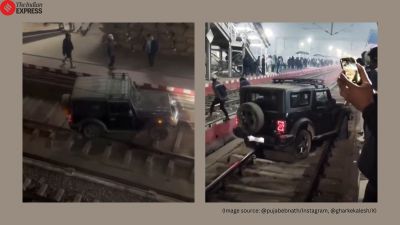
An alarming breach of safety norms was reported in Nagaland’s Dimapur late Tuesday, when a man drove his SUV into the railway tracks, triggering panic among bystanders and prompting swift action from authorities. The incident took place around 11.35 pm at Dimapur Railway Station, when the four-wheeler reportedly entered the tracks near the platform area.