Journalism of Courage
 4 min read



Mumbai is one of the world8217;s finest cosmopolitan cities. Its mix of diverse cultures and harmonious mingling of different communities makes it a unique metropolis. Mumbai8217;s glory cannot be attributed to any particular class or community but is a consequence of the combined industry and efforts of several citizens of our country.
The outlook of our founding fathers who included eminent Maharashtrians and the judicial philosophy of some great Maharashtrian judges of our Supreme Court 8212; Justices Gajendragadkar, Chandrachud, Tulzapurkar and Tarkunde 8212; was not parochial. They believed that 8220;the people of the several states must sink or swim together and that in the long run prosperity and salvation are in union and not division8221;. They did not subscribe to the obnoxious doctrine that would forcibly exclude fellow Indians from living and working in Maharashtra. If this doctrine is implemented the repercussions would be horrendous. Gujaratis cannot work and live in Rajasthan; Maharashtrian engineers, doctors, accountants and lawyers cannot practise in Uttar Pradesh or Bihar and so on. The national stream would inevitably be polluted.
It is argued that the success of Mumbai and Maharashtra has been achieved by the sweat of the toiling Maharashtrian masses. That is partly true. However, that is an iniquitous feature of the working of our economic system, which is detrimental to workers throughout India and is not confined to Maharashtra alone. The claim that Maharashtrian workers should have a better share of the cake, by way of labour welfare schemes, removal of slums, preference for Maharashtrians in employment, merits consideration. However, the blatant outburst of violence against non-Maharashtirans who have been living peacefully in the state and the threat to repeat the same with impunity is totally unacceptable. That is plain and simple goonda raj that cannot be justified on any score. It should be unequivocally condemned by all enlightened citizens, including leading Maharashtrians.
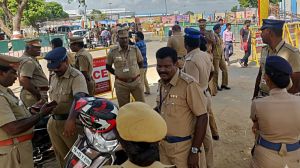
Swift and stringent action should have been taken against those who went on a rampage and indulged in violence. The dithering attitude of the law enforcement authorities, coupled with media hype, has enabled tin-pot politicians to emerge as folk-heroes with popular support, which is the real tragedy.
One incident is worth recounting. The US Supreme Court struck down the segregation policy in education which prevented black students from attending schools along with white pupils. Faubus Orval, governor of the southern state of Arkansas, was determined to defy the Supreme Court order and forcibly prevented black students from attending schools with the help of the local racist police and with the overwhelming approval of the racist southern population. The situation was volatile and General Eisenhower realised its gravity. He stood firm and flew federal troops to Arkansas and ensured the entry of black students in schools. That was courageous vindication of the rule of law. And that is urgently needed now in Maharashtra.
Absent colour discrimination
The governor of West Bengal, Gopalkrishna Gandhi, in his recent brilliant S. Ranganathan Memorial Lecture, deplored matrimonial ads for fair-coloured brides. He pointed out that for generations a bias has worked in India towards a fair complexion and was upset that Article 15 of our Constitution, which lists discriminations, has left out colour. Discrimination on ground of colour is prohibited in human rights instruments. It is most invidious because it subjects a person to humiliation and disadvantages on account of pigmentation of one8217;s skin, for which the person is not responsible. Before independence, discrimination on the basis of colour was specifically prohibited by Section 298 of the Government of India Act, 1935. Curiously, this provision was deleted and was not reenacted in Article 15 of the Constitution, which sets out the prohibited grounds of discrimination. During discussion on this article, Sardar Patel observed that such a provision was unnecessary because, according to him, in our country there are no colour preferences. Apparently, the Sardar had no time for reading matrimonial ads. It is unfortunate that the National Commission to Review the Working of the Constitution under the chairmanship of former Chief Justice M.N. Venkatachaliah, of which I was a member, omitted to make a recommendation about colour discrimination.