Journalism of Courage
 3 min read



The year was 1949. Along with my family, I had moved from Lahore to Delhi a couple of years earlier in the wake of Partition. After a brief stint as a part-time teacher in a primary school, I was fortunate enough to be hired by All India Radio AIR as a programme executive.
The first assignment in my new job was to produce programmes for children. Jawaharlal Nehru, the then prime minister, was famed for his fondness for children. His birthday fell on November 14 8212; a day that was later to be celebrated as Children8217;s Day in India. My boss and mentor suggested that on the eve of his birthday, we might try and get Nehru over for a live interface with children in our studios.
What at first seemed a Herculean task turned out surprisingly to be simple. No sooner had the invitation been sent out than pat came the response that the prime minister would be happy to accept. But there was a caveat: no senior official of AIR need be present during the event except for the producer of the programme. I remember the director general calling me to his office and wistfully remarking, 8220;He is going to be your baby!8221;
When Nehru arrived at the appointed time, immaculately attired, with his famous trademark red rose in the button-hole of his jacket and a spotless white cap, the atmosphere was surcharged with excitement. The director general received him at the gate and escorted him to the studio entrance. At that point, I took over.
Nehru squatted among the children just like one of them, and they chatted with him freely and uninhibitedly, addressing him as 8216;Chacha Nehru8217;. They asked him assorted, and at times, naughty questions about his childhood which he unabashedly answered. The chat went on air live and uncensored. Millions listened, glued to their radio sets. The programme is today a part of AIR8217;s archives.
The children had been warned to behave in an orderly manner, to speak only when one8217;s turn came, except when it came to applauding when everyone could join in. This rule was followed meticulously for as long as the programme was on the air. The moment it was over, all hell broke loose. The kids mobbed the PM, wanted to shake his hands and had come armed with fancy autograph books and pens. The inimitable Nehru unstintingly obliged them all.
It then struck me that I had not had the foresight to keep even a piece of paper, much less an autograph book, to capture this golden moment. I quickly rifled through my handbag for a scrap of paper. All that I could ferret out was a two-rupee currency note. With trepidation, not sure how Nehru would view it, I presented it to him for an autograph. With an impish smile, he scrawled his signature in Hindi right in the middle of it, not forgetting to date it.
To this day, more than 50 years after the event, it remains one of my precious possessions.
The writer was with AIR for over three decades, from 1949 onwards, in its programmes division

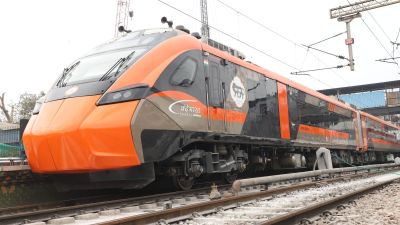
Railway Minister Ashwini Vaishnaw on Saturday said Vande Bharat Sleeper trains will be introduced across all states, including Kerala. He made the comments during a press briefing at New Delhi railway station after inspecting the Howrah–Guwahati–Howrah Vande Bharat Sleeper rake, which is set to be launched this month.