7 min read

Journalism of Courage




It was a smile that broke through the rubble. Held up by her rescuers aftertwo days under the debris of the earthquake, there was joy on the face ofa woman from Bhuj as she greeted the light and the living. The smilewas a reminder that after death comes life, after the devastation, therebuilding. It8217;s this instinct to carry on, no matter what, that should concern us now as we figure out the enormity of Gujarat8217;s loss, the nation8217;s loss, our loss.
In many ways conjuring up a figure to capture it, is a mug8217;s game. Loss of this nature cannot be calculated in rupees, dollars, or any other currency for that matter. Money cannot make whole habitations emerge again; bringtogether communities torn asunder; replace lost faces around the family table. When something like this happens it is as if there is a gaping hole in the web of life.
In the chaotic aftermath of devastation of this order, perspectives tend to be clouded by panic. But, as the well-known architect Laurie Baker once observed, relief is immediate, rehabilitation is long-term. This is a crucial distinction to make. Relief is tentative, blind, ad hoc, the doling out of rotis and blankets to a hundred outstretched hands in a random fashion. Effective rehabilitation, by its very nature, demands perspective and planning and must ensure that every affected person is included. Relief approaches people as objects, as recipients of succour and largesse. Rehabilitation, in contrast, must see the subjects as builders of their own destinies. By its very nature then, sensible rehabilitation programmes are sustainable because those affected directly by the disaster have a stake in ensuring that they are a success. In Latur and its environs, after the 1993 earthquake, mobile exhibitions of films and slides on earthquake safety displayed in local mandis are said to have attracted hugecrowds and a great deal of interest. This was because people were searching for ways to manage the calamity that had visited them.
A rational rehabilitation plan, then, is what Gujarat needs at this juncture. The Republic Day earthquake, by a strange quirk of fate, destroyed simultaneously some of the most prosperous and some of the least developed regions of the state, as the tilting high-rises of Ahmedabad and the smashed hutments of Anjar so eloquently testify to. While help must reach everybody in their hour of need, special care must be taken to ensure that the most vulnerable don8217;t get left out in the general clamour, indeed every effort must be made to ensure that their needs are addressed because their survival base is extremely narrow in the first place.
Invariably, in situations like this it is the most articulate who get to be heard. Not only are city elites closely connected to those who wield power and take the decisions, they also tend to be a constant source of embarrassment and therefore manage to get help that much faster. The very fact that rescue teams landed in Bhuj a good 24 hours after they did in Ahmedabad, although it was much closer to the epicentre of the earthquake, demonstrated the dangers of such a shortsighted approach. Casualty figures would have been significantly less if Bhuj had received timely assistance. Yet, going by the reports coming in from Gujarat, of lorries stacked with relief material thundering past villagers crying for aid, it is the same old story: of those out of the loop continuing to be neglected, of a failure to even acknowledge the existence of a large numbers of victims.
Since India has had numerous brushes with earthquakes over the centuries, it also has a considerable body of information, both scientific and quotidian, on managing its consequences. The tragedy, of course, is that these insights have not found their way into actual practice, locked away as they are in dusty tomes in some institute or the other. Decades ago, the Geological Survey of India had made some extremely useful observations based on the Bihar quake of 1934, or so the experts say. There are also the studies the University of Roorkee did in 1960 on the collapse of non-engineered traditional buildings crafted out of clay or brick, based on data from several earthquakes. Indian housing is, by and large, made up of structures of this kind yet they continue to be built without any advice or supervision worth the name.
What makes for this enormous ennui, this criminal lack of recall? Is itbecause we 8220;adjust8221; quickly to the situation and carry on as if nothinghas happened? Is it because life is not worth a straw? Is an estimated death toll of 50,000 dead sufficient to jolt us into reviewing our approach to such tragedies? Our ancestors seem to have displayed a far better sense of having learnt from their past. The pherols of Uttarkashi, with its bands that bind the walls of the house together, and its use of long flat stones placed at 90 degrees to one another at corners to reinforce walls, have withstood the tremors of over a century. Yet local people continue to import the shoddy concrete death traps from the plains in the name of housing. All the deaths caused by the Uttarkashi earthquake of 1991 were caused by house collapses.
Gujarat, fortunately, has a fairly stable base. With a population of 41.3 million 1991 census and a state domestic product per capita of Rs 10,578, it happens to be one of the country8217;s most prosperous states in the country. Its female to male ratio, at 944, is higher than the national average of 929. In sharp contrast to neighbouring Rajasthan, 70.5 per cent of its children in rural areas, between the ages of 6 and 14, are in school. That8217;s not all. Gujarat8217;s per capita consumption of electricity at 520 kwh is second only to Punjab at 690. What8217;s more, according to NCAER data, development in the state is fairly well spread out, with over 80 per cent of the villages in the state having a bus stop and post office within a two-kilometre radius.
The challenge then is to use these positives to rebuild the state and rebuild it in such a way as to secure the life of its people. Ultimately, what is human development all about if a better standard of living cannot guarantee citizens a safe existence? Isn8217;t development about reducing people8217;s vulnerabilities to the vagaries of nature?
The Roman statesman Marcus Tullius Cicero, being a natural orator, couldn8217;t have put it better: The safety of the people shall be the highest law.
Going by reports of lorries stacked with relief material thundering past desperate villagers, it is the same story: of those out of the loop being left neglected

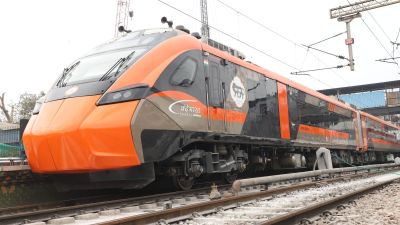
Railway Minister Ashwini Vaishnaw on Saturday said Vande Bharat Sleeper trains will be introduced across all states, including Kerala. He made the comments during a press briefing at New Delhi railway station after inspecting the Howrah–Guwahati–Howrah Vande Bharat Sleeper rake, which is set to be launched this month.