6 min read

Journalism of Courage




More than a decade ago, the Delhi Development Authority DDA decided to provide more than 20,000 people with adequate residential facility in the central part of New Delhi. As citizens flocked to Kalkaji Extension in 8217;84, little did they predict the problems awaiting their daily existence.
Electricity failures, water shortage coupled with the unending encroachments and security lapses are only some of the issues which assert how drastically authorities have failed to tackle the worsening conditions of the locality.
Flanked by Govindpuri Extension, Sangam Vihar and the Tuglaqabad Industrial Area, the colony has around nine pockets of the DDA 8211; MIG flats, but the authorities seem to take very little notice of this thickly populated area even as the residents continue to suffer.
What catches the immediate attention for wrong reasons, is the inefficient sewerage system. 8220;The filtering machinery doesn8217;t work, thus the main pipeline that carries the waste finds an outlet into the forests behind the main nullah,8221; points out S. D. Sharma, General Secretary, Kalkaji Extension RWA, Pocket A-12. The result: blockage and stagnation of waste which serve as a breeding ground for diseases. 8220;The stench is nauseating making life a virtual hell for the residents,8221; adds Sharma. But despite the repeated appeals, the concerned authorities simply fail to take note of the situation. It becomes even worse when the MCD sweepers fail to turn up.
Shashikant Mehrotra, Deputy Commissioner Central, MCD, sidesteps all these allegations: 8220; We also face financial and manpower constraints. There8217;s a limit to how much we can solve the existing problems of the residents.8221; In fact, the only response is to pass the buck. 8220;There is no natural flow of nullahs in this area. An outlet has to be provided for the collected wastes,8221; says Mehrotra, 8220;For this the Delhi Jal board plans to create an outlet near Alaknanda, which will actually solve the problem.8221; The residents however contend that the situation hasn8217;t changed for the past three years, despite a visit by Area MLA, Choudhary Sheeshpal.
If this were not enough, power situation in the area remains deplorable. 8220;The power supply is highly erratic and recently we had a power cut for more than ten hours,8221; informs V. G. Govindan, President, Kalkaji Ext, Pocket-13 RWA, 8220;Electricity stolen by the neighbouring jhuggis and Tughlaqabad industrial area units worsens the situation.8221; The only response from the Delhi Vidyut Board has been empty promises. DESU Inspector Anil Kumar says, 8220;The electricity situation was bad only when the heavy rains had caused damage to the station, now we have things under control.8221;
However B. S. Bawa, President, Kalkaji, Pocket-12, RWA points out, 8220;The electrical panels of sub-stations are faulty and need to be replaced or repaired to achieve stability in power supply.8221; And as the power supply is linked with that of surrounding areas like Govindpuri, disruptions in one place affects the others. Even the streetlights in the colony are non-functional with more than 70 lights being out of order. 8220;This has even led to an increase in the crime rate in this area,8221; complains Uday Singh, General Secretary of Pocket A-3. 8220;The security of the area is at stake,8221; seconds S. C. Chauhan, an executive member of the A-13 RWA. And while residents clamour for the five-foot boundary wall to be raised to 10 feet, the MCD refuses to accept responsibility.
The main road No. 13 circumventing the residential area portrays another dismal picture. Initially at the level of 45 feet, it has come to a 10-foot low since jhuggi-dwellers have encroached the roadside. 8220;The MTNL and the DESU people have dug it up at various places. No one bothers to repair these patches though it is the responsibiliy of the CPWD,8221; says Bawa. The CPWD people too express their helplessness in terms of lack of funds and so the road remains in a shabby condition.
The main approach road, Ravidass Marg, is no less than a roller-coaster ride. 8220;It is the most striking example of bad drainage and poor workmanship,8221; comments O. N. Razdan, a former civil engineer, 8220;The two-month-old road has already turned into a bad patch.8221; To make matters worse, there is no traffic light at a very major crossing on Road No. 13. The huge tubewell trucks parked on the sides add to the congestion. Commuting remains an ordeal for the people living in these pockets as there are only five DTC buses plying on this route, of which a few buses have further reduced their frequency from seven trips a day to only two.
A transit camp established five years ago, to rehabilitate over 50,000 slum-dwellers has become almost permanent, causing congestion and anti-social activities in the area. 8220;This was meant to be recreational land but now the DDA wants to change its original purpose from recreational to residential,8221; complains Jagdeesh Singh, General Secretary of Pocket A-14, 8220;It would serve as a lung-space to the residents and any change in its original use would mean a betrayal of our trust and violation of safety norms.8221;
Another striking fact about the area is that where there were originally meant to be 14 pockets, only nine exist. Pocket 1, 2, 5, 6 and 7 have been missing and slum-clusters have come up on the allotted land. The residents also emphasise on the need for a community-centre in the area. 8220;There is no place where we can hold our functions or assemblies,8221; points out H N Bhanot, Vice-President of RWA of A-13, 8220;If we use the parks, the people from the horticulture department harass us.8221;
The list of woes is endless but it is the authorities8217; attitude that rankles. Defends Sheeshpal: 8220;To a great extent we have been successful in rooting out the problems from this area but these are all long-term problems and everything cannot be corrected in one day.8221; But for the residents of the colony, these words are cold comfort.

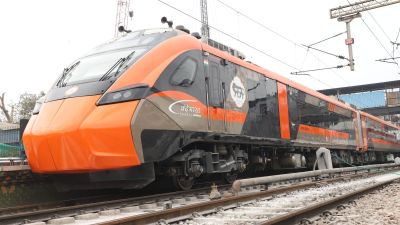
Railway Minister Ashwini Vaishnaw on Saturday said Vande Bharat Sleeper trains will be introduced across all states, including Kerala. He made the comments during a press briefing at New Delhi railway station after inspecting the Howrah–Guwahati–Howrah Vande Bharat Sleeper rake, which is set to be launched this month.