Journalism of Courage
 5 min read



Before we begin celebrating the opening up of higher education to foreign direct investment as we should 8212; the Foreign Education Providers Regulation Bill is likely to be tabled in the coming budget session of Parliament 8212; let8217;s pause. The assumption that universities across the world, from Harvard and MIT to Cambridge and Oxford, are just waiting for the clearance of this Bill to enter India with all their intellectual and financial infrastructure may not quite be realised. What we do see today are liaison offices of two-bit, unknown universities making a pitch that8217;s part education, part 8216;come share the good life8217;.
That private investment 8212; Indian or foreign 8212; in education primary, secondary or higher is an aching need is a rhetoric that has been bled to death. Of course, it is needed. It should have happened decades ago. The cost of not doing that is a mediocre teaching infrastructure, where status and financial incentives to a teacher are based on how long s/he has worked for rather than the foremost quality: Quality.
Err, what was that? Quality is the ability of a teacher to teach, get students interested and help them discover subjects, explore ideas and express them. It is a talent that turns specialities like astronomy and physics, for instance, into gripping, racy experiments as Stephen Hawking8217;s A Briefer History of Time or Richard Feynman8217;s Surely You8217;re Joking, Mr. Feynman! It is the primary job of a teacher to go beyond the textbook, to seek knowledge, to take it further through research and pass on that body of work to students who pay to get it. When was the last time you read a paper in any subject written by an Indian working in an Indian university in any top international peer-reviewed journal?
To say, therefore, that the haloed University Grants Commission will approve, administer and perhaps regulate global entities with Nobel Prize winners on their rolls, would be funny had it not been true. If I were the dean of a university looking at investing money and that even more precious commodity 8212; intellectual infrastructure 8212; in India, would I let loose my top professors here? Much rather call students to me 8212; so many of them are willing to pay.
Nuances, that will perhaps get sorted out. But what about the biggest road block in the way of higher education 8212; the talent pool, the students? Will foreign universities be allowed to choose students on merit? So far, half the seats in institutes of higher education that are fully or partly funded by the government have been reserved by criteria other than merit 8212; caste, for starters; religion, possibly. Only the very foolish or the very brave will assume the political mood will leave private universities untouched 8212; if reservations can be thrust down the throat of the private sector, what stops them from coercing global institutes of learning to take unmeritorious candidates and dilute their brand? How many world-class universities will be willing to sacrifice merit and affirmative action at the altar of crude reservation-based politics? Their current model 8212; those who can pay, will pay; those who can8217;t, seek loans or compete for scholarships; and then some affirmative action 8212; will crash in just one stroke.
Finally, as we open up a vital sector to foreign investment, as we must, we need to ask just what is needed. What is the final product that this FDI will deliver? Is it a branded degree? Is it knowledge, skill, expertise? Is it the access to a global network of teachers and students? Most important, what is it that an economy hungry for growth and wealth seeks?
To get this answer we need to take a picture that8217;s slightly bigger than one Bil. We need to question the role of education in the knowledge economy, that currently a small percentage of Indians are a part of but which is not growing at the fastest rate.
As a peeved single mother pointed out, her son who wants training to be a pilot can8217;t get an education loan because it8217;s not considered 8220;education8221; but 8220;training8221;. So, instead of a 11.5 -12.5 per cent education loan, she will have to take a personal loan and pay 16-20 per cent. The shortage is of pilots but pilot training is not 8216;education8217;. There is a shortage of engineers and graduates in IT and ITES, but Kiran Karnik of Nasscom says selection averages around 20-25 per cent for engineers and 10-15 per cent for other graduates; the rest are 8220;unemployable8221;. Down the road, the maid who wants to send her child to learn English is willing to pay two months8217; household income to help her get access to a life beyond cleaning dishes or ironing clothes.
Something is missing here, and it8217;s not FDI. Money is just one of the many spokes in the wheel of education. It8217;s the attitude and crude commodification of what once stood for excellence, skill and relevance. In the knowledge economy of tomorrow there8217;s no place for mediocrity, seniority, reservations, controls.

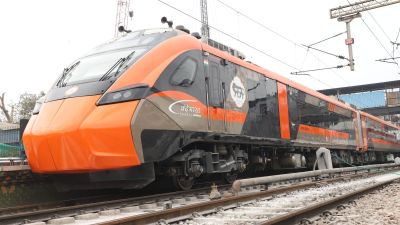
Railway Minister Ashwini Vaishnaw on Saturday said Vande Bharat Sleeper trains will be introduced across all states, including Kerala. He made the comments during a press briefing at New Delhi railway station after inspecting the Howrah–Guwahati–Howrah Vande Bharat Sleeper rake, which is set to be launched this month.