2 min read

Journalism of Courage




Thanks to two new genetic tests, a drop of mother8217;s blood could soon be all it takes to say if an unborn baby has Down8217;s syndrome.
A child with Down8217;s syndrome inherits an extra copy of chromosome 21 from their mother or father. Now two teams of researchers have devised a simple blood test which they claim will detect this extra copy by simply analysing foetal genetic material shed into a mom8217;s blood.
According to lead researcher Dennis Lo of the Chinese University in Hong Kong, this would reduce and even eliminate the need for invasive tests that can cause miscarriage. 8220;This problem really appears to be solvable.8221; In fact, Lo8217;s method is now being commercialised by Sequenom of San Diego in California.
The approach focuses on a stretch of chromosome 21 that is only expressed in foetuses. Sequenom detects this RNA and determines which parent it comes from by identifying the differences between individuals in single letter variations 8212; single nucleotide polymorphisms, the 8216;New Scientist8217; reported.
If the amount of chromosome 21 from each parent is about the same, the foetus is healthy, but if one is about double the other, the foetus probably has Down8217;s, according to the researchers.
In another research, Stephen Quake and colleagues at Stanford University in California have developed a Down8217;s test that doesn8217;t depend on single nucleotide polymorphisms SNPs.
The team uses 8220;shotgun sequencing8221; to sequence short DNA fragments in the mother8217;s blood. Subsequently, they map each fragment to specific chromosomes and calculate proportion from chromosome 21.
In their study, they analysed blood samples from 18 pregnant women, half of which had foetuses with Down8217;s. They found that these mothers had 11 per cent more chromosome 8212; 21 fragments in their blood than the mum8217;s with healthy foetuses.
The findings have been published in the 8216;Proceedings of the National Academy of Sciences8217; journal.

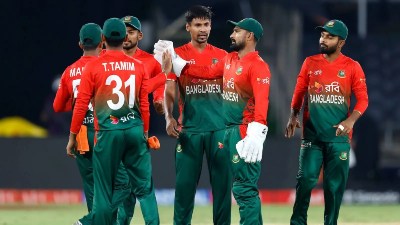
Bangladesh have brought back pacer Taskin Ahmed and dropped Jaker Ali in their squad for the 2026 T20 World Cup. Litton Das will be leading the side and senior pacer Mustafizur Rahman, who has been caught in the middle of a storm after being released by his Indian Premier League (IPL) side Kolkata Knight Riders (KKR), has also been included.