Journalism of Courage
 4 min read



One of the five cricketers tested for banned substances by the World Anti-Doping Agency WADA during the Indian Premier League IPL has been found positive.
While there was no official word on the identity of the player, it is learnt that Delhi Daredevils8217;s Pakistan import Mohammad Asif is the man in the dope net once again.
Asif, who had undergone a one-year ban after testing positive for nandrolone during the 2006 Champions Trophy, was detained in Dubai on his way home after his IPL assignment in India for allegedly possessing a recreational drug. He was released after 20 days in detention. During the tournament, Asif had been suffering from an elbow injury and that saw him miss seven of the 14 games that his team played.
Meanwhile, IPL commissioner Lalit Modi tried to downplay the dope story. Modi confirmed that a player had tested positive but he also added that there was still ambiguity if an IPL cricketer was a dope cheat.
8220;Two days ago the IPL received a letter from WADA informing us about the positive test. This is the first stage with several more stages to go. The issue is now with the IPL8217;s medical committee. The identity of the player will matter only after we check on the pre-declared drugs,8221; he told the media.
Random test
The WADA officials had landed in India from Sweden on May 18 8212; the fifth week of the IPL 8212; to do a random test on the cricketers involved in the event. A day before the WADA testing, Asif sat out of the outing against Kings XI Punjab and wasn8217;t part of the team in subsequent three games. The reason given for Asif8217;s absence was 8220;elbow injury8221; and the player was found wearing a strap around his elbow as his teammates continued to practice.
It is not known as yet whether the IPL can take any disciplinary action against the player on grounds of a positive dope test. Since the IPL is considered to be India8217;s domestic tournament and because the BCCI doesn8217;t have an anti-doping code as yet, it is not confirmed whether IPL has the power to ban or suspend the player as per the ICC or WADA rules.
At best, an official explains, they only have the power to suspend the player for which they have a standard two-year suspension if the charge is proved for the first time and life-time ban for a second offence, or slap a fine.
ICC puts onus on BCCI
After the IPL got hit by its first doping scandal, the International Cricket Council ICC reacted by saying that it is aware of an adverse analytical finding AAF and it is up to the BCCI to deal with the situation in a fair manner.
8220;When an AAF arises, the WADA accredited laboratory that has tested the sample sends a report to the commissioning body IPL and copies in WADA and the International Federation, in this case the ICC. As with any AAF that arises during a testing programme organised by one of the ICC8217;s Members, it is the responsibility of that Member, in this case the BCCI, to deal with the process in a timely and fair manner,8221; the ICC said in a statement.
The ICC retains a right of appeal if any penalty that may be imposed is inconsistent with the WADA Code.

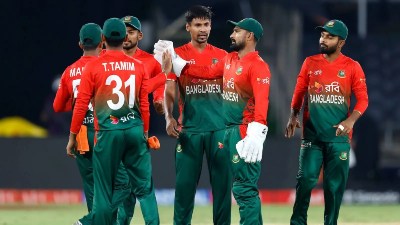
Bangladesh have brought back pacer Taskin Ahmed and dropped Jaker Ali in their squad for the 2026 T20 World Cup. Litton Das will be leading the side and senior pacer Mustafizur Rahman, who has been caught in the middle of a storm after being released by his Indian Premier League (IPL) side Kolkata Knight Riders (KKR), has also been included.