7 min read


© IE Online Media Services Pvt Ltd



 Top news on July 11, 2025
Good morning,
We begin today with a story that seems straight out of a literary classic. In 1952, Ernest Hemingway introduced the world to The Old Man and the Sea, the tale of Santiago, an ageing fisherman engaged in a long struggle to catch a giant marlin, regarded as one of the fiercest predatory fish. But this is no work of fiction. And Yerraya C was no Santiago. For one, he was only 28 years old. On July 3, the young fisherman would face his marlin. The giant fish had caught onto his net, and he was determined to land it. After a gruelling battle, the marlin dragged Yerraya into the waters. He has been missing ever since.
My colleague Nikhila Henry has more details.
On that note, let’s get to the rest of today’s edition.
It’s that time of the year again. The temporary pause on US President Donald Trump’s steep reciprocal tariffs is set to expire today. At least 14 countries have been hit with tariffs, ranging from 25 to 40 per cent. However, the administration has kept the door for negotiations open until August 1. India is still to formalise an interim trade agreement, despite months of discussions.
Big guns: Trump’s recent announcements may have thrown another spanner in the works. On Tuesday, he announced a 50 per cent tariff on copper, having implemented similar duties on steel and aluminium. Significantly, India exports $2 billion worth of copper and its products globally, with the US accounting for 17 per cent of that. Trump also warned that tariffs on pharmaceuticals could rise to 200 per cent after a year — a major concern, given that the US is India’s largest overseas market for drugs.
‘Dollar is king’: Trump has also threatened to impose a 10 per cent tariff on BRICS nations, claiming that the coalition was set to “destroy” the dollar. Although he asserted that BRICS was not a “serious threat”, Trump added, “The dollar is king. We are going to keep it that way. If people want to challenge it, they can. But they are going to have to pay a big price.” Earlier, India stated that it was not pursuing “de-dollarisation” and only intended to enter into local currency trade agreements to “de-risk” its trade. Notably, amid the rise of the Chinese yuan, India cannot risk backing de-dollarisation.
Also read: As Trump begins unilaterally setting tariffs for most nations, experts highlight the rise of the US as a “rogue superpower.” Columnist C Raja Mohan explains how New Delhi can navigate this American unilateralism and the importance of understanding America’s domestic affairs in depth.
Paper trail: In an ongoing Express series that tracks the progress of electoral roll revision in Bihar, today’s focus is on the unique “roti-beti ka rishta” (a union of economics and marriage) between India and Nepal. In several districts of Bihar, the ties run deep, with many families having at least one daughter-in-law from across the border. Under a 1950 treaty, the Governments of India and Nepal grant each other’s nationals the same privileges in matters of residence, property ownership, and so forth. Those from Nepal who are legally residing in India also possess documents such as Aadhaar, PAN, and voter IDs. However, with the Election Commission’s new requirements to prove citizenship, a question mark hangs over the status of such voters. Read on.
Alert: The Financial Action Task Force (FATF), a global watchdog, has flagged that digital platforms, including social media, messaging applications, and crowdfunding sites, are increasingly being exploited for terror financing. It flagged the use of online payment services, VPNs and e-commerce platforms in the terror attacks in Pulwama in February 2019 and Gorakhnath Temple in April 2022.
Block, unblock: A recent controversy over the blocking of X accounts of international news agency Reuters in India has once again put the social media platform at odds with the Indian government. While X claims that New Delhi ordered it to block 2,355 accounts in India, including Reuters and Reuters World, the IT ministry has refuted the claim, stating that it has not issued any such order.
Decline: The number of US student visas issued between March and May fell to the lowest level for these months since the pandemic. These months usually mark a busy visa season for students planning to begin their studies in the Fall semester. The slump comes amid the Trump administration’s crackdown on international students.
In deep water: A Liberian container ship, MSC Elsa III, sank off the coast of Kerala in May. Over a month later, the Kerala High Court ordered the conditional “arrest” of MSC Akiteta II, currently anchored at Thiruvananthapuram’s Vizhinjam port. Both ships are operated by different firms within the Mediterranean Shipping Company group. The “arrest” results from the Kerala government’s admiralty suit, seeking compensation for damages to the marine ecosystem. Nikhil Ghanekar explains how admiralty suits work.
New chief: The BJP has appointed a new state unit president in West Bengal with just under a year remaining before the Assembly elections. Rajya Sabha MP Samik Bhattacharya’s appointment is not the only apparent change within the main Opposition party in the state. It has also indicated a subtle shift in the party’s positioning. From Bhattacharya’s comments on Muslims and signals to the Left to the internal factionalism issues, we observe the evolving dynamics in the BJP’s strategy in Bengal.
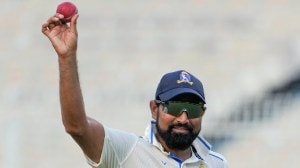
The neo-Jonty Rhodes: The new Team India, now progressing without big names like Virat Kohli, Rohit Sharma, and R Ashwin, is finding its rhythm. As national sports editor Sandeep Dwivedi states, the ongoing series against England signifies the rise of the ‘apna time aayega’ generation. And as Captain Shubman Gill settles into his role, he has developed a group of leadership partners. Among them is Mohammed Siraj, a friendly, spirited leader. On the field, he takes on many roles: from bowling coach and motivator to strict schoolteacher when necessary.
Is there life beyond Earth? Or are we truly alone in the cosmos? The question of planets beyond our solar system and the potential for life there has long been a theme in science fiction (think Star Trek or even the new cult favourite Dune). However, the concept of a “habitable zone” — a region around a star where water can remain liquid — and advances in space technology offer some hope that one day, fiction could become reality. In his weekly column, astrophysicist Shravan Hanasoge writes that the search for alien life is only just beginning.
🎧 Before you go, tune in to the latest ‘3 Things’ podcast episode. Today’s lineup: A law for the death penalty for ‘sacrilege’; debate around Dalai Lama’s successor; and a 1990 scam of Rs 200 in Karnataka.
That’s all for today, folks! Until next time,
Sonal Gupta
 Business As Usual by EP Unny