Journalism of Courage



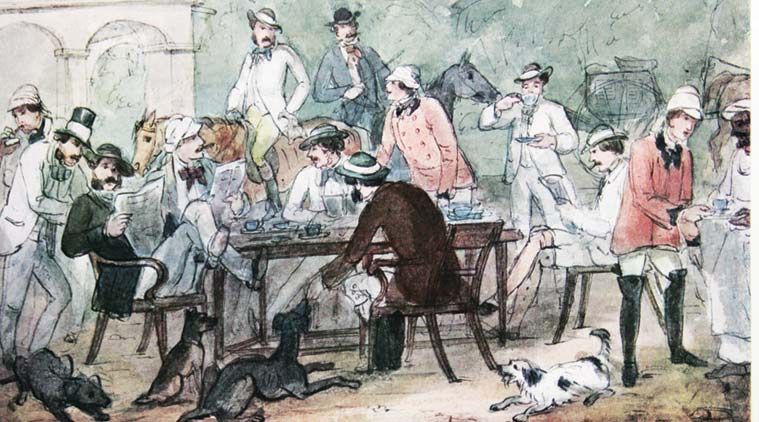 A work from Curry and Rice, a collection of satirical lithographs.
In 1859, immediately after the mutiny, British gentlemen and ladies of the time found themselves the target of satire in a collection of lithographs titled Curry and Rice. One of the images, Our Tiger Shooting, depicted white sahibs seated high up on elephant back, aiming their guns confidently at a startled tiger. An Indian “native”, stationed close to the prey in the bushes, wears a dhoti and a shocked expression. Another lithograph, Our Coffee Shop, showed Englishmen dressed in suits, boots and hats relaxing while an Indian man hidden in the backdrop serves them coffee. Made by George Francklin Atkinson, the lithographs were set in the fictional town of Kabob but the scenes, unlike the setting, were real. A few of the works are now a part of an exhibition, titled “An Indian Kaleidoscope” at 1AQ in Delhi.
The exhibition by Pran Sabharwal Foundation features 300 lithographs, wood engravings and steel plate engravings by William and Thomas Daniell, Solvyn, Mortimer Menpes and Dottor Ferrario, among others. Together, they offer a view of the architectural marvels of the Indian subcontinent and the everyday life of its people. Sourced from the collection of founder Gautam Sabharwal, the works date between the early 1700s and 1800s, when the British commissioned artists to capture Indian elements such as monuments, gods and goddesses, ways of worship and cultural traditions apart from regular colonial life.
Some works show ways of life in India that still exist. W Llyod’s coloured chromolithographs, for instance, feature children flying kites, and coolies carrying luggage at the railway station at Kanpur. Architecturally, too, little seems to have changed at heritage sites such as Elephanta Caves, Taj Mahal and Fatehpur Sikri Fort as etchings by Elliot R N reveal vast tracts of land that visitors can see even today. The land that features in a reproduction of the Qutub Minar by William Daniell, too, survives.
“Daniell and Elliot were not artists but trained draftsmen. They were taught how to measure monuments, and the British army maps were created by them,” says Sabharwal, who has been collecting art for 20 years, often sourcing these from book dealers and kabadiwalas.
‘An Indian Kaleidoscope’ is being held at 1AQ in Delhi till May 17. Contact: 26642932

 3 min read