4 min read
📣 For more lifestyle news, click here to join our WhatsApp Channel and also follow us on Instagram
© IE Online Media Services Pvt Ltd



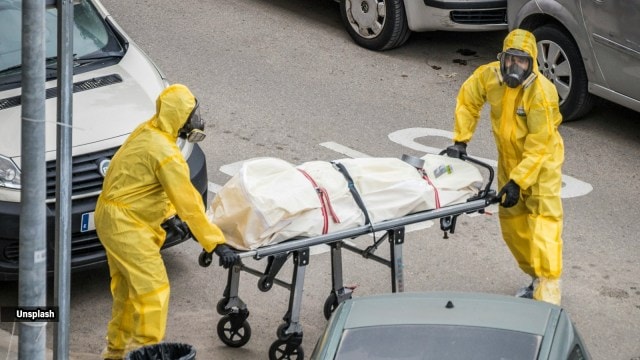 some medical conditions can make post-mortem bleeding appear more pronounced (photo: unsplash)
Losing a loved one in itself is a painful experience, which worsens manyfold when the body of the deceased shows any unusual signs. A Quora user posted about such an unfortunate incident. “When my father died he started to bleed from his mouth and nose. He was dead yet his body kept pouring out liters of blood. There was no injury inside or outside his body. What could be the cause of this?” the post read.
While this unusual experience can be haunting for most people, it isn’t as uncommon as one might think.
“Bleeding from the mouth and the nose after death is very common,” says Dr Basavaraj S Kumbar, Consultant, Internal Medicine, Aster Whitefield Hospital, Chennai.
Dr Kumbar explains that this typically happens when the vessels get dilated. Depending on the location of this dilation, leakage of blood occurs. Dr Jagadish Hiremath, a public health expert, weighs in, stating that internal pressure changes within the chest and abdomen are the main reason behind the phenomenon. “After death, as the body begins to relax and decompose, fluids, including blood from the lungs, stomach, or airways, can be expelled through the mouth or nostrils,” he says.
 After death, as the body begins to relax and decompose, fluids, including blood from the lungs, stomach, or airways, can be expelled through the mouth or nostrils.
The doctors further reveal that the risk of such bleeding is higher in case of medical complications or conditions like tuberculosis. “If the patient had experienced trauma, was given CPR, or went through any procedure before death, bleeding may occur,” says Dr Kumbar. According to him, this accumulated blood tries to leak through any opening like the nose, mouth or even the anal canal.
Dr Hiremath adds that if the patient had lung congestion, a heart condition, internal bleeding, or suffered from a sudden cardiac arrest, the risk increases. “The pooling of blood in the lungs or airways may flow outward once circulation ceases and body pressure equalises.”
Whether the person was on any medication also has a role to play. Dr Kumbar explains that for any person who was on blood thinners–for example in case of organ transplantation or wall replacements–the “anti-coagulation process” post death leads to the formation of pools of blood.
 As the body’s muscles relax, gases form and expand inside organs during decomposition
The amount of blood, as per Dr Kumbar, depends on the underlying medical condition, trauma, or preceding procedure. Dr Hiremath concurs, confirming that medical conditions can make post-mortem bleeding appear more pronounced.
“For example, liver disease, severe infections, blood disorders like leukaemia, or conditions that impair clotting, such as disseminated intravascular coagulation (DIC), can cause extensive internal bleeding that continues to drain externally after death. In such cases, even small internal ruptures or natural openings can release a significant volume of blood because the body’s clotting mechanism fails to seal them effectively before death,” Dr Hiremath says.
Thus even though this profuse bleeding may give off the idea of an injury, or worse, the person being alive, it is a common occurrence, which depends on the underlying medical condition, procedure, and medication.
In Dr Hiremath’s words, “these changes are not signs of life but normal biochemical and physical effects of the body’s transition after death”.