


📣 For more lifestyle news, click here to join our WhatsApp Channel and also follow us on Instagram
Tags:


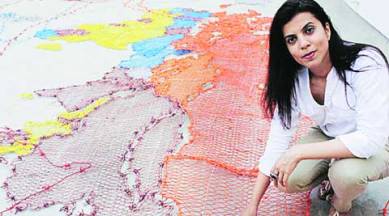
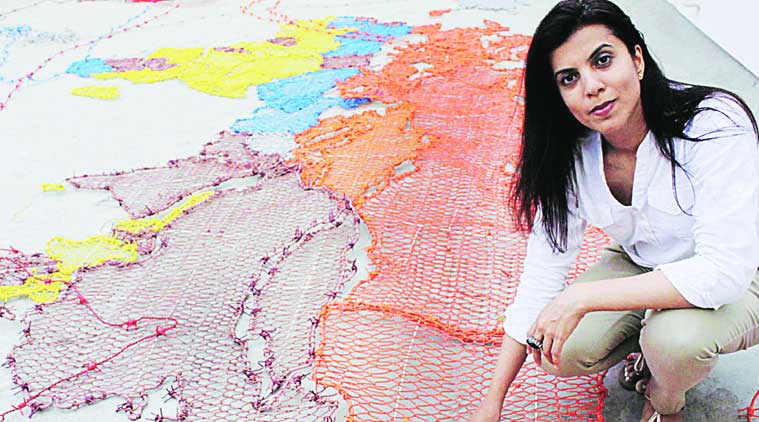
From designing ginormous installations to writing notes with salt, Reena Kallat strikes a balance between the fundamental human dilemmas and larger social issues in her work. Now, Kallat’s site-specific installation at the Vancouver Art Gallery Offsite will address the dichotomy of the fibre-optically connected world, where there is an increase in the movement of people, yet the borders are more controlled. The Mumbai-based artist shares some of her thoughts and notes before the exhibition opens on May 14.
If you could discuss the conceptual-isation of the map drawings; electric wires forming patterns that trace the movement of migrants. You first showcased it at the 2011 Goteborg Konsthall Biennale and now you are taking it to Vancouver, where it will be exhibited outdoors.


This work has a latent effect of embroidery. In the past, you have also used embroidery in works such as White Heat (2008) and Untitled (Bodice, 2010). Your mother used to embroider very well, did you pick it from her?
She did not live long enough for me to learn from her but I grew up looking at things she had left behind that were made by her. The slow working can be a meditative exercise; there is a certain aspect of making a work and transforming it, as it transforms you.
Your work also often centres around borders. Can you share the research for Synonym (2007) that had portraits of ordinary citizens with names of people who have gone missing?
More than the actual physical borders, I am interested in the sociological barriers that exist between people. We carry our own set of prejudices, agree or disagree with each other based on our own understanding of different races and religions. For Synonym, I scoured official records to retrieve names of those who have disappeared; those who have slipped out of the radar of human communication, thrown off the social safety net.
What is your opinion of the opposition raised against the fashion show at the Bhau Daji Lad Museum and the resolution that gives the Municipal Corporation greater control over the affairs of the museum. (In 2013, Kallat had her cobweb-shaped installation on the facade of the building).
It is unfortunate. It has taken so many years to build the institution after its restoration through active programming, where contemporary artists are being invited to make interventions within the collection. The world over, museums organise fundraisers. There was nothing inappropriate about the fashion show. The protest represents a regressive mindset that will hinder possibilities of collaborations and partnerships in the future.
vandana.kalra@expressindia.com


