


📣 For more lifestyle news, click here to join our WhatsApp Channel and also follow us on Instagram
Tags:


Book – Ruled or Misruled: Story and Destiny of Bihar
Author – Santosh Singh

Publishers – Bloomsbury India
Pages – 320 pages
Price – Rs 333
Soon after the 2004 defeat of the NDA, Nitish Kumar was at the home of an old friend and compatriot, Prem Kumar Mani. They were discussing the reasons for the BJP’s defeat in the general elections. Mani felt the Gujarat riots had been the party’s undoing. Nitish disagreed. He defended Narendra Modi vigorously — that Modi was an emerging leader of the party, hardworking and an OBC, and interestingly, that he had been a victim of the Brahmin lobby of the BJP, which included Atal Bihari Vajpayee. “I have become a fan of the man,” Nitish Kumar had reportedly told his friend.
This little known nugget, contained in Santosh Singh’s new book Ruled or Misruled: Story and Destiny of Bihar, only intensifies the speculation about why Nitish Kumar really broke with the BJP in 2013. The author explains that when Nitish was thinking only of Bihar, Modi was another OBC compatriot. But this changed the moment Nitish acquired prime ministerial ambitions in 2009. And his admiration for Modi turned into hostility by 2010, when he famously cancelled the dinner he was going to throw for the BJP brass in Patna, just because Narendra Modi was going to attend it.
Delhi’s political circles, however, had a different take on Nitish’s break-up with the BJP, and many attributed it to a power struggle within the saffron party. They believed that Nitish had been encouraged to walk out of NDA by those in the BJP who wanted to throw a spanner in Modi’s works to prevent him from becoming the party’s prime ministerial candidate. It was hardly a secret that Nitish had been close to LK Advani and not so much to Atal Bihari Vajpayee.
In fact, Nitish Kumar has expressed his disappointment with Vajpayee in an interview cited in the book, talking about how the former PM failed to project him as the NDA’s CM candidate in February 2005 assembly polls: “Vajpayeeji did praise me greatly, but forgot to talk about the main thing — my CM candidature.”
It goes without saying that Nitish’s parting of ways with the BJP was a defining moment in Bihar’s political history, culminating in the 2015 battle which has become a fight between “a credible CM” and a still “popular PM”.
Santosh Singh, assistant editor of The Indian Express, who has watched at close quarters — and chronicled developments in Bihar since 2008 — obviously readied the book in time for the present elections, though it could have done with better editing. But its timeliness imparts it value because all eyes are on Bihar, which is expected to alter the trajectory of Indian politics.
The book starts with the decline of the Congress since the Seventies, and highlights Sonia Gandhi’s sense of helplessness about how to revive the party in Bihar. When a Bihar Congress leader urged her to send a senior party leader to the take charge of the state, she is quoted as having said, “Meira Kumar is not interested in going back to Bihar. Nikhil Kumar is too bureaucratic. Sadanand Singh is useless and Shakeel Ahmad is too pro-Lalu.”
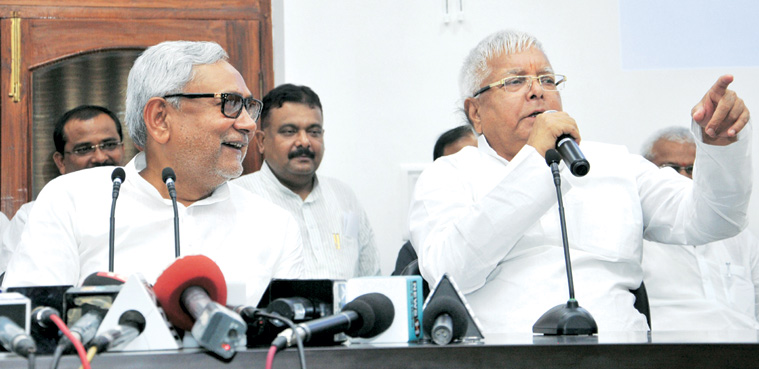
The book, however, is essentially the story of the two Mandal siblings, Lalu Prasad Yadav and Nitish Kumar, their contrasting styles of functioning, their initial bonhomie — Lalu Yadav became CM in 1990 with Nitish’s support — their subsequent estrangement, and finally, their coming together again in 2014 to stop the Modi juggernaut.
It is also the continuing story of the Mandalisation of Bihar, rich in recall, replete with interviews with major players including the two protagonists, bringing it to the present and agonizingly suspenseful battle for Bihar, which has once again acquired a forward versus backward pitch, what with Lalu Yadav quickly seizing the opportunity provided by RSS chief Mohan Bhagwat’s reopening of the reservation debate, which may turn out to be a gamechanger.
“Perhaps no other Indian politician vernacularised, Mandalised and secularised politics in the manner…in which Lalu did,” writes Singh. There were no communal riots during the 15 year Lalu-Rabri rule, and Lalu had not forgotton how the 1989 Bhagalpur riots had proved to be the last nail in the Congress’ coffin.
Singh’s anecdotes about Lalu’s rustic and homespun style in the early years makes interesting reading about the rise of a leader who is hated — or at best seen as a frivolous entertainer — by some, but loved by others with whom he managed to make a huge political connect. This was at a time when the social realities in Bihar were changing, and the Congress had failed to read the message and transit beyond “upper caste dominance”.
While Lalu gave voice and dignity to the OBCs, EBCs and Dalits, he lost the plot with “social justice” that degenerated into “Yadavisation”, leading to kidnappings, ransoms, and other forms of “jungle raj”. Administration and file signing was never Lalu’s cup of tea, and former Bihar MP Shivanand Tiwari recalls an instance when he had gone to meet Lalu in office, and he was signing files. “After signing a few files, he turned to me saying, ‘Baba, file sign karte karte kareja dukhta hai’.”
Administration, on the other hand, was Nitish Kumar’s forte, and he, in alliance with the BJP, brought Bihar back on tracks. Today — and this is quite unprecedented — there is hardly anyone you meet, supporter or opponent, who does not have a good word to say about what Kumar has done for Bihar.
Byproducts of the same ideological processes, and rivals to boot, Nitish, who thinks with his mind and Lalu, who thinks with his heart, have been thrown together again to take the Bihar story further. At the end of the book, the reader is left asking the question: win or lose, will they continue to be together and overcome the challenges that are going to come their way?


