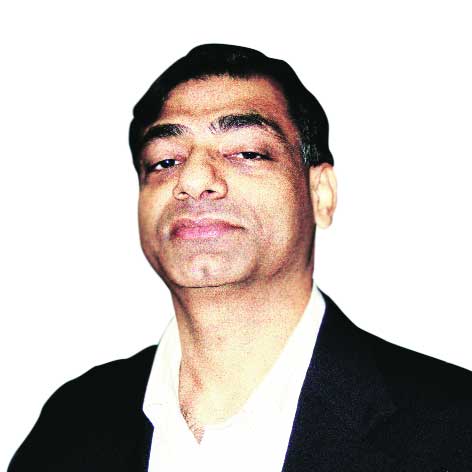
In the mid-1990s, during one of his visits to Pakistan, Anis Shivani was sitting at his computer in his airy apartment on the top floor of Saima Palace in Karachi’s Bahadurabad, working on an essay for Dawn, when he was struck by a realisation. Despite a degree in Economics from Harvard and attractive job offers from hedgefunds and global economic think thanks, he had found corporate life, with its bias towards hidebound analysis, restricting. “In that welcoming room, the life of the writer — fortified in solitary enclosure and becoming an observer rather than a participant — held the dramatic promise of freedom and authenticity,” says the 40-something Pakistani writer, whose novel Karachi Raj (Fourth Estate) was published last month to generous reviews.
While the prospect of freedom was heady, mastering that authenticity took the Houston-based writer time. Over the last 15 years, he began and abandoned several drafts. “I knew that to become good as a writer I would probably churn out bad writing for about 10 years, and that’s exactly how it went,” he says. But he had a flair for short stories and poetry, and his early works — My Tranquil War and Other Poems, and the quite unconventional The Fifth Lash and Other Stories — drew affirmative criticism and made it to longlists for awards. About a decade ago, he decided to quit writing short stories altogether, fearing that he was “burning up, at great pace, a lot of novelistic material” and wanted to set his sights on “the hardest thing one can do as a writer” — write a novel. The time for Karachi Raj had come, though it would take him several attempts to get to the heart of the story he wanted to tell.
You’ve Read Your Free Stories For Now
Sign up and keep reading more stories that matter to you.
In a way, Karachi Raj follows the classic template of literary and celluloid works on South Asia — looking at a megapolis from the perspective of an inverted vertex, in much the same way as Katherine Boo did in her acclaimed non-fiction work Behind the Beautiful Forevers or Danny Boyle in his Oscar-winning film Slumdog Millionaire. At the core of Shivani’s novel is the basti and the life lessons it holds for its protagonists — Hafiz and Seema, a brother-sister duo, one an assistant to a starlet, the other a student at Karachi University; an American anthropologist, Claire, in search of ways to understand Karachi more intimately than her work at a local NGO allows her, and a host of other characters. Life in the basti lends the book a visceral charge, bringing alive the many Karachis that exist within that microcosm. “The slum as a state of mind with associated stereotypes and prejudices, as a problem whose solution can neither be stated nor pursued, allowed me to get to the root of the hypocrisies and double-talk that lead to the existence of unforgivable gaps in social status,” says Shivani.
The inspiration behind Karachi Raj dates back to the pioneering work done by social activist Akhtar Hameed Khan with his Orangi Pilot Project (OPP) first in the region, and to other similar NGO efforts, including Muhammad Yunus’s Grameen Bank in Bangladesh, to improve slum conditions in south Asia. “If I lived in Karachi and if I wasn’t a writer, I would probably work for an outfit like the OPP. So the seeds of this go back to a time before ‘the slum’ became a theme in popular culture,” he says.
The tone of Shivani’s novel is quirky and unapologetic, looking at the foibles of society through a lens of pillorying humour. “I intended the novel to be a counter-narrative to the journalistic myths and conventional notions about Pakistan, and wanted the cheerful tone to do the bulk of the work in going against the established myths. I was absolutely determined to write a funny, light-hearted, fast-paced book, a book of optimism and energy, even though it took account of the dark side of Pakistani life,” he says.
It helped that Shivani has never lived in Pakistan for long. Born into a Memoni Muslim family — his parents had migrated from Porbander in India to Karachi after Partition — he left the country at a young age and felt most at home in southern California, where the family had moved to. He made forays into Pakistan as an adult in the mid-90s, a “critical time of transition to democracy”. He engaged with its politics, wrote for its national newspapers and magazines, and felt his disenchantment grow over time. “Had I kept going back during the 2000s or lived there for a longer period as an adult, I would not have been able to write Karachi Raj. My memories of Pakistan, particularly as a child, provide the foundation from which I extract all the good you see in the novel; all of the innocence and optimism and the vitality, rather than the daily terror that seems to be the logical way to comprehend Pakistan at the moment,” he says.
Shivani now looks at the country as “a native without illusions”. “I’m certain that had I personally experienced, for extended periods of time, some of the dark periods of dictatorship in Pakistan, my writing would have been profoundly affected, and I would have written a more cynical, pessimistic book. I tell myself that I must live in South Asia for a period of time in order to write that dark novel — of degeneration, corruption and every vice imaginable,” he says.
Story continues below this ad
But it would be a while before his plot would crystallise. He had to first work his way through a “completely different beast, having to do with CIA intrigue, Americans adrift in Pakistan”. He discarded it when he realised his mistake: “The emphasis needed to be on the basti, as an overarching fact and reality, the physical environment that shapes characters’ destinies,” he says. In February 2009, he began a brand new version, and by the summer of 2010, he had finished writing the book.
The experience he had gained over a decade as a literary critic guided him along.“I don’t like faux naivete, pretending that one is not aware of the history of the genre one seeks to enter. I like being overtly part of the conversation that preceding writers such as Rohinton Mistry, Aravind Adiga, Mohammed Hanif, Mohsin Hamid, and others, have established in their own forays into a given genre. There is, of course, the story at hand to tell, independent of how others have treated similar material in the past, but there is also the parallel interest in responding to how others have worked with the same stuff,” he says.
Shivani prefers the solitude of early mornings for work, approaching fiction like poetry and writing in “short intense bursts of concentration”. He never rewrites his drafts, building them up from scratch every time, immersing himself in reading fiction to help liberate his imagination. “I never read for plot, but to absorb the author’s sensibility towards language and atmospherics,” says the writer who counts the modernists — EM Forster, Virginia Woolf, Katherine Anne Porter, John Updike, Henry Miller — and others of the generation among his literary influences.
Shivani now hopes to explore other ways of engaging with the form. Incomplete manuscripts from years ago, abandoned in the spurt of short stories await a revisit. Up next is another novel, Abruzzi, 1936, an absurdist exploration of fascist tyranny under Benito Mussolini at the peak of his power and a picaresque one called An Idiot’s Guide to America. There are also some ideas for novellas and a book of poetry called Empire.
Paromita Chakrabarti is Senior Associate Editor at the The Indian Express. She is a key member of the National Editorial and Opinion desk and writes on books and literature, gender discourse, workplace policies and contemporary socio-cultural trends.
Professional Profile
With a career spanning over 20 years, her work is characterized by a "deep culture" approach—examining how literature, gender, and social policy intersect with contemporary life.
Specialization: Books and publishing, gender discourse (specifically workplace dynamics), and modern socio-cultural trends.
Editorial Role: She curates the literary coverage for the paper, overseeing reviews, author profiles, and long-form features on global literary awards.
Recent Notable Articles (Late 2025)
Her recent writing highlights a blend of literary expertise and sharp social commentary:
1. Literary Coverage & Nobel/Booker Awards
"2025 Nobel Prize in Literature | Hungarian master of apocalypse" (Oct 10, 2025): An in-depth analysis of László Krasznahorkai’s win, exploring his themes of despair and grace.
"Everything you need to know about the Booker Prize 2025" (Nov 10, 2025): A comprehensive guide to the history and top contenders of the year.
"Katie Kitamura's Audition turns life into a stage" (Nov 8, 2025): A review of the novel’s exploration of self-recognition and performance.
2. Gender & Workplace Policy
"Karnataka’s menstrual leave policy: The problem isn’t periods. It’s that workplaces are built for men" (Oct 13, 2025): A viral opinion piece arguing that modern workplace patterns are calibrated to male biology, making women's rights feel like "concessions."
"Best of Both Sides: For women’s cricket, it’s 1978, not 1983" (Nov 7, 2025): A piece on how the yardstick of men's cricket cannot accurately measure the revolution in the women's game.
3. Social Trends & Childhood Crisis
"The kids are not alright: An unprecedented crisis is brewing in schools and homes" (Nov 23, 2025): Writing as the Opinions Editor, she analyzed how rising competition and digital overload are overwhelming children.
4. Author Interviews & Profiles
"Fame is another kind of loneliness: Kiran Desai on her Booker-shortlisted novel" (Sept 23, 2025): An interview regarding The Loneliness of Sonia and Sunny.
"Once you’ve had a rocky and unsafe childhood, you can’t trust safety: Arundhati Roy" (Aug 30, 2025): A profile on Roy’s recent reflections on personal and political violence.
Signature Beats
Gender Lens: She frequently critiques the "borrowed terms" on which women navigate pregnancy, menstruation, and caregiving in the corporate world.
Book Reviews: Her reviews often draw parallels between literature and other media, such as comparing Richard Osman’s The Impossible Fortune to the series Only Murders in the Building (Oct 25, 2025). ... Read More