


📣 For more lifestyle news, click here to join our WhatsApp Channel and also follow us on Instagram
Tags:


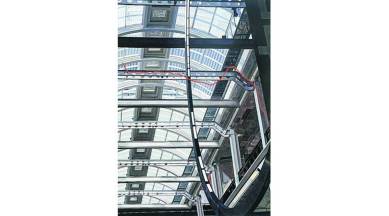
LOOK at the 24 drawings on display at Navjot Altaf’s solo show at Mumbai’s Chemould Prescott Road, and you would think that the title of the show — “How Perfect Perfection Can Be” — is an exclamatory statement. The drawings, as Altaf, 66, explains, are inspired by the architectural perfection that she encountered while on a residency in New York City. They are so beautifully — or “perfectly” — rendered, that from afar, they actually look like photographs of the details of the glass-and-steel architecture epitomised by America’s most populous city.
It’s only after stepping closer that one sees the minuscule, deliberate imperfections of the brushstrokes and realise how the eye has been deceived by distance. One also notices that superimposed on the drawings are what might look like mere coloured lines. These are, in fact, screen-printed graphs depicting data on climate change — the mortality rate in NYC during a deadly heat wave in 1980 or the flood levels after Hurricane Sandy hit the city in 2012 or the amount of snowfall during the record-breaking blizzard of 2003.


“New York is a very impressive city. You can walk around and marvel at all the beautiful architecture you see, but what can you do about the heat-trapping gases that the city produces?,” she says, who splits her time between Mumbai and Bastar. She adds, “The devastating floods, storms and heat waves and destruction of habitats are the consequences of the development model that we have been following for so long. Even the Western world has acknowledged that climate change is a result of this.”
This concern about a broken system is typical of Altaf’s oeuvre, and can be traced all the way back to the ’70s, when the artist was associated with the Leftist movement. Her works deal with questions of gender, cultural memory, history and loss.
In the current exhibition, the idea of the Anthropocene — the current geological epoch marked by the impact of human activities on Earth’s geology and ecosystems — looms large. Even though the subject of her drawings may be an ocean and a continent away from India, the works hold questions for all of us to mull over — what is the real meaning and impact of the development promised to us? How are the smart cities and the inter-linking of rivers going to affect the landscape we occupy?
In the second part of the exhibition, she roots these questions in Bastar, where she has worked for over two decades. For instance, in the video Tana, we see weaver Vijay Das silently prepare the warp, while in the background, we hear the sound of trees being felled. It reminds us of the environmental devastation of Bastar’s mineral-rich land. It also tells us how the people of this region — farmers, weavers and storytellers — have lost their livelihoods and are forced to perform labour that their dignity rebels against.
“I’ve been going to Nagarnar in Bastar since the ’90s, and seen the lives of the weavers there change,” says Altaf, adding, “Their weaving techniques for the cotton saris are environmentally and economically sustainable, but these are slowly dying out.” At the same time, the National Mineral Development Corporation acquires more and more land to construct a steel plant that, it promises, will offer livelihood opportunities for the people who have always lived here. “But what about the water, soil and air that are being polluted?,” asks Altaf.
Yet, the exhibition ends on a hopeful note, with a video called Karvi. The Karvi shrub is endemic to the Western Ghats and has an unusual blooming pattern. It flowers once in eight years and during this period, entire hillsides are transformed. In the video, Altaf holds up this shrub as one of the miracles of nature, laying before us a world where the idea of perfection is not confined to precisely engineered metal and concrete structures.


