5 min read

© IE Online Media Services Pvt Ltd



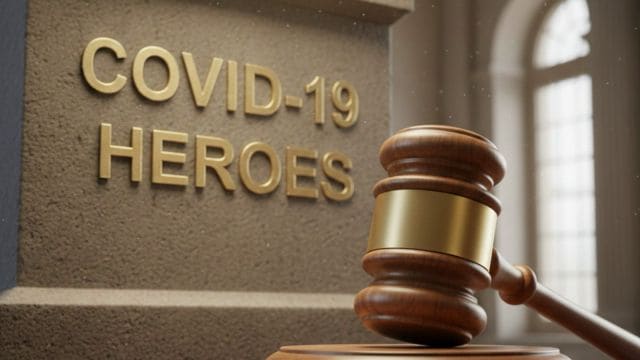 Supreme Court Covid Insurance: The Supreme Court held that the family of private doctors, who were not formally "requisitioned", are also eligible for Rs 50 lakh Pradhan Mantri Garib Kalyan Yojana benefit. (This image is generated using AI.)
 Supreme Court Covid Insurance: The Supreme Court has held that the family members of the private doctors who died during the COVID-19 pandemic and were not “requisitioned” are also eligible for Pradhan Mantri Garib Kalyan Yojana (PMGKY) Insurance Package if the claimant can prove that they died performing COVID-19-related duties.
Justices P S Narasimha and R Mahadevan, on December 11, said the Centre had announced the package, an insurance scheme for health workers fighting COVID-19. The said scheme assured the next of kin of eligible healthcare workers an insurance cover of Rs 50 lakh.
“While COVID-19 pandemic exposed an acute systemic fragility within the global healthcare sector, highlighted lack of preparedness and strained the capacity of health professionals, our doctors and health professionals rose as unwavering heroes, turning challenges into courage,” the court said.
The bench said that it could “never forget” the situation that prevailed in 2020 when it was hearing the plea of a private doctor’s wife, whose husband succumbed to the COVID-19 infection in June 2020. The Bombay High Court previously rejected her plea seeking insurance benefits under the PMGKY-Package on the ground that there was no proof of ‘requisitioning’ of his services for COVID-related duties.
The court partially modified the Bombay High Court’s judgment and observed that the private doctors would be eligible for the PMGKY-Package.
The victim, Dr Surgade, was running a private medical clinic. At the onset of the COVID-19 pandemic, he was allegedly directed to keep his hospital/dispensary open during the lockdown period by the Navi Mumbai Municipal Corporation in 2020, invoking the COVID Regulations, which warned him of criminal prosecution in the event of noncompliance.
He succumbed to COVID-19 in 2020. Subsequently, his wife approached the insurance company seeking insurance benefits under the PMGKY-Package, but was refused. The corporation rejected the insurance request on the grounds that Dr Surgade was carrying out a private practice and hence his next of kin was ineligible for the benefit under the scheme. It was also mentioned that his husband’s dispensary was not a COVID-19-designated dispensary, and his services were not “requisitioned.”
When the doctor’s wife moved the Bombay High Court, her plea was rejected, noting that while private medical practitioners fall under the ambit of the insurance scheme, claims for insurance must necessarily establish that the services of the deceased medical professional were requisitioned in relation to COVID-19-related duty.
The high court also mentioned that the doctor did not respond to the circular concerning requisition of his service and hence his services were not requisitioned.