Gujarat Self-Financed Schools (Regulation of Fees) Act 2017, which seeks to put a cap on the fee of the self-financed schools in the state, is still waiting for implementation. The Indian Express explains why it has angered both parents and schools.

The Bill was passed in the state Assembly on April 20, 2017. Subsequently, its rules were notified on April 25. The Act fixed an upper ceiling on the annual fee charged for primary, secondary and higher secondary classes at Rs 15,000 and Rs 25,000 and Rs 27,000, respectively. The Bill was introduced by the government with an aim to control the “exorbitant fees” charged by private schools “in the absence of a clear law” regarding it. As per the Act, all private schools, which want to charge fees more than what has been prescribed, need to submit their proposal with the Fee Regulatory Committee (FRC) before any hike. The Act provides for establishment of four such committees in four zones, with their headquarters in Ahmedabad, Vadodara, Surat and Rajkot.
Why did it trigger protests?
The managements of various private, minority, Central Board of Secondary Education (CBSE) and the Indian Certificate of Secondary Education (ICSE) schools in the state had approached the Gujarat High Court (HC) against the law, stating that it was not in accordance with the Constitution and should be scrapped. The Act also triggered protests from parents, majorly from urban centres with high concentration of self-financed schools, including Ahmedabad, Rajkot, Surat and Vadodara. They had been voicing their reservations even prior to the notification of the Act, demanding their participation in the committees to decide the fee. Their protest continues to this day. Though they now want the Act to be implemented at the earliest in order to keep a check on its violations by schools. Parents’ associations have come together to maintain pressure on the government, demanding to regulate the fee charged by self-financed schools.
What did the courts rule?
In its verdict on December 27, 2017, the Gujarat HC declared the state government’s law to regulate fees as constitutionally valid. The HC ruled that the state legislature was competent and had the authority to form laws for state boards, the CBSE and ICSE. The HC rejected the contention of the CBSE and minority schools which had argued that the state government could not regulate them.
On January 15, 2018, in a breather to schools, the Supreme Court (SC) ordered that no coercive action should be taken against schools that have not yet submitted their fee proposals before the FRC. It fixed February 1 as the next date for hearing the matter. The Federation of Self-Financed Schools had filed an appeal in SC, challenging the High Court’s order upholding the constitutional validity of the Act. While fixing the next date of hearing, the SC allowed processing of applications for schools that had voluntarily approached the FRC.
Earlier this month, the SC ruled that schools will now collect only provisional fees till the matter is finally settled by May 3, when the next hearing of the case will take place. The final decision in the case will be taken by the apex court. The SC also asked the Gujarat government to reconstitute the FRC and the Revisional Authority under the Act within a week’s time. The reconstituted committee will now be headed by a retired judge of the HC while the Revisional Authority will comprise two retired judges of the HC.
What is the govt’s position?
Story continues below this ad
State Education Minister Bhupendrasinh Chudasama hailed the SC order as a victory for the state government which, he said, was “committed to regulate exorbitant school fees”. The state government now stares at the uphill task of fixing the exemption limit under section 9 of the Act. For this purpose, they will have to hear the representatives of petitioner-schools and one representative from each of the parents association: one which opposes the Act and one which supports the Act. The state government will also have to create categories of fee structure on the basis of facilities provided by various schools for the purpose of determining the fees charged by them. It will also have to take into account suggestions made by citizens for fixing the fee exemption limit within four weeks. After the limit is fixed, the FRC will scrutinise the proposals and accounts submitted by various schools, including the petitioners’ schools and fix the fees.
The FRCs shall provisionally intimate the school and notify the fees chargeable by the schools, on its website. The schools may, within a period of seven days of such notification, make a representation before the committees. The committees will have a period of one week to finalise the fees after receiving the representation. If the schools challenge the fees decided by the committee, then the Revisional Authority will have to dispose it within 30 days.
Last week, Chudasama announced an increase in the the annual fee cap for schools with science stream in Class XI and XII to Rs 30,000. He also claimed that the state government was acting as per the SC orders. “We are working as per the SC orders. The fee cap has been revised and now the schools will be given time to submit their documents in case they want to charge more than the upper limit,” Chudasama said.
What has angered the parents’ associations?
For parents, the wait to see a fruitful end to the issue has got longer. And this has angered them. To pressure the government for early implementation of the rules, the parents have threatened to take protests more aggressively in the coming days. They also plan to gherao the state Assembly on March 9. Fresh protests were held on Monday by a parents’ association, Parents Ekta Manch outside Ahmedabad’s Kochrab Ashram. The parents have now begun to raise doubts over the “intentions” of the state government.
Story continues below this ad
“The state government has closed its eyes and ears to the whims and fancies of the self-financed schools. Even the District Education Officers (DEOs) are hand in gloves with these schools and fail to take any action against the violations. The state government does not understand the woes of the parents,” says Pooja Prajapati of Parents Ekta Manch.
The parents have been highlighting the issue of self-financed schools charging exorbitant fee despite the notification of the Act and have garnered support from independent MLA Jignesh Mevani.
“We have received support from Mevani, who hopes to join the gherao scheduled on March 9. If the state government is not able to fix the fee of self-financed schools, then they should dismiss the FRC that have been empowered to decide the fee on the basis of proofs submitted by the school, justifying the fee if it exceeds the cap. Fix the fee of all schools at Rs 15,000, Rs 25000 and Rs 30,000. The state government should overtake the management of the schools which fail to abide by this,” said Prakash Kapadiya of Jagega Gujarat Sangharsh Samiti.
“Schools are openly charging fee under various heads,” adds Prajapati.
Story continues below this ad
When there were protests against semester system in science stream for Class Class IX-XII or over replacing Joint Entrance Examination (JEE) with the state’s Gujarat Common Entrance Test (GujCET) earlier in 2017, the state government was compelled to give in to parents’ demands.
Where do the schools stand?
The schools have showed reluctance in following the fee limit announced by the state government despite the HC’s order in which it rejected the demand of self-financed schools to declare the Act unconstitutional. The schools now have hopes from the SC. Also, the fee already taken by schools during the academic session 2017-18 has not been returned by them despite the SC order to the effect that the Act will be implemented from the 2017-18 academic session.
How does it affect students?
While the parents are protesting against the state government for the delay in the implementation, they are also at loggerheads with the schools over fees. The schools, in turn, are pitted against the Gujarat Secondary and Higher Secondary Education Board (GSHSEB). The schools have declined to collect admit cards of students for state board Class X and XII exams, which are scheduled to start from March 12, saying that dues have not been cleared. Though the GSHSEB has claimed this as “illegal” and directed schools to abide by the GSHSEB rules, it has left the students in a lurch. Amid these protests, schools have already issued notices to parents to submit fee (not as per the fee cap) for the academic session 2018-19 before March 7 or else the admission will be cancelled.


 9 min read


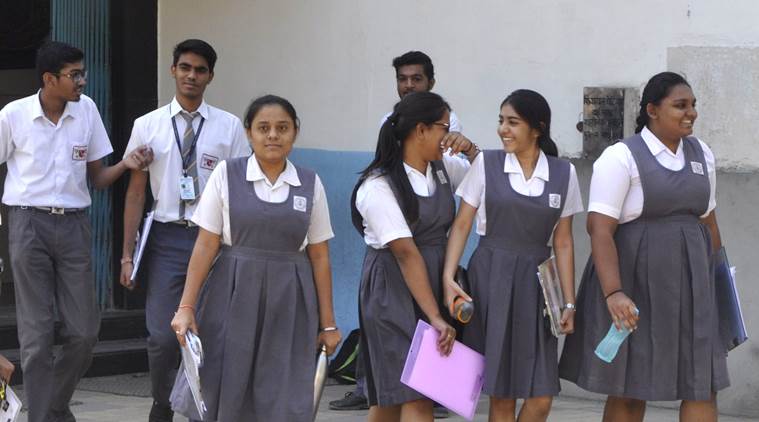 Class XII examinations for CBSE students kicked off on Monday (Express Photo/Javed Raja)