


Stay updated with the latest - Click here to follow us on Instagram
Tags:


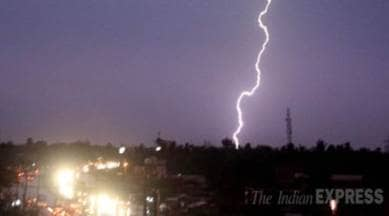
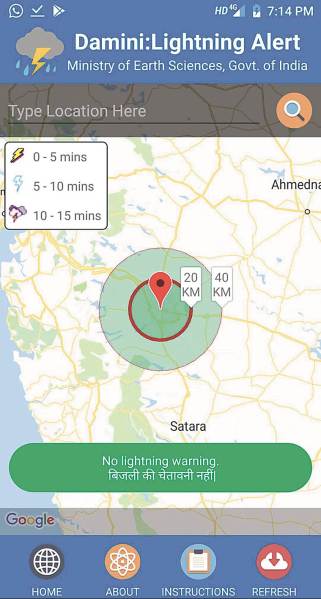
The Indian Institute of Tropical Meteorology (IITM) on Saturday launched ‘Damini’, a free mobile-based application that can warn people about lightning at least 30-45 minutes before it strikes. The first-of-its-kind app was launched by Vijay Bhatkar, eminent scientist and chancellor of Nalanda University, during an event to mark the 57th foundation day of IITM, in Pune on Saturday.
Among the vagaries of weather and extreme climate conditions — floods, droughts, lightning, heavy rainfall, cold waves and heat waves — lightning strikes are known to cause the maximum casualties in India. Of the 1,538 deaths reported due to extreme weather conditions in India in 2016, 424 people died due to lightning strikes, as per the ‘Climate of India’ report released by the India Meteorological Department (IMD) that year.

“… This app will be able to track lightning and send alerts and notify individuals…,” S D Pawar, senior researcher and an expert in the subject, told The Indian Express.
“Whenever a person is within 20-km radius of the lightning event, the app will send warnings… the alert will be sent 30 minutes to 45 minutes before the event and this will help people get to safer locations. For now, the warnings will be given in Hindi and English… more languages will be added later,” said Pawar.
India has as many as 48 lightning detecting sensors, many of which are located along the Himalayan foothills and north-eastern states, which experience lightning strikes on several days. Ahead of the next pre-monsoon season, another 20 sensors will be added to the existing network. Lightning is most commonly reported during pre-monsoon months — March to May — over most parts of the country.
“ … The local orography and tree cover play a crucial role in preventing deaths caused by lightening strike…,” said Pawar.
In Maharashtra, Vidarbha records the maximum number of days with lightning — 30 to 40 days every year —, followed by Marathwada, with 20 to 30 such days. The number of deaths from these sub-divisions are also significantly high. A fortnight ago, two women farmers were killed near Kamshet after being struck by lightning.
The IITM team took two months to develop this app and the institute has handed it over to the respective state governments. Scientists said the app will be most effective when disaster management teams in every district actively engage in information dissemination.
‘Advanced technologies will be meaningless unless climate change is taken seriously’
Scientist and Chancellor of Nalanda University, Vijay Bhatkar, said that no technological advancements would be of any use if climate change is not considered as a serious threat. Speaking on the occasion of the 57th foundation day of IITM, he said, “Climate change is today’s biggest problem and it questions the very basic survival of humankind. Droughts and floods have a serious impact on farmers and on our food and water supplies. Even the world’s best technologies will be of no use if measures to address and study climate change are not taken.” He also emphasised on the need to strengthen weather prediction models, for which scientists must exploit the power of supercomputers.


Stay updated with the latest - Click here to follow us on Instagram


