Journalism of Courage



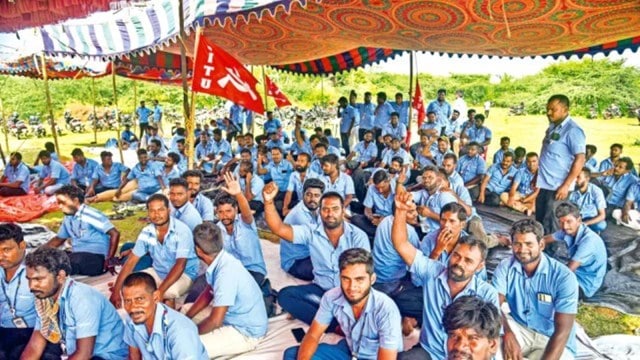 The strike, which had paralysed operations at the plant since September 9, saw more than a thousand workers demanding union recognition and improved working conditions. (File)
After more than a month of protests, the labour strike at Samsung’s manufacturing plant outside Chennai came to an end on Monday, as both the workers and the management reached a tentative settlement brokered by the Tamil Nadu labour department.
Even as there is no final word on the recognition of a union, which is a matter currently pending before the Madras High Court, Samsung has promised to respond in writing to the workers’ charter of demands, while the workers have agreed to return to work and halt all protest activities. The company also committed not to take punitive action against those who participated in the strike, while workers pledged to cooperate fully with the company and refrain from any activities that could harm the interests of the management.
The strike, which had paralysed operations at the plant since September 9, saw more than a thousand workers demanding union recognition and improved working conditions. The decision to call off the strike was reached during conciliation talks overseen by officials from the Department of Labour Welfare.
The state government, which had initially taken a passive approach to the growing unrest, intensified its efforts after the strike dragged into its second month, raising concerns about the potential political and economic fallout. Tamil Nadu Chief Minister M K Stalin had instructed ministers to resolve the strike as soon as possible, and negotiations involving four senior ministers – from the Ministries of Public Works, Micro, Small and Medium Enterprises (MSME), Labour Welfare, and Industries – were launched in an attempt to mediate between the workers and Samsung India.
While last week’s talks resulted in a breakthrough, the road to resolution had been far from smooth, as the state government’s premature attempt to declare the strike resolved had backfired. On October 9, senior ministers, eager to showcase a quick victory, claimed that an agreement had been reached. However, CITU (Centre of Indian Trade Unions), the labour body leading the strike, immediately disputed the claim, stating that the workers who had signed the agreement were not part of the protesting group.
Samsung had meanwhile remained firm in its refusal to recognise the union formed by the workers.
As tensions escalated, police arrested a dozen striking workers from their homes at midnight, dismantled protest tents, and detained key CITU leaders. This led to allies of the DMK, including VCK, Congress, CPM, and CPI, extending their support to the strike. While the aggressive action hardened the workers’ resolve, deepening the impasse, it was the negotiations led by senior DMK leader and state highways minister, E V Velu, that solved the crisis on Tuesday.
The roots of the strike can be traced to early September, when workers at Samsung’s Sriperumbudur plant launched the strike demanding recognition of the Samsung India Workers’ Union (SIWU). In addition, their demands included wage increases, improved working conditions, and better work hours. The protest soon gained momentum, with over a thousand workers joining the strike, threatening the factory’s output and putting pressure on the state’s pro-business image.
Samsung India, however, remained reluctant to engage directly with the union, citing concerns about external influence from CITU, which is affiliated with the Communist Party of India (Marxist), a key ally of the ruling DMK.
The company preferred to negotiate directly with workers rather than external union leaders. Samsung also viewed the workers’ demands as a potential threat to their wider operations, particularly given recent unrest at its plant in Seoul.
Tamil Nadu’s government found itself caught in the middle, torn between the interests of a major foreign investor and those of an influential labour union allied with its own political base. The timing of the strike was particularly problematic, coinciding with the Chief Minister’s international tour aimed at wooing foreign investment. The fact that there were only a few efforts from CITU to talk and resolve the issue with the DMK government, before declaring a high-profile strike, also widened the gap between allies in the DMK camp.
For much of the strike, the political leadership of the ruling DMK was struggling to find the right approach. According to insiders, the government initially focused its efforts on Samsung, neglecting to engage with the striking workers directly. While the state industries minister T R B Rajaa was blamed for his lack of understanding in engaging with trade unions, others in the DMK were also in a wait-and-watch mode. Even though CPM has been a key ally of the DMK alliance since 2019, very few talks were held directly between top leaders. Instead, the government used indirect channels involving IAS officers and second or third-rung leaders in CPM and CITU.
“It was this hands-off approach, coupled with the state’s over dependence on bureaucratic channels, that did little to ease tensions and, in fact, contributed to the deadlock,” a top IAS officer told The Indian Express. He said the government’s lack of a clear political strategy in handling the strike allowed the situation to deteriorate.

 5 min read