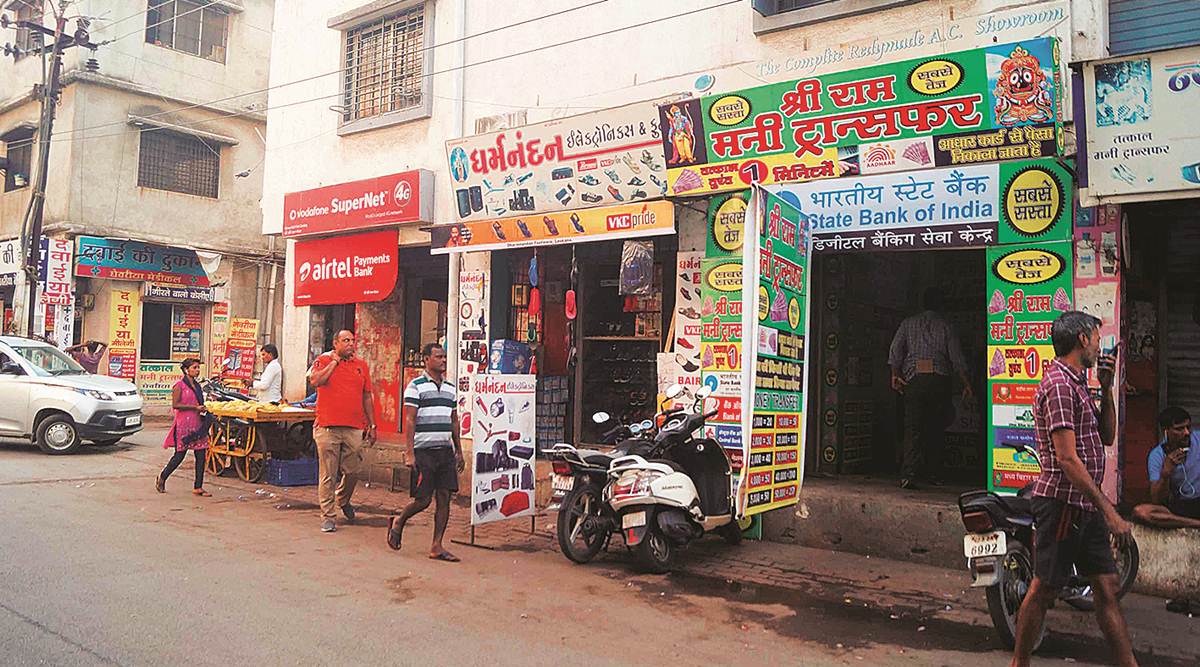
An arched gateway leads to the bustling Diamondnagar Industrial estate in Surat’s Laskana area, where nearly 1,200 powerloom units are slowly whirring into action. Workers have gathered at tea stalls before their shift and a few tempos loaded with cloth bales are struggling to navigate the neighbourhood’s narrow lanes, dotted with lodging facilities with Odia signages, grocery stores, hair salons and mobile phone shops.

But now, nearly eight months later, many of the workers are back in Surat after making a trip to their native states, and have found employment again, bringing the industrial area back to life.
“I returned to Surat last month. It has been quite good since then. I was at my village in Ganjam (in Odisha) since April. There was no work there and I had taken a loan of Rs 50,000 to sustain my family. I wanted to return to work at the earliest. In September, the bus I took to return had an accident (killing eight). I sustained injuries too,” says Jitendra Gouda, who hails from Palipada village in Bellangutha Block in Odisha’s Ganjam district.
Speaking over the phone from Surat, where he has resumed work at a powerloom unit, Gouda adds, “My children were using my phone to study for their online classes. Now since I am here, they have been missing their lessons. I plan to buy them a basic smartphone at the earliest so that their study is not affected.” He has two sons of ages 5 and 11. He gets Rs 18,000 per month as salary in Surat. “It’s the same as it was before the lockdown,” he smiles.
There are around 50,000, small, medium and big textile powerloom factories in Surat, which employ over 10 lakh migrant workers from Odisha, UP, Bihar, Madhya Pradesh, etc.
Babu Sojitra, owner of a powerloom unit in Diamondnagar which opened in June and employs 15 people, claims there have been no Covid-19 cases in the area since the workers returned. “The powerloom units are far apart and so there is natural social distancing. We have kept sanitizer bottles at the entrance and outside toilets, and we have asked all labourers to wear masks,” he says.
Story continues below this ad
Pratapkumar Sahoo, 28, a powerloom operator at Sojitra Textiles,who also hails from Ganjam, says all the 40 workers at his factory had to undergo a Rapid Antigen Test on return. “No one was positive. In April, I borrowed Rs 2,000 and returned to my village. There people were not taking any precautions and were moving around freely. I told them about the measures taken in Surat,” he says.
At the local market, Darshil Vekariya, who runs the Shree Ram Money Transfer service, says business has improved since Diwali. “Fortunately, all the factories are functional again and workers have begun to send money home. We charge Rs 20 on a transfer of Rs 1,000 and so on,” he says.
At the Annapurna Dining Hall in Diamondnagar industrial area at Laskana, where most of the workers have their meals, owner Amit Swai says he has managed to make-up for his losses.
“Over 1,000 workers eat at our mess twice a day. Since, all the workers are now getting their full salaries, they are paying us too. In the early days of the pandemic, I provided free meals to many of them, but now they have all paid back their dues,” says Swai, adding that all the 30 dining halls in the Laskana area are now operational.
Story continues below this ad
Says Chetan Ramani, president of Diamondnagar Industrial estate, “We opened the factories in the second week of June with 15 per cent production, and by August we began full production. The demand for fabric has also picked up. We transferred money into bank accounts of many workers, primarily those in Odisha, so that they can travel back to Surat. We even sent luxury buses to Ganjam district.”
Timely detection and treatment helped control the spread of the virus in Surat, says Deputy Municipal Commissioner of Surat Municipal Corporation Dr Ashish Naik. “The first positive case in Surat was recorded on March 16, when a student returned from United Kingdom, and we have come a long way since then. We deployed mobile testing vans for powerloom workers in the Diamondnagar industrial estate, and other industrial estates in Laskana. Since operations began, not a single positive case has come up in the area.”


 5 min read