4 min read
Stay updated with the latest - Click here to follow us on Instagram

Journalism of Courage



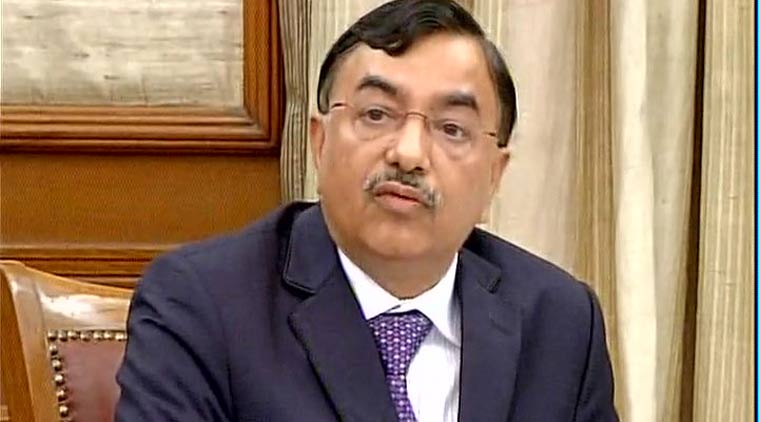 Sushil Chandra
Stating that simultaneous elections were held in the country four times between 1952-’67, Election Commissioner Sushil Chandra on Saturday batted in favour of “one nation, one election,” terming it as a “noble concept,” which will help future governments to focus on development. “In 1952, 1957, 1962 and 1967, there were simultaneous elections in this country,” said Chandra, pointing out that Parliamentary elections coincided with elections of all the state assemblies in the country.
“But after 1967, what happened? Some assemblies were dissolved prematurely. Some time, the Parliament got dissolved prematurely and some time, the Parliament was extended by a year during the Emergency. So the timetables underwent a change,” Chandra said, while speaking during an interactive session at the Gujarat Chamber of Commerce and Industry (GCCI) on Saturday evening.
“Is it good to have elections after every few months or few years, or we should have simultaneous elections? This year, if you see, four elections of state assemblies have already been conducted. We have two assembly elections which are being held next month – Haryana and Maharashtra. Then, the elections of Jharkhand and Delhi are coming up,” he remarked.
Chandra said 17 parliamentary and 400 assembly elections have already taken place in the country since it attained independence. Stating that 1.2 crore personnel, including security personnel, were deployed for conducting Lok Sabha elections of 2019, during which illegal liquor, cash and drugs worth a massive amount of Rs 3,450 crore were seized (three times in value compared to the seizure to the previous election), Chandra said, “Now you see, expenditure being incurred, police personnel being deployed, the government machinery is moved, places are hired especially schools and colleges for the conduct of elections.”
Stating that the Standing Parliamentary Committee, the Law Commission and the Election Commission has already given a green signal for conducting simultaneous elections in the country, Chandra said, “Ideally what should happen? One nation and one election. But how will it happen? What are the challenges? It was given to the standing Parliamentary committee of Parliament in 2015, which recommended simultaneous elections. It was referred to the Law Commission, which submitted a report in 2018 favouring simultaneous elections. So, everyone has agreed for
simultaneous elections which will save time, which will given more time to the government to think about development without any populist measures .. The Election Commission has also given its OK.”
Pointing out that if state assemblies go for simultaneous elections with the Lok Sabha, then the five-year term of some state assemblies will have to be curtailed or extended beyond five years.
“This will require a constitutional amendment,” he said. The Election Commissioner also said a lot of debate is needed including a consensus among all the political parties on the subject. “Similarly, can we think of all elections that are happening in one year to be held in one month? Another idea is if the Parliament is dissolved prematurely, then should elections be held for the full five-year term or for the remaining period? There are various scenarios,” he added.
In a scenario where simultaneous elections are held across the country, the Election Commission will have to deploy more machines and personnel for the same, he said. “But we are geared up for that,” he added. “We had simultaneous elections till 1967 and so this can be done…Constitution has always thought of simultaneous elections… This is a noble idea.”
Asking electorates to participate in the voting process, Chandra said the Election Commission wants to persuade and motivate voters to cast their votes. “Because it is a democracy, so far we have not made it mandatory (to cast votes), or depriving of any benefits from government schemes or a person is fined,” he remarked.
Stay updated with the latest - Click here to follow us on Instagram