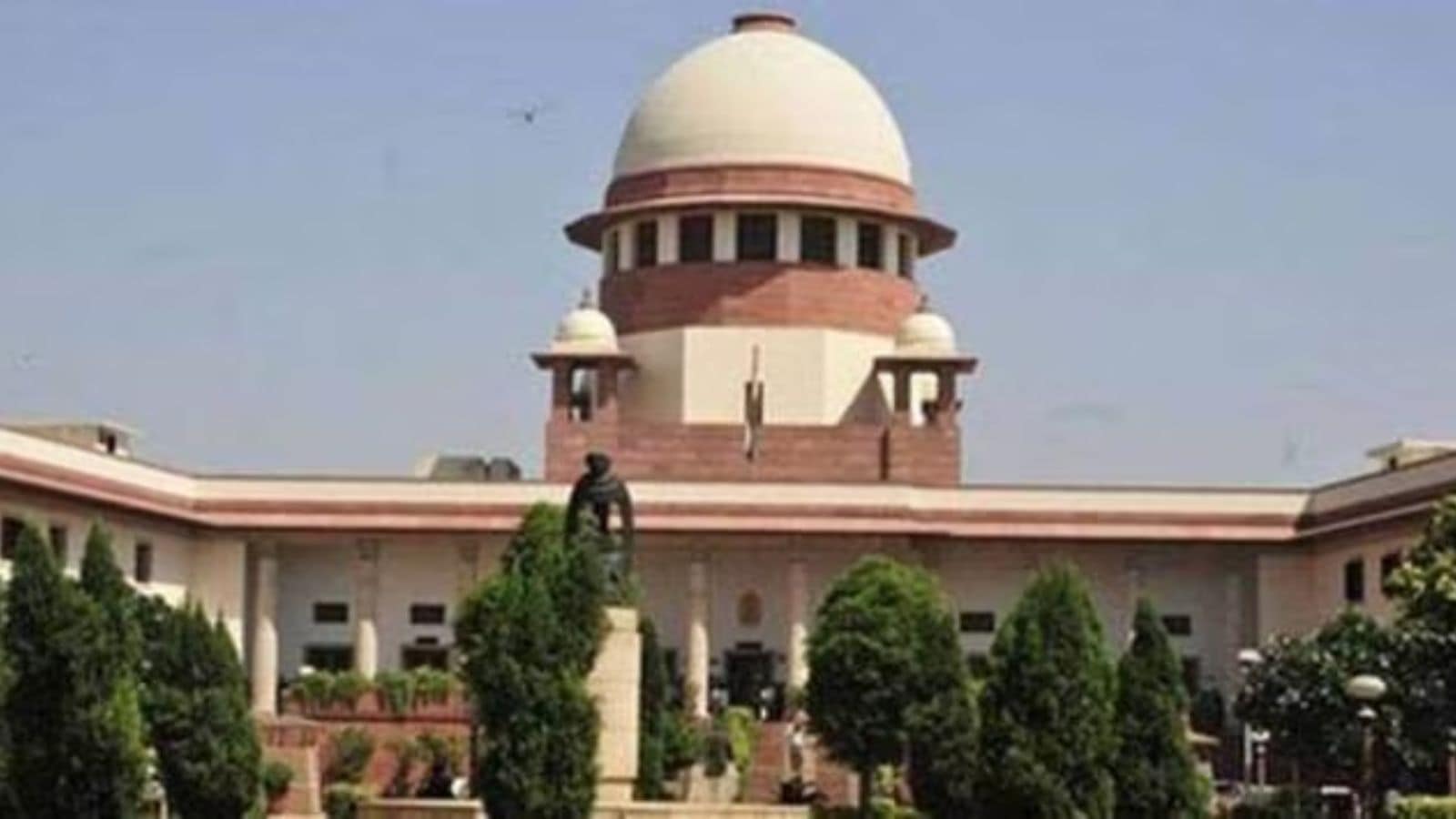
SC grants bail to Uttarakhand man jailed for interfaith marriage, says ‘state can’t object…they married as per wishes of parents’
Two days after his wedding to a Hindu woman in December last year, an FIR was filed against Aman Siddiqui. Booked under the Uttarakhand Freedom of Religion Act, he spent nearly six months in jail.
Written by Sohini GhoshUpdated: June 11, 2025 03:49 PM IST
3 min read
Whatsapp
twitter
Facebook
Reddit
Siddiqui’s counsel also told the Supreme Court bench that if granted bail, Siddiqui and his wife would reside separately from their families and “continue to live peacefully without any hindrance”.
Granting bail to a man booked under the Uttarakhand Freedom of Religion Act, the Supreme Court last month held that the state cannot have any objection to the man’s interfaith marriage as the couple married “as per the wishes to their respective parents”.
The Supreme Court relief by a bench of Justices B V Nagarathna and Satish Chandra Sharma, in an order on May 19, comes after the man, Aman Siddiqui, spent nearly six months in jail, for consensually marrying a Hindu woman in a wedding voluntarily arranged by the families and consented to by the parties involved.
Siddiqui’s counsel had told the apex court that “the families voluntarily decided to arrange the marriage of the appellant with the lady. However, soon after the marriage certain persons and certain organizations seemed to have objected to the marriage”.
This led to an FIR being lodged at Rudrapur police station in Uttarakhand on December 12, 2024, against Siddiqui, two days after his wedding on December 10. Siddiqui’s parents were also booked, but they were later granted anticipatory bail.
Siddiqui’s counsel also told the Supreme Court bench that if granted bail, Siddiqui and his wife would reside separately from their families and “continue to live peacefully without any hindrance”.
Even as the state opposed the bail plea, the bench recorded in its order, “We observe that the respondent – State cannot have any objection to the appellant and his wife residing together inasmuch as they have been married as per the wishes to their respective parents and families. In the circumstances, we find that this is an appropriate case where the relief of bail ought to be granted…”.
A day after his wedding was conducted in accordance with Hindu rituals, Siddiqui was made to sign an undertaking by his wife’s cousin brothers, assuring that he would not cause “any kind of physical and mental harm” to her and that he would not force “in any manner either physically and mentally to convert her to other religion”. The undertaking further stated that his wife would be “independent to practice Hindu Religion” and “free to follow all the Hindu Tradition with full freedom” and that Siddiqui would not interfere in her religious faith.
Story continues below this ad
The Uttarakhand High Court had rejected Siddiqui’s bail plea on February 28. Before the high court, Siddiqui had submitted that his mother was a practising Hindu married to a Muslim man and had not converted. He further said that he too followed his mother’s religion, including his parents performing a thread ceremony for him.
The high court was also told that Siddiqui’s father had separated from his joint family “so that the applicant’s (Siddiqui’s) mother could comfortably follow her customs and rituals of Kumaoni Hindu family”. Meanwhile, the state had alleged that Siddiqui had suppressed the religion of his father. The high court had ultimately refused to grant bail.
Sohini Ghosh is a Senior Correspondent at The Indian Express. Previously based in Ahmedabad covering Gujarat, she recently moved to the New Delhi bureau, where she primarily covers legal developments at the Delhi High Court
Professional Profile
Background: An alumna of the Asian College of Journalism (ACJ), she previously worked with ET NOW before joining The Indian Express.
Core Beats: Her reporting is currently centered on the Delhi High Court, with a focus on high-profile constitutional disputes, disputes over intellectual property, criminal and civil cases, issues of human rights and regulatory law (especially in the areas of technology and healthcare).
Earlier Specialty: In Gujarat, she was known for her rigorous coverage in the beats of crime, law and policy, and social justice issues, including the 2002 riot cases, 2008 serial bomb blast case, 2016 flogging of Dalits in Una, among others.
She has extensively covered health in the state, including being part of the team that revealed the segregation of wards at the state’s largest government hospital on lines of faith in April 2020.
With Ahmedabad being a UNESCO heritage city, she has widely covered urban development and heritage issues, including the redevelopment of the Sabarmati Ashram
Recent Notable Articles (Late 2025)
Her recent reporting from the Delhi High Court covers major political, constitutional, corporate, and public-interest legal battles:
High-Profile Case Coverage
She has extensively covered the various legal battles - including for compensation under the aegis of North East Delhi Riots Claims Commission - pertaining to the 2020 northeast Delhi riots, as well as 1984 anti-Sikh riots.
She has also led coverage at the intersection of technology and governance, and its impact on the citizenry, from, and beyond courtrooms — such as the government’s stakeholder consultations for framing AI-Deepfake policy.
Signature Style
Sohini is recognized for her sustained reporting from courtrooms and beyond. She specialises in breaking down dense legal arguments to make legalese accessible for readers. Her transition from Gujarat to Delhi has seen her expand her coverage on regulatory, corporate and intellectual property law, while maintaining a strong commitment to human rights and lacuna in the criminal justice system.
X (Twitter): @thanda_ghosh ... Read More


 3 min read