5 min read
Stay updated with the latest - Click here to follow us on Instagram

Journalism of Courage



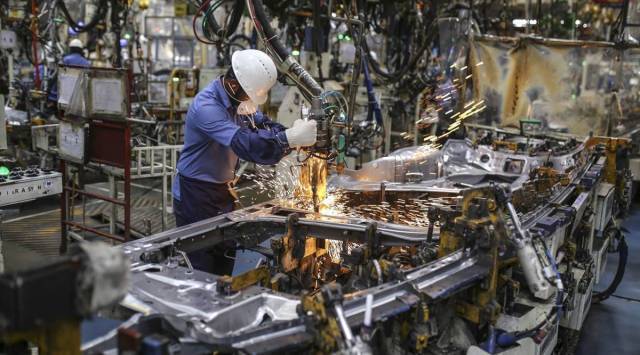 The survey was conducted with an aim to identify the gaps in manufacturing and remedy them (File Photo)
 A survey conducted by the government’s Department of Science and Technology in collaboration with the United Nations Industrial Development Organisation (UNIDO) on the level of innovation in manufacturing in India has found that the state of Karnataka is not only the most innovative in its manufacturing sector but also has the highest number of companies in manufacturing that carry out innovations.
The National Manufacturing Innovation Survey (NMIS) 2021-22, released earlier this month, also found that innovation in manufacturing is the lowest in the Northeastern states (excluding Assam), followed by Bihar.
According to the report, which has carried out its survey across over 8,000 firms in 28 states and 6 Union Territories (UTs), covering manufacturing and related service sector and MSMEs, found that there is a need to increase innovation in manufacturing. It stated that an increase in innovation carried out by firms has resulted in higher sales for them.
DST ranked Karnataka, followed by Telangana, Tamil Nadu, Maharashtra, and Haryana as high innovation states. Uttarakhand has the highest score among the hill states, while Dadra and Nagar Haveli and Daman and Diu has the highest score among the UTs.
Apart from Northeastern states, low-performing states include Jharkhand, Odisha and Andhra Pradesh.
“The Eastern region is weaker in innovation in manufacturing while the Southern and Western parts of the country are stringer – while this is known, the survey has reiterated this. What is interesting is most of the states with the highest innovations have their ranks because manufacturing is centred around major cities; Karnataka because of Bangalore, Telangana because of Hyderabad, Maharashtra because of
Mumbai etc. Interestingly, Andhra Pradesh is one of the lowest-ranking states despite being next to Telangana, and that’s because Hyderabad is now in Telangana,’’ said Dr Akhilesh Gupta, Secretary, Science and Engineering Research Board (Serb) under DST.
Dr Gupta pointed out that the state rankings — and indeed the survey — have been carried out so that both the centre and state governments, as well as industry, can identify the gaps in manufacturing and remedy them to be able to compete on a global stage.
“For India to really get ahead, an emphasis needs to be made on increased manufacturing and innovation in rural India. So, a more granular district-level survey is required,’’ he added. A focus on
innovation in manufacturing will also push India’s ranking up in the Global Innovation Index, he said. India ranked 40 out of 132 countries on the Index last year.
The report states that only 25.01 per cent of the 8,074 firms surveyed were considered innovative. “They have successfully implemented either new or significantly improved products or processes. The majority of the firms, 73.76 per cent, did not introduce product or business process innovations in this period,’’ the report says.
Telangana, Karnataka, and Tamil Nadu had the highest share of innovative firms at 46.18 per cent, 39.10 per cent and 31.90 per cent, respectively, among the total manufacturing firms surveyed from the respective states, according to the report. Odisha, Bihar, and Jharkhand reported the least share of innovative firms at 12.78 per cent, 13.47 per cent and 13.71 per cent, respectively.
“It is the large companies that can afford to invest in innovations. In the micro-firms, they simply do not have the capital to invest in innovations of either their products or their processes. And the MSME
sector in India is huge with over 7 crore firms. In countries like China or the United States, however, we see innovation in even smaller firms. We have seen that in states where overall research and development (R&D) is lacking, like in the Northeast, so are innovations in manufacturing. Sometimes there is a gap in acquisition in materials, sometimes a gap in infrastructure – and the states need to plug these holes,’’ Dr Gupta said.
The Indian government first conducted the National Innovation Survey in 2011 which found that the role of innovations in creating a competitive advantage for firms was rather underdeveloped.
In 2019, the Department of Science and Technology decided to follow up with a second nationwide innovation survey and assigned the innovation survey to the United Nations Industrial Development
Organization (UNIDO), with a view to focus on manufacturing and associated services spread across large, medium, small, and micro-enterprises.
Stay updated with the latest - Click here to follow us on Instagram