Premium
This is an archive article published on February 7, 2021

Judiciary has guarded life force of Constitution: PM Modi

‘Be it citizen rights, national interest... judiciary has fulfilled responsibilities’

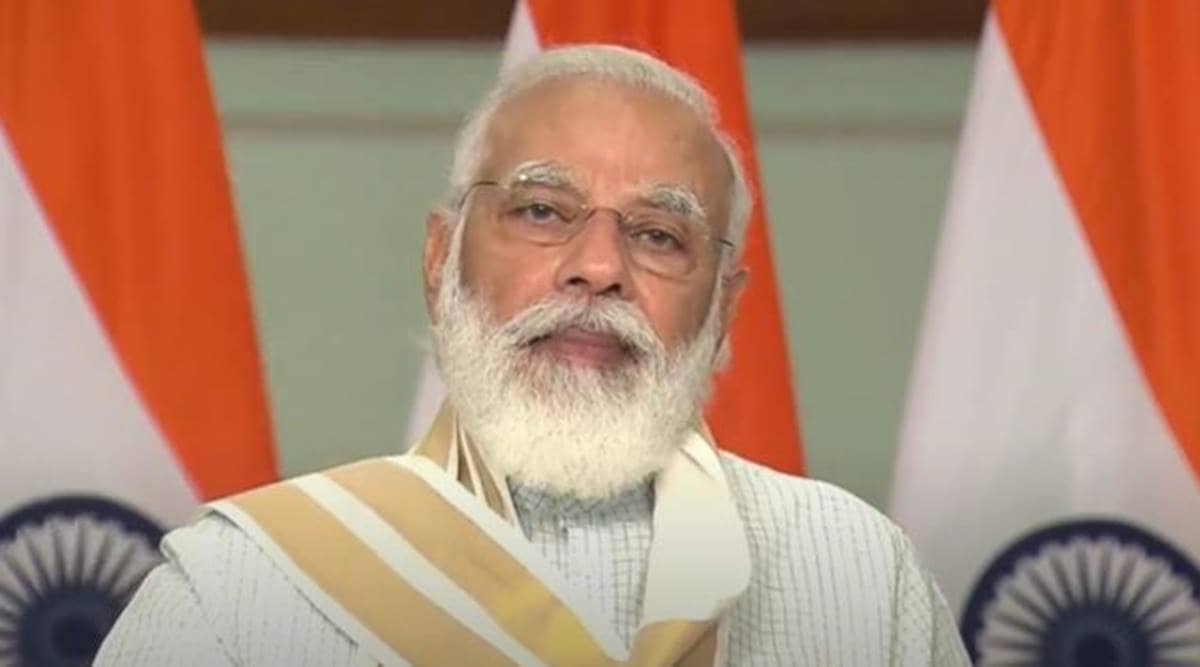
gujarat high court, Narendra modi, pm modi, India news, Indian judicial system, Indian ExpressPrime Minister Narendra Modi. (File)

Describing the Legislature, Executive and Judiciary and the roles assigned to them as the life force of the Indian Constitution, Prime Minister Narendra Modi said Saturday that every citizen can now say with satisfaction that the judiciary has fulfilled its duty of safeguarding the life force.

Addressing an event to mark 60 years of the Gujarat High Court — he also released via video link a commemorative postage stamp on the occasion — the Prime Minister said the judiciary has always strengthened the Constitution by interpreting it “creatively and positively”.

“Be it the protection of citizen rights, the question of personal freedom or situations where national interest has to be given utmost priority, the judiciary has both understood and fulfilled its responsibilities,” he said.

“You all know very well that in Indian society, the rule of law has for centuries been the basis of our civilizational, social and cultural fabric.” He said ancient Indian texts too underline that the roots of good governance are in justice and the rule of law. “This idea has been part of our tradition from time immemorial, and it infused moral courage in our freedom struggle. This was kept supreme by the makers of the Indian Constitution, and the Preamble of the Constitution is a manifestation of this pledge. It is a matter of great pride for every citizen that our judiciary has always given energy and direction to this sentiment of our Constitution and principles,” he said.

“This faith in our judiciary has given rise to self-confidence in the minds of the common people, given them the strength to stand up for truth,” he said.

Modi praised the role of the Bar in meeting the fundamental goals of justice. He said it is the responsibility of both the executive and judiciary to establish a “world-class justice system” that guarantees timely justice to the person at the lowest rung of society. “Today, like the judiciary, the government too is making sustained efforts in this direction to fulfil its duties,” he said.

Recalling the dedication of the judiciary during the difficult days of the pandemic, he said the Gujarat High Court showed its adaptive capability by starting hearings early via video conferencing, SMS call-out, e-filing of cases and ‘Email my case status’. It also started streaming its display board on YouTube and uploaded its judgments and orders on the website.

Story continues below this ad


He said he had been told that during this period, the Gujarat High Court became the first court to stream the court proceedings live. The digital infrastructure put in place by the Law Ministry’s e-Courts Integrated Mission Mode Project, he said, had been adopted quickly by the courts, allowing them to function as virtual courts.

More than 18,000 courts, Modi said, have been computerised and there is new momentum in e-proceedings in courts with the Supreme Court giving legal sanctity to tele-conferencing and video conferencing. “It gives us great pride to know that our Supreme Court has held the largest number of hearings via video conferencing among all Supreme Courts in the world,” he said.

He said e-filing of cases added a new dimension to the “ease of justice” which while “not only enhancing the ease of living for our citizens” also “increased the ease of doing business in the country. It has given foreign investors the confidence that their rights will be protected in India.”

Use of artificial intelligence is being explored to make our justice system future-ready, he said, adding that it will increase efficiency and speed of the judiciary.

Story continues below this ad

“In these efforts, the county’s Atmanirbhar Abhiyan will play a big role. It is under the ambit of Atmanirbhar Bharat Abhiyan that Indian video conference platforms are also being encouraged. To reduce the digital divide in the country, e-seva kendras are being opened in high courts and district courts,” he said.

Sohini Ghosh is a Senior Correspondent at The Indian Express. Previously based in Ahmedabad covering Gujarat, she recently moved to the New Delhi bureau, where she primarily covers legal developments at the Delhi High Court Professional Profile Background: An alumna of the Asian College of Journalism (ACJ), she previously worked with ET NOW before joining The Indian Express. Core Beats: Her reporting is currently centered on the Delhi High Court, with a focus on high-profile constitutional disputes, disputes over intellectual property, criminal and civil cases, issues of human rights and regulatory law (especially in the areas of technology and healthcare). Earlier Specialty: In Gujarat, she was known for her rigorous coverage in the beats of crime, law and policy, and social justice issues, including the 2002 riot cases, 2008 serial bomb blast case, 2016 flogging of Dalits in Una, among others. She has extensively covered health in the state, including being part of the team that revealed the segregation of wards at the state’s largest government hospital on lines of faith in April 2020. With Ahmedabad being a UNESCO heritage city, she has widely covered urban development and heritage issues, including the redevelopment of the Sabarmati Ashram Recent Notable Articles (Late 2025) Her recent reporting from the Delhi High Court covers major political, constitutional, corporate, and public-interest legal battles: High-Profile Case Coverage She has extensively covered the various legal battles - including for compensation under the aegis of North East Delhi Riots Claims Commission - pertaining to the 2020 northeast Delhi riots, as well as 1984 anti-Sikh riots. She has also led coverage at the intersection of technology and governance, and its impact on the citizenry, from, and beyond courtrooms — such as the government’s stakeholder consultations for framing AI-Deepfake policy. Signature Style Sohini is recognized for her sustained reporting from courtrooms and beyond. She specialises in breaking down dense legal arguments to make legalese accessible for readers. Her transition from Gujarat to Delhi has seen her expand her coverage on regulatory, corporate and intellectual property law, while maintaining a strong commitment to human rights and lacuna in the criminal justice system. X (Twitter): @thanda_ghosh ... Read More

Stay updated with the latest - Click here to follow us on Instagram

Latest Comment
Post Comment
Read Comments
Advertisement
Advertisement
Loading Taboola...
Advertisement